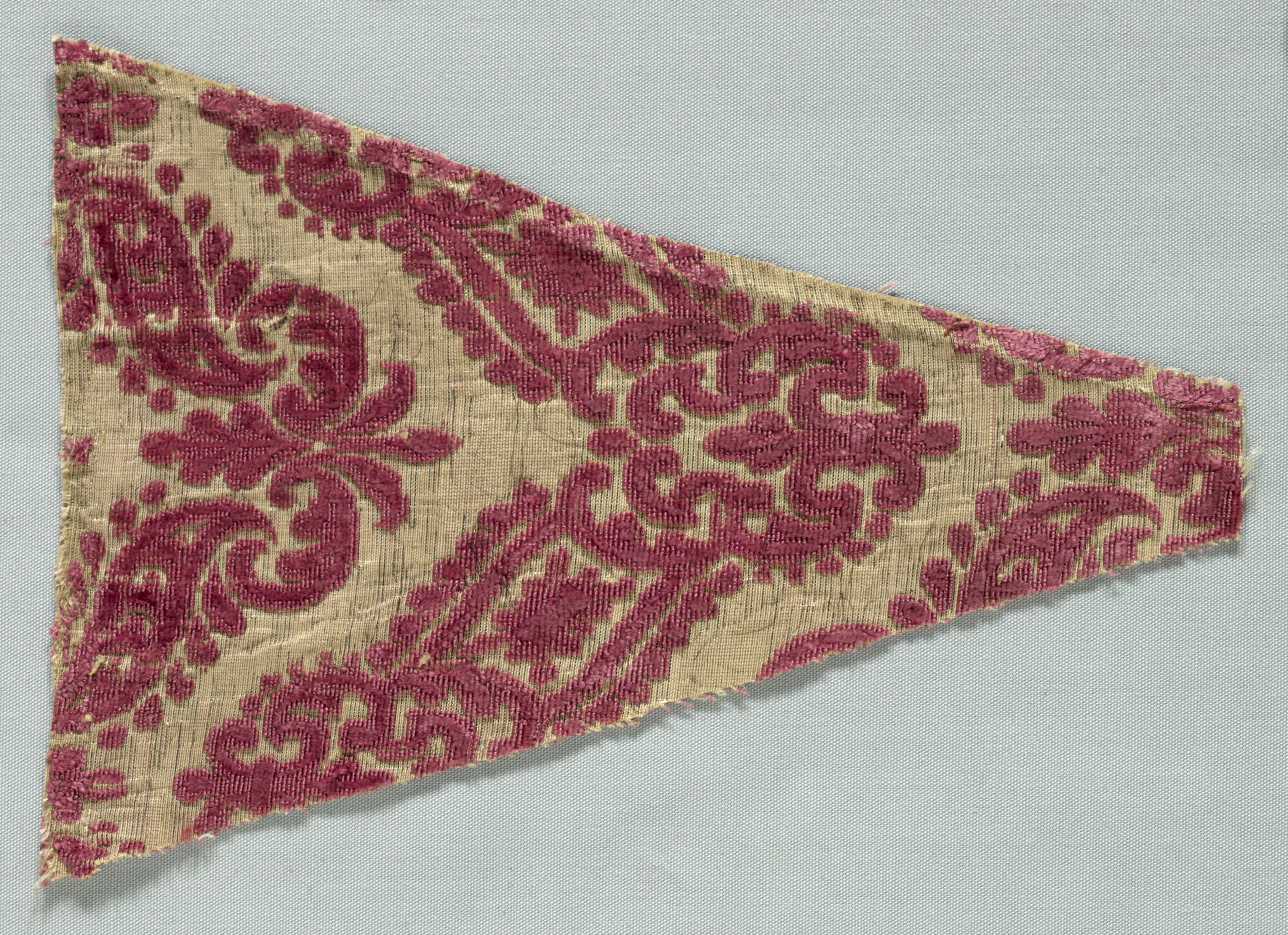
Velvet Fragment Analysis: A Deconstructionist Perspective
This analysis, prepared for Zoey Fashion Lab by the Chief Fabric Deconstructionist, examines a singular velvet fragment originating from Italy in the second half of the 17th century. The piece, designated as a New DNA Strand within our avant-garde research framework, represents a critical artifact for understanding the intersection of historical craftsmanship and radical contemporary design. The fragment is not merely a textile; it is a coded message from a past era, a blueprint for future innovation.
Technical and Material Deconstruction
The fragment is a classic cut velvet, a technique that reached its zenith in 17th-century Italian workshops, particularly in Genoa, Florence, and Venice. The base structure is a silk foundation, typically a twill or satin weave, providing a dense, stable ground. The pile, also silk, is created by weaving extra warp threads over small rods, which are then cut to form the raised, plush surface. The fragment’s condition—frayed edges, faded dye, and areas of pile loss—offers a rich narrative of wear, use, and decay. The original color, now a muted, oxidized crimson, indicates the use of kermes or cochineal, insect-based dyes that were highly prized and expensive. This color, once a symbol of wealth and power, now speaks to the transient nature of material prestige.
From a deconstructionist standpoint, the technical flaws are as important as the intended perfection. The uneven pile height in some areas suggests either a skilled artisan’s intentional variation for pattern depth or the result of differential wear. The selvedge, where present, shows a tight, reinforced edge, indicating the fabric was intended for upholstery or ceremonial garments. The weave density, at approximately 60-80 warp threads per centimeter, is exceptionally high, reflecting the labor-intensive, pre-industrial production process. This technical precision is a key DNA strand—a genetic marker of a specific era’s material culture.
Historical and Cultural Context
The 17th century in Italy was a period of both opulence and decline. The velvet fragment likely originated from a cattaneo or altar cloth, or perhaps a section of a nobleman’s cioppa (a long, formal coat). The pattern, though partially obscured, suggests a pomegranate or artichoke motif, a common design derived from Ottoman and Persian influences. This motif, often stylized with interlacing branches and leaves, was a symbol of fertility, abundance, and eternal life. The fragment’s design is not merely decorative; it is a cultural artifact that encodes religious, political, and economic hierarchies. The use of velvet itself was regulated by sumptuary laws in many Italian city-states, restricting its use to the aristocracy and clergy. Thus, the fragment is a textile document of social stratification.
For Zoey Fashion Lab, this fragment is a New DNA Strand because it challenges the linear narrative of fashion history. It is not a pristine relic to be preserved in a museum case; it is a living, breathing element that can be re-coded for avant-garde expression. The fragment’s decay—its frayed edges, faded dyes, and missing pile—is not a sign of failure but of potential. It represents the transience of beauty and the impermanence of material value, concepts that are central to deconstructionist fashion.
Avant-Garde Interpretation and Application
In the context of Zoey Fashion Lab’s avant-garde ethos, this velvet fragment is a primary source for radical design. The deconstructionist approach involves unraveling the fabric’s traditional associations—luxury, tradition, preservation—and reassembling them into new forms that question contemporary fashion’s obsession with newness and perfection. The fragment’s imperfections are its most valuable assets. The frayed edges can be left raw, as a deliberate anti-finish, challenging the notion of a garment as a completed object. The faded color can be used as a chromatic narrative, a visible record of time and exposure. The areas of pile loss can be exposed, revealing the underlying weave structure, creating a layered, archaeological aesthetic.
Specifically, the fragment can be re-contextualized in several ways:
- As a panel in a deconstructed jacket: The velvet fragment, with its historical weight, can be juxtaposed against transparent organza or industrial nylon, creating a dialogue between opulence and utility, past and future. The frayed edges can be left to fray further, becoming a living fringe that evolves with wear.
- As a sculptural element in a dress: The fragment’s stiffness, due to its age and the original silk’s brittleness, can be exploited. It can be used as a structural insert, a rigid, historical counterpoint to soft, flowing modern fabrics. The pattern can be partially cut away, creating a negative-space motif that reveals the body beneath.
- As a print or texture reference: The fragment can be digitally scanned and manipulated, its pattern and texture used as a generative source for new digital prints or 3D-embroidered surfaces. The faded color can be color-matched and used as a base for a collection’s palette, creating a chromatic bridge between centuries.
The New DNA Strand: A Theoretical Framework
The designation of this fragment as a New DNA Strand is central to Zoey Fashion Lab’s methodology. In biological terms, DNA carries genetic information across generations. In fashion, a textile DNA strand is a material code that can be extracted, analyzed, and recombined to produce new forms. This fragment’s DNA includes:
- Material code: Silk, dye, weave structure, pile height.
- Cultural code: Sumptuary laws, religious symbolism, economic value.
- Temporal code: Age, wear, decay, historical context.
- Aesthetic code: Pattern, color, texture, light reflection.
By deconstructing these codes, Zoey Fashion Lab can reconstruct them into avant-garde garments that are not merely inspired by history but are critical dialogues with it. The fragment is not a source of nostalgia; it is a tool for critique. It allows us to question why velvet was considered luxurious, why its decay is seen as a loss, and how we can value imperfection in a culture that demands perfection.
Conclusion: From Fragment to Future
This 17th-century Italian velvet fragment, analyzed through the lens of deconstruction, is a powerful catalyst for Zoey Fashion Lab’s avant-garde vision. Its technical precision, historical weight, and visible decay offer a rich vocabulary for radical design. As a New DNA Strand, it is not a relic to be preserved but a living code to be re-written. The fragment’s frayed edges, faded colors, and missing pile are not flaws; they are opportunities for creating garments that are honest about time, critical about value, and fearless about beauty. Zoey Fashion Lab will use this fragment not to replicate the past but to deconstruct its meanings and reconstruct them for the future, one thread at a time.