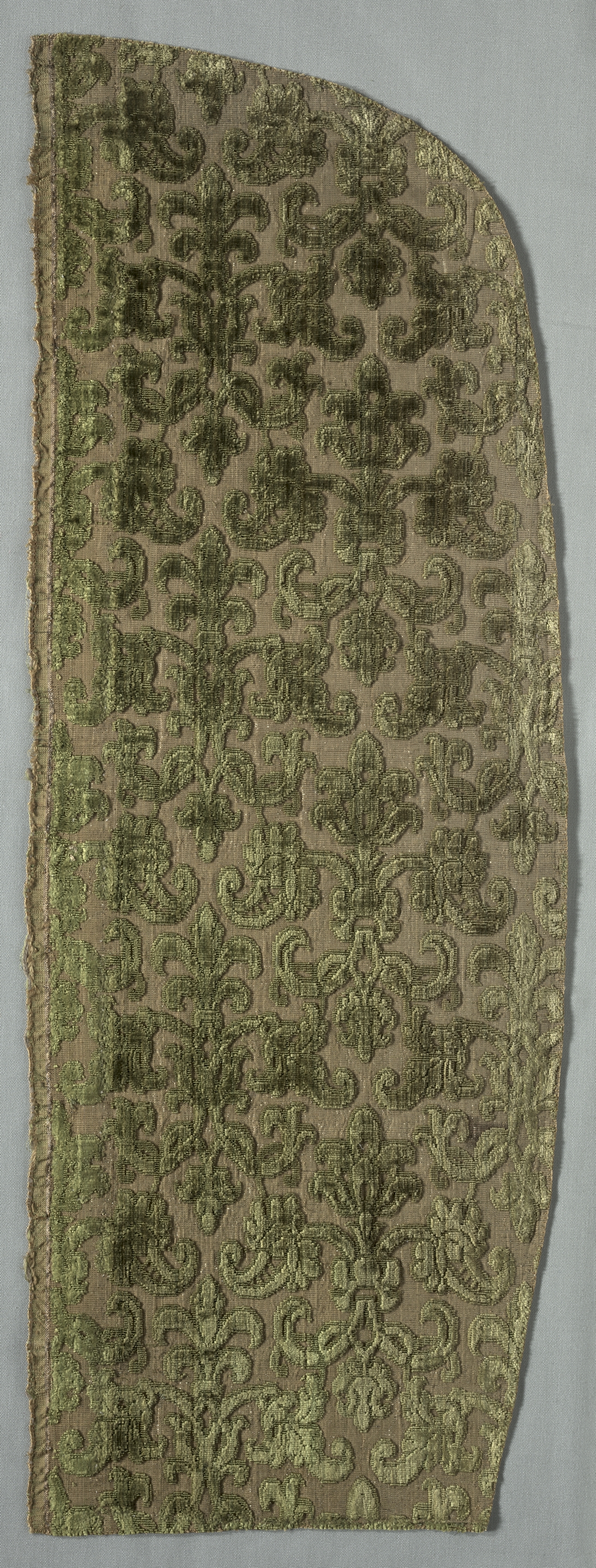
Deconstructing the Velvet Fragment: An Avant-Garde Analysis for Zoey Fashion Lab
At Zoey Fashion Lab, the role of the Chief Fabric Deconstructionist is to interrogate the material past, not as a museum curator, but as a forensic futurist. The subject of this analysis—a velvet fragment originating from Italy in the early 17th century—presents a unique challenge and opportunity. Designated as a “New DNA Strand,” this fragment is not merely a historical artifact; it is a living code, a biological and cultural blueprint waiting to be re-sequenced. This report dissects the fragment’s technical, aesthetic, and symbolic DNA, proposing a framework for its radical transformation within an avant-garde context.
I. Technical Deconstruction: The Velvet Matrix
Material Composition and Weave: The fragment is a classic silk velvet, likely produced in centers such as Genoa, Venice, or Florence. The technical structure is a pile weave, where an additional warp—the pile warp—is woven over metal rods or wires to create loops, which are then cut to form the dense, plush surface. In the early 17th century, this was a labor-intensive process requiring highly skilled artisans. The base weave, or ground, is typically a plain or twill weave of silk, providing structural integrity. The pile height is moderate, suggesting a fabric intended for both drapery and apparel, possibly for ecclesiastical vestments or aristocratic court wear.
Color and Dye Analysis: The fragment retains a deep, oxidized crimson, indicative of kermes or cochineal dyes—precious and laborious to produce. The color is not uniform; it shows subtle variations in hue, a hallmark of natural dyeing processes. The original vibrancy has been muted by centuries of light exposure and handling, creating a patina of age. This patina is not a flaw but a temporal layer—a record of the fabric’s journey through time. The dye itself is a chemical archive, containing trace elements of metal mordants (alum, iron) that could be analyzed for precise historical reconstruction or, more provocatively, for bio-mineralization in new materials.
Structural Integrity and Degradation: The fragment exhibits typical signs of age: fiber brittleness, pile loss in high-wear areas, and minor fraying along the cut edges. The silk filaments have become fragile, with some areas showing a loss of tensile strength. This degradation is not a weakness but a signature of entropy. For the avant-garde designer, this is a call to embrace impermanence. The fragment’s fragility suggests that any new application must respect its physical limits while exploiting its narrative potential. It cannot be used for high-stress garments; instead, it demands a context that celebrates its vulnerability—such as a wearable sculpture, a conceptual installation, or a digital-physical hybrid.
II. Historical and Cultural DNA: The Early 17th Century Italian Context
Social and Economic Significance: In early 17th-century Italy, velvet was a marker of status, wealth, and power. It was worn by the nobility and the clergy, often in garments that signaled political allegiance or religious devotion. The fragment’s deep red color was associated with cardinal robes, princely mantles, and the blood of Christ. It was a fabric of ritual and hierarchy. To deconstruct this is to understand that the velvet carried not just physical weight but symbolic gravity. It was a tool of social performance, a textile that demanded attention and reverence.
Artistic and Technological Milieu: This period saw the flourishing of the Italian Renaissance, with advancements in weaving technology, particularly in the production of figured velvets (velluto cesellato) and voided velvets (velluto a risparmio). The fragment may have been part of a larger panel featuring a pomegranate or thistle motif, common in the era. The craftsmanship reflects a society that valued precision, luxury, and the fusion of art and craft. The velvet was not just fabric; it was a textile painting, a three-dimensional expression of artistic mastery.
Symbolic Resonance: Velvet’s texture—soft, absorbent, and light-absorbing—creates a unique visual and tactile experience. It is a fabric that swallows light, creating deep shadows and a sense of depth. In the 17th century, this was interpreted as a metaphor for mystery, wealth, and the divine. The nap of the velvet, when brushed in different directions, changes its appearance, making it a fabric of illusion and transformation. This quality is crucial for avant-garde reinterpretation: the fabric’s inherent mutability can be amplified through technological interventions.
III. Avant-Garde Re-Sequencing: The New DNA Strand
Conceptual Framework: The fragment is not a relic to be preserved but a genetic template for new forms. The term “New DNA Strand” implies that the velvet’s historical code can be extracted, mutated, and re-expressed. The avant-garde approach rejects nostalgia; instead, it seeks to rupture the continuity of tradition. This velvet must be decontextualized, its original function and meaning stripped away, to reveal its raw materiality and potential for radical reinterpretation.
Potential Design Interventions:
- Digital Weave Reconstruction: Using 3D scanning and digital weaving technology, the fragment’s pattern and texture can be captured and re-rendered in non-traditional materials—such as bio-engineered silk, recycled polyester, or even conductive fibers. This creates a hyper-real copy that challenges the notion of authenticity. The new velvet could be programmed to change color or texture in response to environmental stimuli (heat, light, sound), turning the historical fabric into an interactive, living surface.
- Deconstructive Layering: The fragment can be physically dissected into its constituent threads—pile, warp, weft—and re-assembled as a deconstructed garment or installation. For example, the pile could be detached and re-adhered in chaotic patterns, creating a “shattered” velvet that references both the original and its decay. This process celebrates the fragment’s fragility while asserting a new, aggressive aesthetic.
- Bio-Integration: The velvet’s natural silk can be used as a scaffold for growing mycelium or other biomaterials. This creates a symbiotic fabric that is part historical, part living organism. The resulting material would be a literal hybrid of past and future, challenging the boundaries between textile, biology, and art. The crimson dye could be recreated using engineered microbes, producing a color that is chemically identical but biologically produced.
- Conceptual Garment as Archive: The fragment can be incorporated into a garment that is designed to be worn only once, or to decay over time. This garment would be a performance of memory, where the velvet’s degradation is accelerated or controlled, turning the wearer into a living archive. The garment could include embedded sensors that document its own deterioration, creating a digital companion piece that evolves alongside the physical textile.
IV. Conclusion: The Avant-Garde Imperative
The early 17th-century Italian velvet fragment is a threshold object—it stands between a past of aristocratic luxury and a future of radical material experimentation. For Zoey Fashion Lab, the task is not to restore or replicate but to mutate and provoke. By treating this fragment as a New DNA Strand, we unlock its potential as a source code for garments that are not just clothing but conceptual statements on time, decay, and transformation. The avant-garde designer must be a material alchemist, turning historical residue into a catalyst for new forms. This velvet, with its deep crimson and plush surface, is not a relic of the past; it is a seed for the future. The only question is: what will we grow from it?