Deconstructing the Avant-Garde: A Technical and Stylistic Analysis of a 15th-Century Turkish Velvet for Zoey Fashion Lab
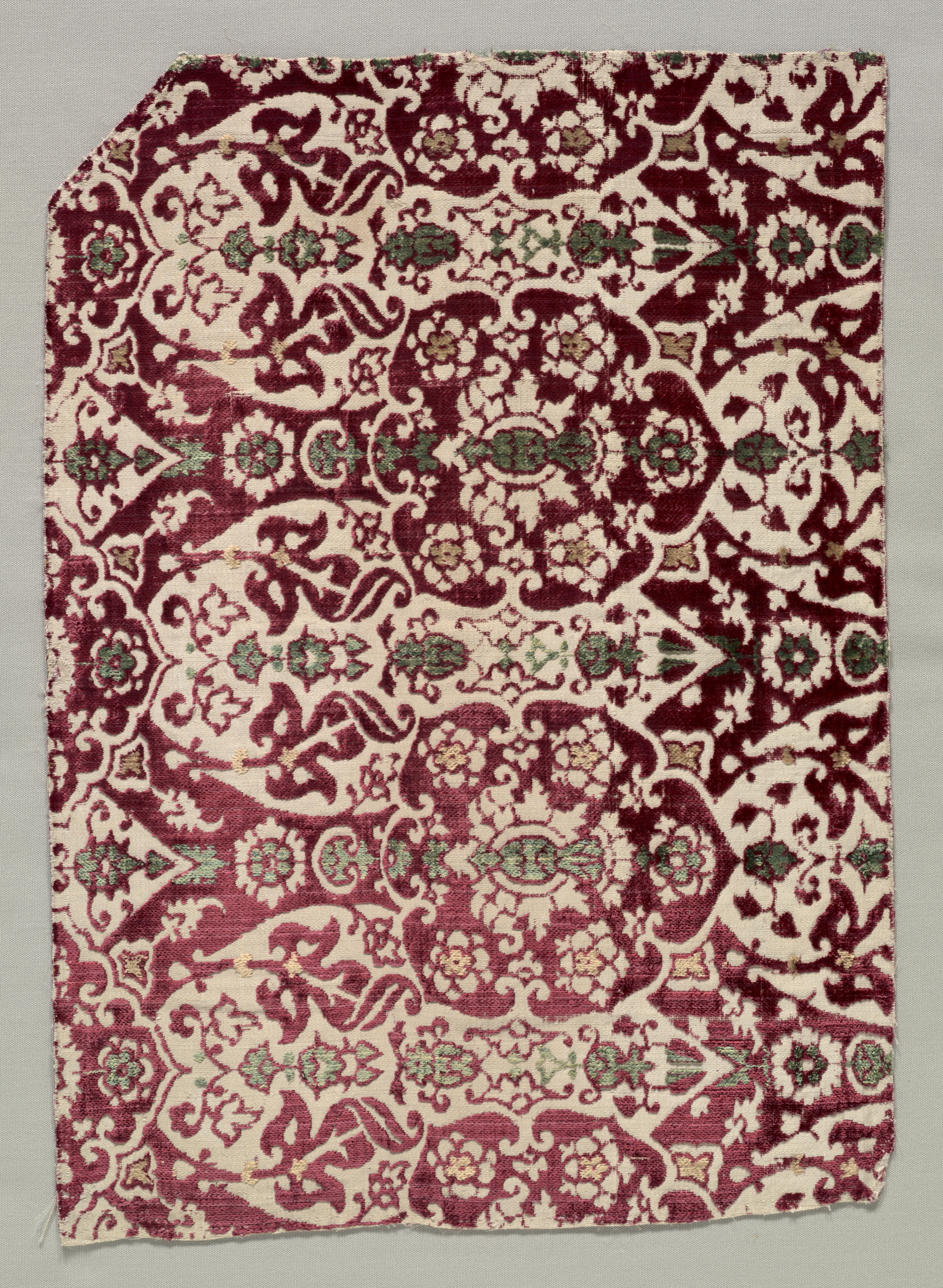
As the Chief Fabric Deconstructionist for Zoey Fashion Lab, I am tasked with dissecting textiles not merely as historical artifacts, but as living, breathing sources of inspiration for avant-garde design. The subject of this analysis is a remarkable specimen: a cut and voided silk velvet, originating from Bursa, Turkey, circa the second half of the 15th century. This fabric, designated under the reference "New DNA Strand," presents a unique paradox—a relic of Ottoman imperial power that holds the genetic code for radical, future-facing fashion. Below, we deconstruct its material, technical, and stylistic DNA to extract its potential for the Zoey Fashion Lab avant-garde ethos.
I. Material Provenance: The Ottoman Silk Road Legacy
The origin of this velvet is paramount. Bursa, the first capital of the Ottoman Empire, was not just a political center; it was the epicenter of the global silk trade. By the 15th century, Bursa’s workshops had mastered the art of silk cultivation and weaving, producing textiles that rivaled those of Persia and China. This velvet is a product of that golden age. The silk itself is a narrative of luxury and labor—each filament harvested from silkworms, spun, and dyed using natural pigments (likely madder for reds, woad for blues, and walnut for browns, though we will analyze the specific palette later).
For the avant-garde designer, this provenance is not about nostalgia. It is about material intelligence. The silk’s natural luster, its ability to absorb and reflect light asymmetrically, and its tensile strength are qualities that can be repurposed. At Zoey Fashion Lab, we do not mimic history; we recontextualize it. The "New DNA Strand" reference implies that we are extracting the core genetic properties—the fiber’s drape, its handle, its photonic behavior—and using them as a foundation for radical experimentation. This velvet is not a costume; it is a raw material for a new species of garment.
II. Technical Deconstruction: Cut and Voided Velvet
The technical classification—cut and voided velvet—is where the avant-garde potential truly resides. Let us break down the process:
- Cut Velvet: This involves weaving a pile warp and a ground warp. The pile loops are cut during or after weaving, creating a dense, upright, plush surface. This is the "fur" of the fabric, offering depth, softness, and a velvet’s signature shimmer.
- Voided Velvet: This technique introduces negative space. Areas of the fabric are woven without the pile warp, leaving the ground weave exposed. The result is a pattern of raised, plush velvet against a flat, satin-like ground. This contrast is not merely decorative; it is a structural dialogue between volume and void.
In a 15th-century Bursa velvet, these voids were typically used to create intricate floral or geometric motifs—tulips, carnations, arabesques—symbolizing paradise and imperial authority. However, for Zoey Fashion Lab, we view this technique as a proto-digital manipulation. The void is a pixel of absence. The cut pile is a pixel of presence. This binary logic—on/off, full/empty—is the very foundation of pattern-making in both weaving and digital design.
From a deconstructivist standpoint, the voided areas are the most radical. They reveal the fabric’s skeleton—the warp and weft that hold the pile. This is a textile that exposes its own construction. For an avant-garde collection, we can amplify this self-referential quality. Imagine a garment where the voided sections are not just pattern but cutouts, revealing the body or a secondary layer. Or, consider using the ground weave as a canvas for laser etching or metallic foil, while the pile remains untouched. The technical DNA of this velvet is a system of contrasts: soft vs. hard, dense vs. open, opaque vs. transparent.
III. Stylistic Analysis: The Avant-Garde Imperative
How does a 15th-century Turkish velvet align with an avant-garde aesthetic? The avant-garde is defined by its rejection of the conventional, its embrace of the unexpected, and its interrogation of form and function. This velvet, in its original context, was the epitome of convention—a symbol of wealth, status, and religious piety. But for Zoey Fashion Lab, we see its subversive potential.
1. The Paradox of Opulence: The velvet’s deep pile and rich silk luster are traditionally associated with luxury and comfort. The avant-garde designer can invert this. Use the fabric in a deliberately deconstructed silhouette—raw edges, exposed seams, asymmetrical draping. The opulence becomes a foil for the garment’s fragility. The velvet’s weight can be used to create dramatic, gravity-defying folds, reminiscent of architectural draping by designers like Issey Miyake or Rei Kawakubo. The "New DNA Strand" reference suggests we are extracting the fabric’s structural memory—its ability to hold a shape—and using it to build forms that defy the body’s natural contours.
2. Void as Interface: The voided areas are not just negative space; they are interfaces for interaction. In an avant-garde context, these voids can be layered with contrasting materials: transparent organza, reflective mylar, or even digital screens. The velvet’s pile becomes a tactile, analog surface that frames the cold, digital void. This creates a dialectic between history and hypermodernity. The 15th-century artisan’s careful control of pile and ground is reinterpreted as a 21st-century exploration of surface and interface.
3. The Photonic Behavior of Pile: The cut pile’s ability to catch and scatter light is a dynamic, time-based property. As the wearer moves, the velvet’s appearance shifts—from deep shadow to brilliant highlight. For the avant-garde, this is a performative material. It does not simply cover the body; it activates the space around it. This can be amplified by incorporating metallic threads into the pile or by using a gradient dye technique that fades from dark to light, creating a visual gradient that mimics digital gradients or the passage of time. The velvet becomes a living surface, not a static one.
IV. The "New DNA Strand" Protocol: From Artifact to Algorithm
The reference code "New DNA Strand" is not arbitrary. It signals that this analysis is not about preservation but transformation. We are extracting the fabric’s core properties—its material, technique, and style—and re-sequencing them into a new design language.
Material DNA: The silk’s tensile strength and luster will be replicated and hybridized. We might blend silk with bio-engineered fibers or conductive threads to create a velvet that responds to touch or temperature. The 15th-century material becomes a template for future materials.
Technical DNA: The cut-and-voided structure will be reprogrammed. Using digital jacquard looms, we can create voided patterns that are not floral but algorithmic—fractals, data visualizations, or even QR codes. The void becomes a code that can be read by machines or humans. The velvet is no longer a decorative object but a communicative surface.
Stylistic DNA: The Ottoman aesthetic of symmetry and hierarchy will be fractured. The avant-garde garment will not be a robe or a kaftan; it will be a modular system—detachable panels, adjustable volumes, and reversible constructions. The velvet’s traditional role as a status symbol is subverted; it becomes a tool for identity exploration, not a marker of fixed identity.
V. Conclusion: The Velvet as Proto-Avant-Garde
This 15th-century Turkish velvet is not a museum piece. It is a proto-avant-garde artifact. Its technical sophistication—the cut-and-voided structure—is a precursor to modern binary systems. Its material luxury is a challenge to the avant-garde’s love of the abject and the raw. Its stylistic opulence is a foil for deconstruction. At Zoey Fashion Lab, we do not preserve this velvet; we activate it. We extract its DNA and splice it with the future. The result will be a garment that is both ancient and alien, luxurious and unsettling, tactile and digital. This is the essence of the avant-garde: not to reject the past, but to re-sequence it into something that has never existed before.
Final Recommendation: The "New DNA Strand" velvet should be used as the base layer for a collection that explores the tension between the hand-made and the machine-made, the historical and the speculative. It should be cut, voided, and layered in ways that honor its technical legacy while breaking its stylistic chains. The velvet is ready. The lab is open. Let us weave the new strand.