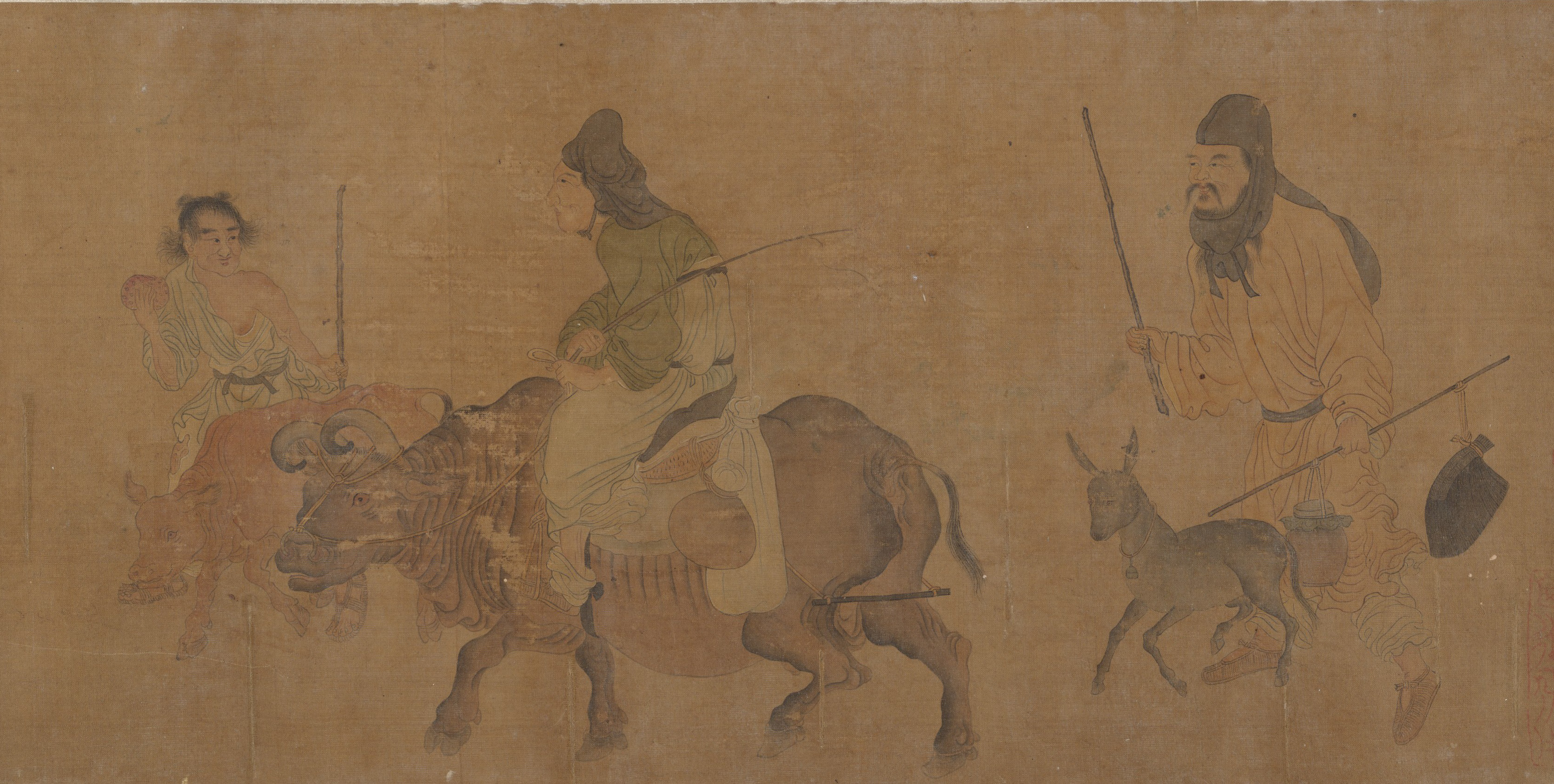
Deconstructing the Scroll: A Futuristic Silhouette Study for SS26
The intersection of ancient Chinese artistry and avant-garde fashion is not a mere juxtaposition of eras; it is a deliberate, tectonic collision. For Zoey Fashion Laboratory’s SS26 collection, we dissect the seminal handscroll Happy Return from the West, a masterpiece of ink and color on silk, to extract a radical new vocabulary of structural innovation. This is not a nostalgic reproduction. Instead, we treat the scroll as a blueprint for a post-humanist garment architecture—a system of fluidity, tension, and temporal layering that redefines the silhouette for a future where movement is both a physical and conceptual act.
The core of our analysis lies in the scroll’s inherent paradox: it is a static object that demands kinetic engagement. The viewer unrolls it, traversing a landscape that unfolds in time. This temporal dimension becomes our primary structural thesis. We reject the static, two-dimensional pattern-making of traditional couture in favor of a kinetic, four-dimensional modeling that mimics the scroll’s own unspooling. The result is a silhouette that is perpetually in a state of becoming—never fully resolved, always in transition.
Fluid Architecture: The Unspooling Silhouette
The most immediate influence of Happy Return from the West is its visual rhythm—the alternating density of ink washes, the sudden bursts of color from returning travelers, the negative space of silk itself. For SS26, we translate this into a silhouette that is asymmetric and volumetric, yet paradoxically weightless. The primary structural innovation is the “Scroll-Cut”: a garment that is not sewn from front and back pieces, but rather from a single continuous length of fabric that wraps, folds, and drapes around the body like a handscroll being unrolled horizontally.
Consider a long, sculptural coat. Its left side is a dense, structured panel—akin to the heavy ink strokes of a mountain—while its right side dissolves into a cascade of sheer, floating silk organza, mimicking the mist and open sky of the scroll’s landscape. The silhouette is not defined by a waist or a shoulder line, but by a dynamic axis of rotation. The garment’s hem is not straight; it is a jagged, calligraphic line that rises and falls, echoing the mountain peaks and valleys in the painting. This is a silhouette that breathes, that shifts with the wearer’s movement, creating a live, evolving composition.
Structural Innovation: The Ink-as-Garment System
The materiality of the handscroll—the delicate, yet resilient silk, the unpredictable flow of ink—demands a new approach to garment construction. We have developed a proprietary technique called “Ink-Wash Draping”. This involves applying a liquid resin to specific zones of the fabric, creating areas of controlled stiffness and transparency. The resin mimics the ink’s density: darker, more concentrated areas become structural corsetry or collars, while lighter, diluted areas remain fluid and translucent.
For example, a dress inspired by the scroll’s central procession features a bodice that is a single, unbroken piece of silk. The left side is heavily resin-treated, forming a rigid, sculptural cuirass that reads as a dark, abstract mountain. The right side is untreated, flowing freely into a train that trails behind the wearer like a river. The transition between these two states is not a seam, but a gradient of structural tension. This is not a garment; it is a wearable map of a landscape’s changing altitude and humidity.
Further, we introduce the “Scroll-Sleeve”: a sleeve that extends from the shoulder and continues in a single, unbroken line down the side of the body, wrapping around the back and ending in a long, trailing panel. This sleeve is not a tube; it is a flat, painted surface that folds and unfolds as the arm moves. The interior of the sleeve is printed with a micro-scale reproduction of the scroll’s calligraphy, visible only when the arm is raised, revealing a hidden narrative layer.
Temporal Layering: The Past as a Future Silhouette
The handscroll’s narrative—a joyous return from the West—is not a story of arrival, but of the journey itself. For SS26, we interpret this as a layering of time within the garment’s structure. The collection features multiple, overlapping layers that are not simply worn one over another, but interlocked through strategic cutouts and magnetic closures. An outer shell, made of stiff, resin-coated silk, is cut with jagged, landscape-shaped apertures. Through these apertures, a second, inner layer of fluid, hand-painted silk is visible, depicting the scroll’s figures in motion.
This creates a double-exposure effect in three dimensions. The wearer is simultaneously in the present (the outer, architectural shell) and in the past (the inner, narrative layer). The silhouette is not a single shape, but a composite of temporalities. A jacket, for instance, might have a rigid, futuristic shoulder line, yet its back is entirely open, revealing a trailing, hand-painted train that reads as a historical scroll. This is not retro-futurism; it is chrono-architecture, where the garment’s form is a direct expression of its own history.
The “Return” in the title is reimagined as a structural loop. A skirt is constructed from multiple, overlapping panels that are each a different length and opacity. These panels are attached at a single, central pivot point at the waist, allowing them to rotate independently. As the wearer walks, the panels shift and re-sort themselves, creating a constantly changing silhouette that never repeats. This is the garment as a kinetic sculpture, a perpetual return to a new form.
Conclusion: The Silhouette as a Living Scroll
In Happy Return from the West, the landscape is not a background; it is the protagonist. For Zoey Fashion Laboratory’s SS26, the garment is not a covering; it is the landscape itself. The silhouette is no longer a static outline but a dynamic, temporal membrane that records movement, narrative, and material transformation. By deconstructing the handscroll into its elemental components—ink, silk, time, and space—we have constructed a new paradigm for avant-garde couture. The future of fashion is not about creating new shapes, but about unfolding new structures from the past. The body becomes the handscroll; the garment, the ink that never dries. This is the definitive return: a structural innovation that is as ancient as it is impossibly new.