The Deconstructed Mandate: Reimagining the Chinese Robe of State for SS26
Prologue: The Weight of History, the Light of Tomorrow
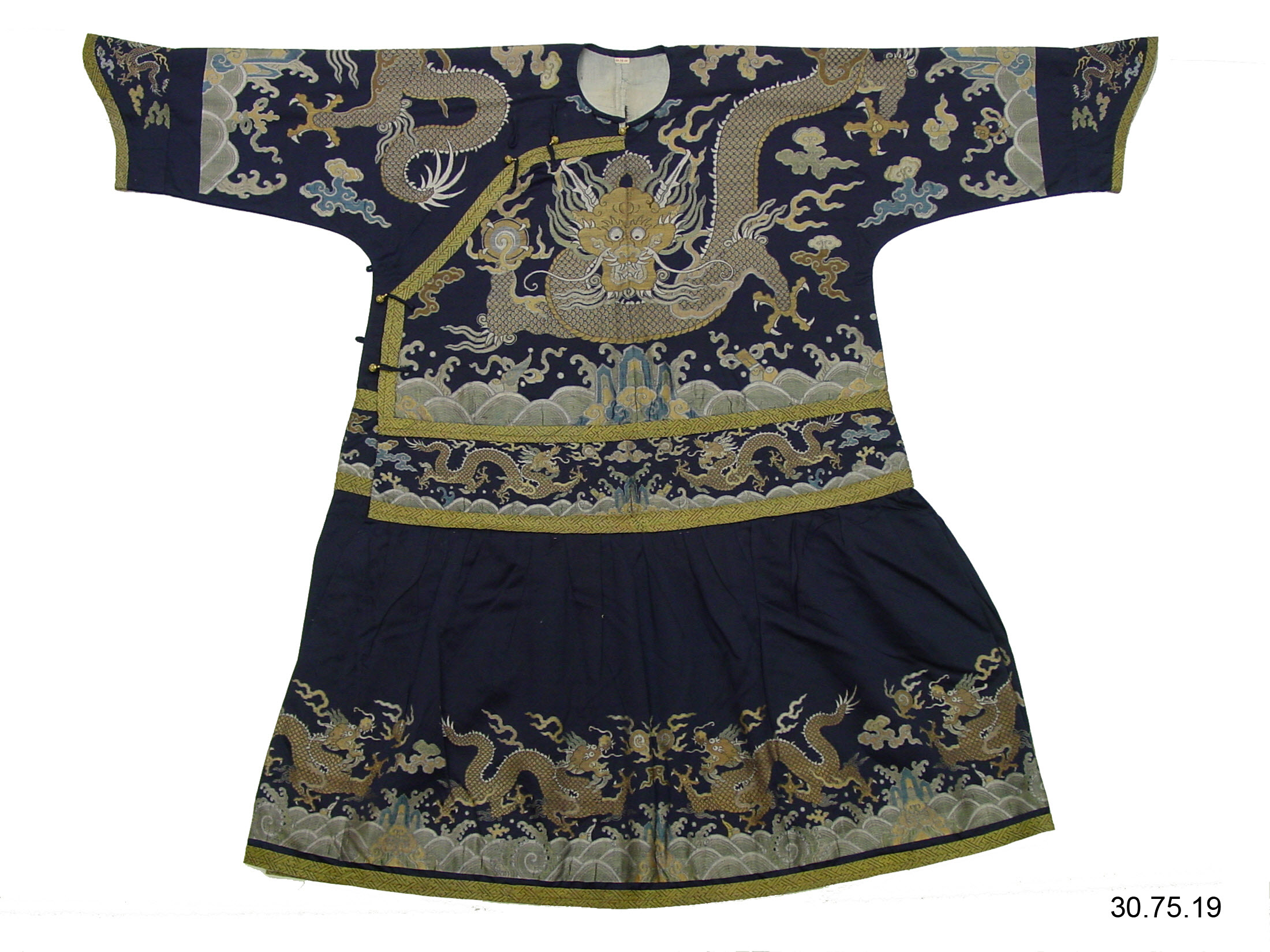
The Robe of State, a garment synonymous with imperial authority, dynastic continuity, and the meticulous hierarchy of Chinese court ritual, represents a paradox for the avant-garde. Its very essence is rooted in stasis—a fixed silhouette of rigid formality, heavy with gold thread, dragon motifs, and the semiotics of absolute power. For Zoey Fashion Laboratory’s SS26 collection, we do not seek to replicate this artifact. Instead, we propose a radical deconstruction: a surgical extraction of its DNA to forge a futuristic silhouette that interrogates authority, materiality, and the body’s relationship to space. This is not a robe of state; it is a robe of state of flux—a garment that embodies the tension between inherited structure and kinetic liberation.
I. Material Dialectics: Silk as a Substrate for Structural Innovation
The choice of silk is deliberate and subversive. Historically, silk in the Chinese court was a medium for opulence—its lustrous surface a canvas for intricate embroidery, its weight a testament to labor. For SS26, we weaponize silk’s inherent contradictions: its simultaneous strength and fragility, its capacity to drape and to resist. Through a process of thermoplastic resin bonding and laser-cut micro-perforation, the silk is transformed into a quasi-architectural membrane. The fabric no longer flows; it folds, creases, and cantilevers. The traditional pao silhouette—broad shoulders, sweeping sleeves, and a floor-length hem—is fractured into modular panels that hover millimeters from the body. These panels are held in tension by carbon-fiber boning and magnetic closures, creating a silhouette that is simultaneously rigid and airy, like a digital ghost of a Ming dynasty dragon robe.
The structural innovation lies in the negative space. Where the original robe concealed the body beneath layers of authority, our version reveals the body as a dynamic core. A high, asymmetrical collar—reminiscent of the liling (standing collar) of the Qing dynasty—is cut away to expose the clavicle and trapezius, while the back is left open, held only by a single, sweeping biomimetic spine of laser-sintered silk. This spine mimics the curve of a dragon’s vertebrae, but its function is purely structural: it distributes the weight of the garment across the shoulders, allowing the wearer to move with the fluidity of a dancer, not the stiffness of a sovereign.
II. Silhouette as Critique: The Futuristic Deconstruction of Power
The futuristic silhouette of this robe is a direct response to the historical garment’s spatial politics. The original robe of state was designed to occupy space—to expand the wearer’s physical presence and command the room. Our SS26 iteration inverts this logic. The silhouette is asymmetric, with one side extending into a sharp, floor-sweeping train (a nod to the courtly changfu) while the opposite side is cropped to the hip, revealing a second skin of liquid crystal-embedded silk that shifts color with movement. This imbalance is intentional: it disrupts the visual hierarchy of the original, suggesting a power that is unstable, provisional, and in constant negotiation.
The sleeves are reimagined as detachable exoskeletal appendages. One sleeve is a full, voluminous da xiu (wide sleeve) that can be inflated via a small air pump to create a dramatic, sculptural volume; the other is a tight, second-skin sleeve that ends in a 3D-printed gauntlet etched with a deconstructed dragon motif—a creature whose body is fragmented into geometric polygons. This duality speaks to the contemporary condition: the tension between the desire for grandeur and the need for agility, between the ceremonial and the functional.
The hemline is a study in kinetic engineering. Instead of a static, straight edge, the robe’s lower perimeter is composed of interlocking, petal-like panels that can be reconfigured by the wearer. Through a system of hidden drawstrings and magnetic snaps, the hem can be shortened for movement or extended to create a train that echoes the yichang (ceremonial skirt) of the Ming court. This mutability is the core of the garment’s structural innovation: it is not a fixed object but a responsive system, a wearable architecture that adapts to the environment and the wearer’s intent.
III. The Embodied Experience: Wearing the Future of Tradition
To wear this robe is to engage in a dialogue with history. The garment does not merely cover the body; it frames it as a site of contestation. The interior of the robe is lined with a conductive silk mesh that, when touched, triggers subtle vibrations along the spine—a haptic feedback system that reminds the wearer of the weight of ancestral authority even as they move freely. The color palette is a deliberate departure: not the imperial yellow or deep crimson of the court, but a monochromatic spectrum of lunar silver, oxidized copper, and charcoal, punctuated by iridescent threads that catch light only at certain angles. This is a robe of state for a world where power is no longer absolute but spectral, mediated by screens and algorithms.
The futuristic silhouette is further accentuated by the integration of wearable technology. A micro-LED panel, embedded in the collar, displays a scrolling text of classical Chinese poetry—but the characters are randomized, fragmented, and recombined into new, nonsensical phrases. This is a critique of the ossification of tradition: the robe of state was once a vessel for immutable texts; now, it is a vessel for flux, for reinterpretation, for the avant-garde impulse to destabilize and reimagine.
IV. Conclusion: The Robe as a Manifesto for SS26
Zoey Fashion Laboratory’s deconstruction of the Chinese robe of state is not an act of desecration but of transcendence. By stripping the garment of its historical context and rebuilding it through the lens of structural innovation, we create a piece that is both a critique and a celebration. It is a futuristic silhouette that honors the past by refusing to be bound by it. In an era of globalized fashion, where cultural appropriation is a constant risk, this robe stands as a model for critical engagement: it borrows the language of power only to rewrite its grammar. The wearer is not a monarch but a cyborg sovereign, a hybrid of silk and circuitry, tradition and transformation. This is the robe of state for a world that no longer believes in states—only in the relentless, beautiful flux of becoming.