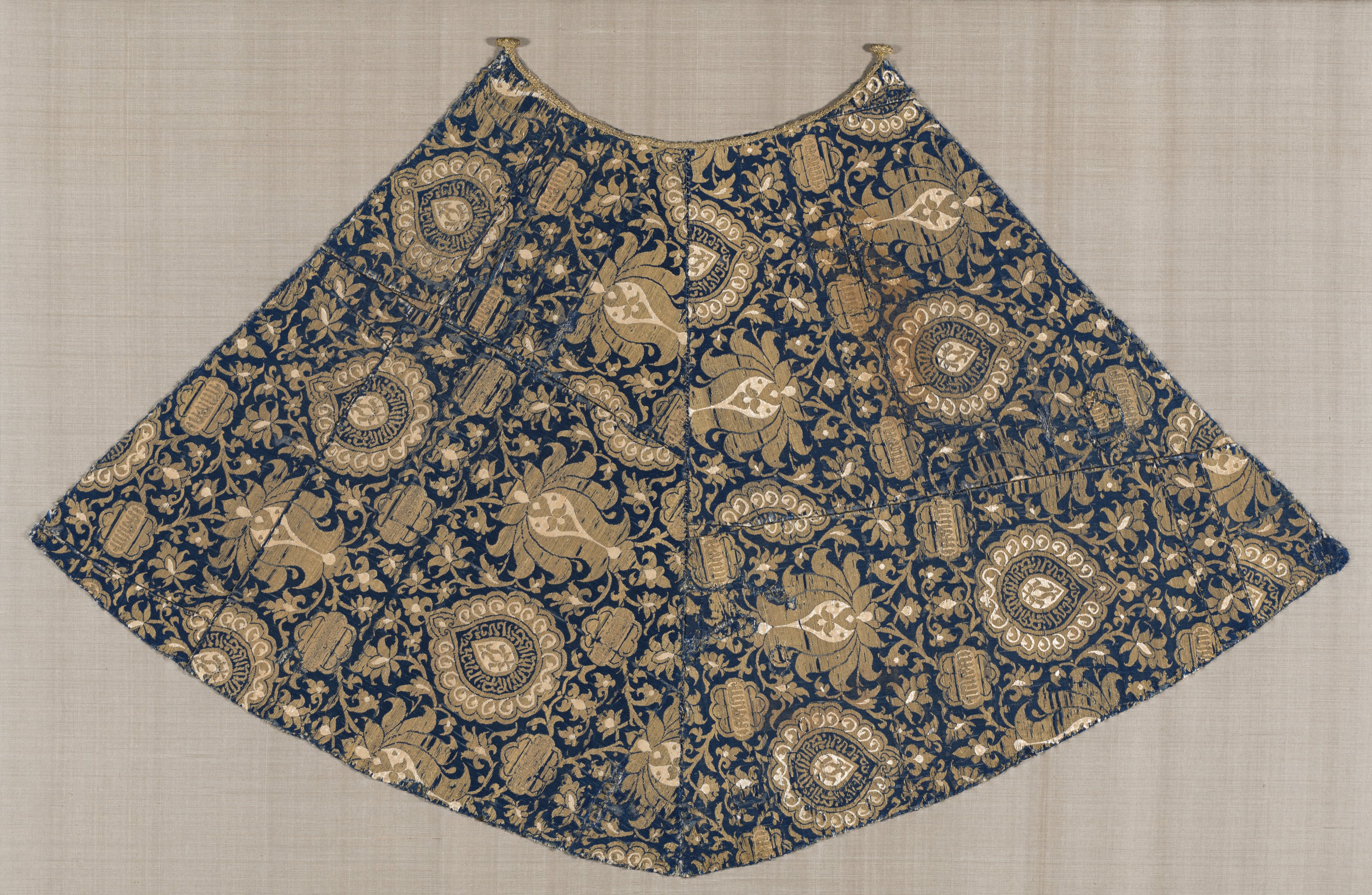
Deconstructing the Divine: A Technical and Stylistic Analysis of the Mantle for a Statue of the Virgin with Lotus Blossoms and Medallions
At Zoey Fashion Lab, the act of fabric deconstruction is not merely an exercise in material analysis; it is a dialogue between history, technique, and avant-garde expression. The subject of this report—a Mantle for a Statue of the Virgin with Lotus Blossoms and Medallions—presents a unique challenge. Originating from the cross-cultural confluence of Egypt and Spain, this textile is a masterwork of silk and gilt-metal thread in a lampas weave. Its reference to a New DNA Strand signals a radical reinterpretation: we are to see this sacred garment not as a relic, but as a living, mutable code for future fashion. This analysis will dissect its technical construction, decode its symbolic DNA, and propose how its essence can be reborn in an avant-garde context.
Technical Deconstruction: The Lampas Weave as Architectural Scaffolding
The mantle’s foundation is the lampas weave, a complex structure that elevates it beyond mere cloth. Unlike simpler weaves, lampas employs two or more warp and weft systems, creating a raised, patterned effect that is both robust and luxurious. In this piece, the ground weave is likely a silk satin, providing a luminous, fluid base. The pattern—the lotus blossoms and medallions—is then introduced through a supplementary weft of gilt-metal thread. This thread, typically a thin strip of silver-gilt wrapped around a silk or linen core, is not woven flush with the ground. Instead, it floats on the surface, creating a brocaded, metallic relief that catches light with every movement.
This technical choice is profoundly significant. The lampas structure allows for a dual narrative: the silk provides a soft, almost ethereal backdrop, while the gilt-metal thread asserts a rigid, ceremonial presence. The lotus blossoms, a motif deeply rooted in Egyptian symbolism (rebirth, purity, the sun), are rendered in this metallic thread, transforming a natural form into something transcendent. The medallions, likely influenced by Spanish Islamic or Mudéjar design, echo this interplay of geometry and nature. The New DNA Strand reference implies that this weave is not static. In an avant-garde lab, we would isolate these structural elements—the satin ground, the floating metallic threads, the raised pattern—as genetic sequences to be recombined. Imagine a laser-cut silk organza overlaid with a 3D-printed, flexible metal mesh that mimics the lampas’s raised medallions, but in a deconstructed, asymmetrical silhouette.
Symbolic DNA: The Lotus, the Medallion, and the Sacred Mantle
The iconography of this mantle is a hybrid genome. The lotus blossom, a quintessential Egyptian symbol, represents the sun’s daily rebirth and the soul’s journey toward enlightenment. In a Christian context, it was often assimilated to the Virgin Mary’s purity. The medallions, circular and enclosing geometric or floral motifs, are a hallmark of Spanish textile art, particularly from the Nasrid period in Granada. They evoke the infinite, the protective seal, and the celestial sphere. Together, they create a visual language that is both universal and specific: a mantle meant to drape a statue of the Virgin, elevating her to a cosmic, intercessory role.
From a New DNA Strand perspective, these symbols are not fixed. They are mutable codes that can be re-coded for contemporary expression. The lotus can be abstracted into a series of overlapping, translucent petals in a deconstructed gown, perhaps using heat-set pleats to mimic the flower’s unfolding. The medallions can be transformed into wearable architecture—circular, laser-cut panels that pivot on a garment’s surface, revealing or concealing the body beneath. The mantle itself, traditionally a heavy, enveloping garment, can be reimagined as a modular cape composed of separate, interlocking sections. Each section could feature a single lotus or medallion, allowing the wearer to reconfigure the piece as a statement of personal identity.
Avant-Garde Reinterpretation: From Sacred Relic to Living Code
The Zoey Fashion Lab approach demands that we break the mantle’s “DNA” into its core components—material, structure, motif, and function—and then reassemble them in a way that challenges traditional fashion paradigms. The original mantle was designed for veneration; its purpose was static, ceremonial. Our avant-garde version must be dynamic, interactive, and wearable in the context of a high-concept runway or a conceptual art installation.
Material Mutation: The silk and gilt-metal thread can be replaced with high-tech alternatives. Consider a base of bio-engineered silk, grown in a lab, which offers the same luster but with programmable properties (e.g., color-changing under UV light). The gilt-metal thread can be substituted with conductive metallic yarns that can power embedded LEDs or sensors. The lotus blossoms and medallions could then become interactive elements: the blossoms might glow in response to the wearer’s heartbeat, while the medallions could emit a soft, pulsing light, transforming the garment into a living, responsive organism.
Structural Deconstruction: The lampas weave’s rigidity can be subverted. Instead of a continuous fabric, we might create a deconstructed lattice—a series of silk ribbons and metallic threads that are woven in the lampas pattern but left loose at the edges, fraying into a fringe. This would echo the original weave’s complexity while embracing impermanence and decay, a core tenet of deconstructionist fashion. The mantle could be cut asymmetrically, with one side retaining the full pattern and the other reduced to a skeletal lattice, symbolizing the tension between tradition and innovation.
Functional Reimagining: The mantle’s sacred function can be translated into a ritual of transformation. Imagine a garment that can be worn in multiple configurations: as a full-length cloak for a formal presentation, then unzipped and reconfigured into a short, sculptural bolero for a more casual setting. The lotus and medallion motifs could be printed or embroidered in a UV-reactive ink that only reveals its full pattern under specific lighting, creating a sense of revelation and mystery. This aligns with the original mantle’s role as a veil between the divine and the mortal, but now the veil is controlled by the wearer.
Conclusion: A New Genetic Expression
The Mantle for a Statue of the Virgin with Lotus Blossoms and Medallions is not a historical artifact to be preserved in amber. It is a genetic blueprint—a strand of DNA that contains the code for a thousand future garments. By deconstructing its technical weave, decoding its symbolic language, and reassembling its elements through an avant-garde lens, Zoey Fashion Lab can produce a collection that honors the past while radically redefining the future of fashion. The result will be a garment that is not merely worn, but activated—a living dialogue between silk and metal, Egypt and Spain, the sacred and the profane. This is the new strand, woven into the fabric of tomorrow.