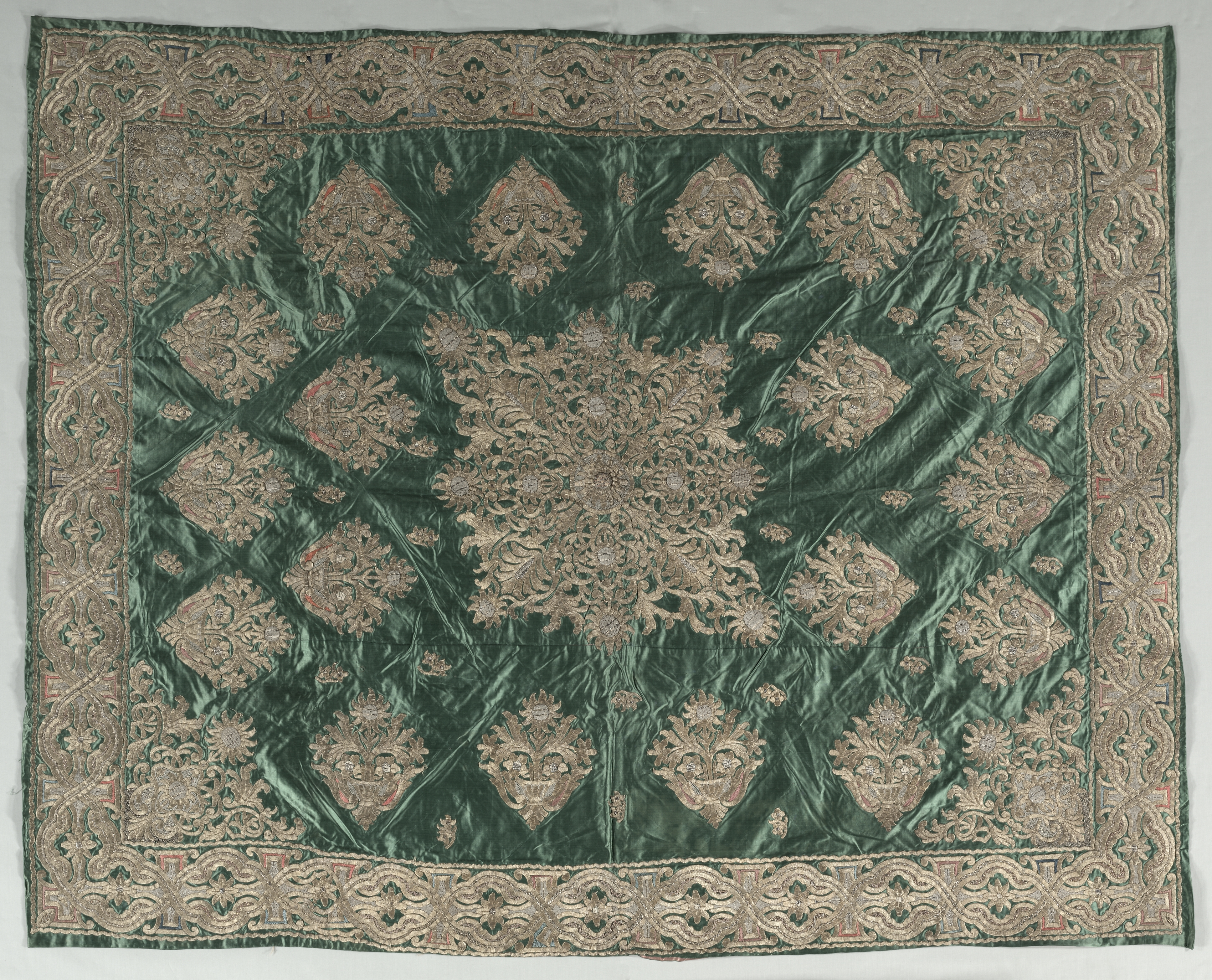
Deconstructing the Ottoman Archive: The Gold-Thread Embroidered Cover as Avant-Garde Catalyst
At Zoey Fashion Lab, the role of the Chief Fabric Deconstructionist is not merely to analyze textiles, but to excavate their latent potential, to reverse-engineer their historical and material DNA, and to re-synthesize them into propositions for the future. The subject of this analysis—a Gold-Thread Embroidered Cover from the Ottoman period—presents a particularly rich case. Its technical composition of silk, gilt-metal, silver-metal, paper, and cotton padding, executed in satin weave and dense embroidery, is an archive of imperial power, artisanal mastery, and symbolic language. However, our lens is not antiquarian. We approach this object through the concept of Archive Resonance, a methodology that treats historical artifacts not as static relics, but as active, vibrating frequencies that can be tuned to contemporary avant-garde expression. The reference point provided—the duality of a mirrored surface and a sarcophagus relief—offers the critical framework for this deconstruction: the cover is simultaneously a surface of dazzling reflection and a layered narrative of substance and mortality.
I. Material Deconstruction: The Alchemy of Opulence and Structure
The first layer of our analysis concerns the physical components. This is not a simple fabric; it is a composite of radically different materials. The silk satin weave provides a ground of liquid, shifting light—a base of pure sensuality. Upon this, the embroidery introduces gilt-metal and silver-metal threads. These are not merely decorative; they are structural interventions. The metal threads, often wound around a silk or paper core, create a rigid, reflective lattice that contrasts with the silk’s fluidity. The inclusion of paper is particularly telling. In Ottoman embroidery, paper was frequently used as a stabilizing backing or as a core for metal threads, introducing a fragile, ephemeral element into a construction intended for durability. This paradox—strength built upon a paper skeleton—is a key deconstructive insight. The cotton padding beneath certain embroidered motifs, such as the split-leaf palmette (the rumi motif), creates a raised, almost sculptural relief. This is not two-dimensional decoration; it is a low-relief topography. The object, therefore, is not a flat surface but a stratified terrain of silk, metal, paper, and padding. For the avant-garde designer, this suggests a radical departure from flat pattern-making. The garment could become a landscape, with padded, embossed zones that catch light at different angles, creating a dynamic, architectural silhouette. The metal threads, if left exposed or frayed, could function as conductive elements or as literal armor, while the paper core suggests a deliberate fragility—a garment that is both opulent and transient.
II. Surface and Depth: The Mirror and the Sarcophagus
The provided reference—the mirror with gold-encrusted split-leaf motifs on one side and a sarcophagus relief on the other—is the conceptual key. The Ottoman embroidered cover embodies this duality. Its surface is a mirror: the gilt-metal threads and satin weave create a highly reflective, dazzling field. The gold-embroidered split-leaf palmettes (the rumi and hatayi motifs) are designed to catch light, to impress, to assert the wealth and cosmic order of the Ottoman court. This is the iconic function—a surface of pure, overwhelming presence. It is the public face, the spectacle.
Yet, the depth of the cover tells a different story. The cotton padding beneath the embroidery creates a physical weight and a tactile density. The motifs, when touched, are not flat; they are palpable, almost architectural. This is the sarcophagus function. The cover is not just a surface; it is a repository of labor, of time, of the bodies of the embroiderers. The metal threads are not merely shiny; they are heavy. The paper core is fragile. The object, in its materiality, speaks of the life and death of the craft. The split-leaf motif, a stylized representation of a plant in perpetual bifurcation, can be read as a symbol of organic growth, but also of fragmentation—a life split, a narrative divided. For the avant-garde, this duality is fertile ground. A collection could oscillate between hyper-reflective surfaces (mirror-like, metallic, screen-printed) and deep, padded, almost funerary volumes (padded shoulders, quilted bodices, sculptural sleeves). The garment becomes a wearable artifact that simultaneously seduces and repels, that dazzles and then reveals its own structural weight and mortality. The rumi motif, deconstructed, could be rendered as a 3D-printed, metallic exoskeleton over a soft, padded silk base—a literal fusion of mirror and sarcophagus.
III. Embroidery as Narrative: The Split-Leaf as Deconstruction
The central motif—the split-leaf palmette—is not merely decorative. In Ottoman art, it represents the infinite, the cosmic, the perpetual renewal of life. But from a deconstructionist perspective, the split is the critical element. The leaf is always already fragmented. It is a symbol of wholeness that is defined by its division. This is the essence of Archive Resonance: we do not replicate the motif; we amplify its inherent tension. The gold thread that traces the split is not a line of closure but a line of rupture.
In a contemporary design context, this could manifest as deliberate, engineered fraying of the metal threads at the seams, or as laser-cut, negative-space versions of the palmette that reveal the skin or an under-layer of contrasting material. The embroidery could be reversed, with the metallic threads on the inside of the garment, creating a secret, reflective lining that only the wearer knows. The cotton padding could be exaggerated into extreme, almost grotesque volumes, referencing the sarcophagus relief but rendered in a soft, tactile material. The paper core, so essential to the historical technique, could be replaced with biodegradable, dissolvable polymers or recycled paper pulp, making the garment a commentary on ephemeral luxury and ecological transience. The narrative is not about preserving the past, but about activating its contradictions.
IV. Synthesis: The Avant-Garde Silhouette and Material Language
From this analysis, Zoey Fashion Lab can derive a distinct avant-garde design vocabulary. The silhouette should be architectural and fragmented, not fluid. The body is a terrain. Key elements include:
1. The Metallized Second Skin: A base garment of silk satin, but with embedded, exposed metal threads that create a conductive, reflective grid. This is not a print; it is a structural weave. The surface is a mirror that distorts the viewer’s gaze.
2. The Padded Relief: Areas of extreme, sculptural padding (cotton, but also memory foam or recycled padding) that create raised, embossed forms based on the rumi motif. These are not decorative appliqués; they are integrated into the garment’s construction, altering the silhouette with swooping, asymmetrical volumes. The padding is the sarcophagus—the weight of history made palpable.
3. The Fragmented Motif: The split-leaf is deconstructed. It appears as a laser-cut, metallic overlay that is only partially attached, flapping or peeling away to reveal the raw silk or a contrasting, dark under-layer. It is a motif in the process of dissolution, a symbol of the archive’s inevitable decay and transformation.
4. The Paper Core Intervention: The historical use of paper is honored through deliberate inclusions of paper-based materials—perhaps as a temporary, tear-away element in the garment’s lining, or as a paper-thin, metallic-coated fabric that crinkles and catches light. This introduces an element of deliberate fragility, a memento mori within the opulence.
5. The Reversible Narrative: The garment is designed to be worn inside out. One side is the mirror—the dazzling, public, gold-embroidered surface. The other side is the sarcophagus—the padded, raw, structural underbelly, with seams exposed and padding visible. The wearer chooses which narrative to present.
In conclusion, the Ottoman Gold-Thread Embroidered Cover is not a museum piece to be copied. It is a resonant archive of material contradictions: light and weight, surface and depth, opulence and fragility, life and death. By deconstructing its technical and symbolic components—the metal thread, the paper core, the cotton padding, the split-leaf motif—Zoey Fashion Lab can generate a design language that is both historically informed and radically contemporary. The resulting garments will not simply reference the past; they will perform its tensions, offering a wearable critique of ornament, power, and the passage of time. The mirror and the sarcophagus become one garment.