Deconstructing the Avant-Garde: The Stenciled Velvet of Zoey Fashion Lab
At Zoey Fashion Lab, the role of the Chief Fabric Deconstructionist is to dissect not just the physical threads of a textile, but the narrative, the technology, and the cultural resonance embedded within its weave. Our latest subject, a piece of American stenciled velvet originating from New York, presents a compelling paradox. It is a fabric that speaks of old-world opulence yet is manipulated through a distinctly modern, almost scientific, lens. This analysis will deconstruct its technical composition, its stylistic implications, and its profound resonance with our current “New DNA Strand” design paradigm.
Technical Provenance: The Alchemy of Silk and Vegetable Dye
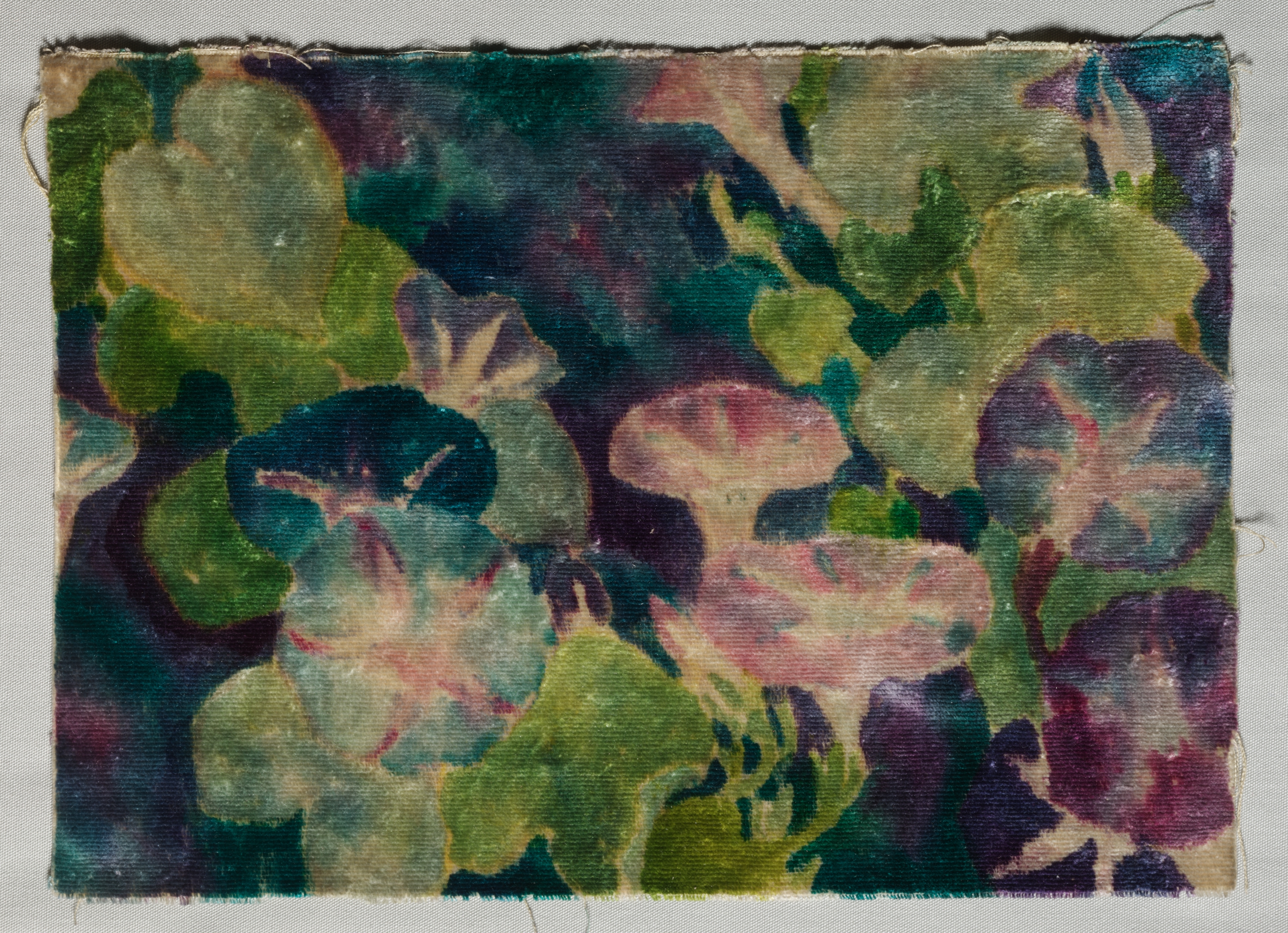
The foundation of this fabric is undeniably luxurious: a plain silk velvet. This is not a crushed or devoré velvet; it is a pure, uncut pile of silk filaments standing erect from a silk ground. The technical challenge here is inherent. Silk velvet is notoriously difficult to manipulate. Its delicate pile can be easily crushed, stained, or distorted. The choice to use vegetable dyes further complicates the process. Unlike synthetic aniline dyes, which are predictable and colorfast, vegetable dyes are living entities. They react to the pH of the fiber, the mineral content of the water, the temperature, and the mordant used. Applying them via a stencil—a method that requires precision and controlled application—is a feat of technical mastery.
The stenciling process itself is a form of resist printing. A pattern is cut into a rigid or flexible stencil, and the dye is applied through the openings. On a pile fabric like velvet, this is particularly challenging because the dye must penetrate the dense, upright fibers without wicking uncontrollably into the adjacent pile. The result is a sharp, defined image that sits on the surface, creating a distinct contrast between the dyed and undyed areas. The vegetable dyes, in this case, have been chosen for their subtle, earthy vibrancy. They do not scream; they whisper. The colors are not flat; they have depth, shifting slightly as the light catches the pile at different angles. This is a far cry from the uniform, industrial perfection of synthetic dyes. It is a fabric that has been coaxed into existence, not manufactured.
Stylistic Analysis: The Avant-Garde as a New Biology
From a stylistic perspective, this fabric is a masterclass in Avant-garde design. The term “Avant-garde” is often misused to describe anything that is merely unusual or shocking. True Avant-garde design, as practiced at Zoey Fashion Lab, is about redefining the boundaries of the possible. It is about creating a new visual language, not just a new dress. The stenciled velvet achieves this by juxtaposing the organic with the geometric, the ancient with the futuristic.
The stencil pattern itself is not a traditional floral or damask. Instead, it evokes a biological, almost microscopic, structure. Think of cellular mitosis, DNA helices, or the branching of a neural network. The pattern is irregular, yet it possesses an internal logic. It is a “New DNA Strand”—a visual representation of a code that is both ancient and nascent. The velvet’s pile provides the perfect medium for this. The soft, plush surface mimics the texture of organic tissue, while the sharp, stenciled lines suggest the precision of a genetic blueprint. The result is a fabric that feels both alive and engineered.
This duality is the essence of the Avant-garde. It challenges the viewer to reconcile the luxurious, tactile comfort of velvet with the cold, intellectual concept of a genetic code. The garment made from this fabric would not simply be worn; it would be inhabited. It would become a second skin, a statement of identity that is both deeply personal and universally biological. The vegetable dyes, with their inherent imperfections, add a layer of humanity and impermanence. They remind us that even the most sophisticated code is subject to the vagaries of nature.
The New DNA Strand: Fabric as a Living System
Our reference to a “New DNA Strand” is not merely a poetic flourish. It is a fundamental design principle. In the same way that DNA is a code that dictates the form and function of a living organism, the stenciled pattern on this velvet dictates the form and function of the garment. The pattern is not decorative; it is structural. The placement of the stencil determines where the fabric will drape, where it will hold its shape, and where it will create shadows. The undyed areas of the velvet, with their pure, unadorned pile, offer a sense of calm and neutrality. The dyed areas, with their intricate biological forms, introduce tension and movement. This creates a dynamic interplay between the two states of the fabric.
Furthermore, the vegetable dyes themselves are a form of living technology. They are not inert; they will continue to evolve over time. Exposure to light, air, and the oils of the skin will cause the colors to shift and fade. This is not a flaw; it is a feature. The garment will age gracefully, developing a patina of use that tells the story of its wearer. This aligns perfectly with the Zoey Fashion Lab philosophy of slow, sustainable design. We are not creating disposable fashion; we are creating artifacts that will live and breathe alongside their owners.
Conclusion: A Fabric for the Future of Fashion
In conclusion, this American stenciled velvet is far more than a textile. It is a manifesto in material form. It demonstrates that luxury and innovation are not mutually exclusive. It proves that ancient techniques, like vegetable dyeing and stenciling, can be repurposed for a futuristic, Avant-garde aesthetic. It embodies the “New DNA Strand” by treating the fabric as a living system, a code to be read, interpreted, and evolved. For Zoey Fashion Lab, this fabric is not a starting point or an ending point. It is a catalyst. It challenges us to rethink the relationship between material, pattern, and identity. It asks us to consider what it means to wear a piece of art that is also a piece of science. And it compels us to continue deconstructing, analyzing, and ultimately, reconstructing the very fabric of fashion itself.