Deconstructing the Court Sword: An Avant-Garde Analysis for Zoey Fashion Lab
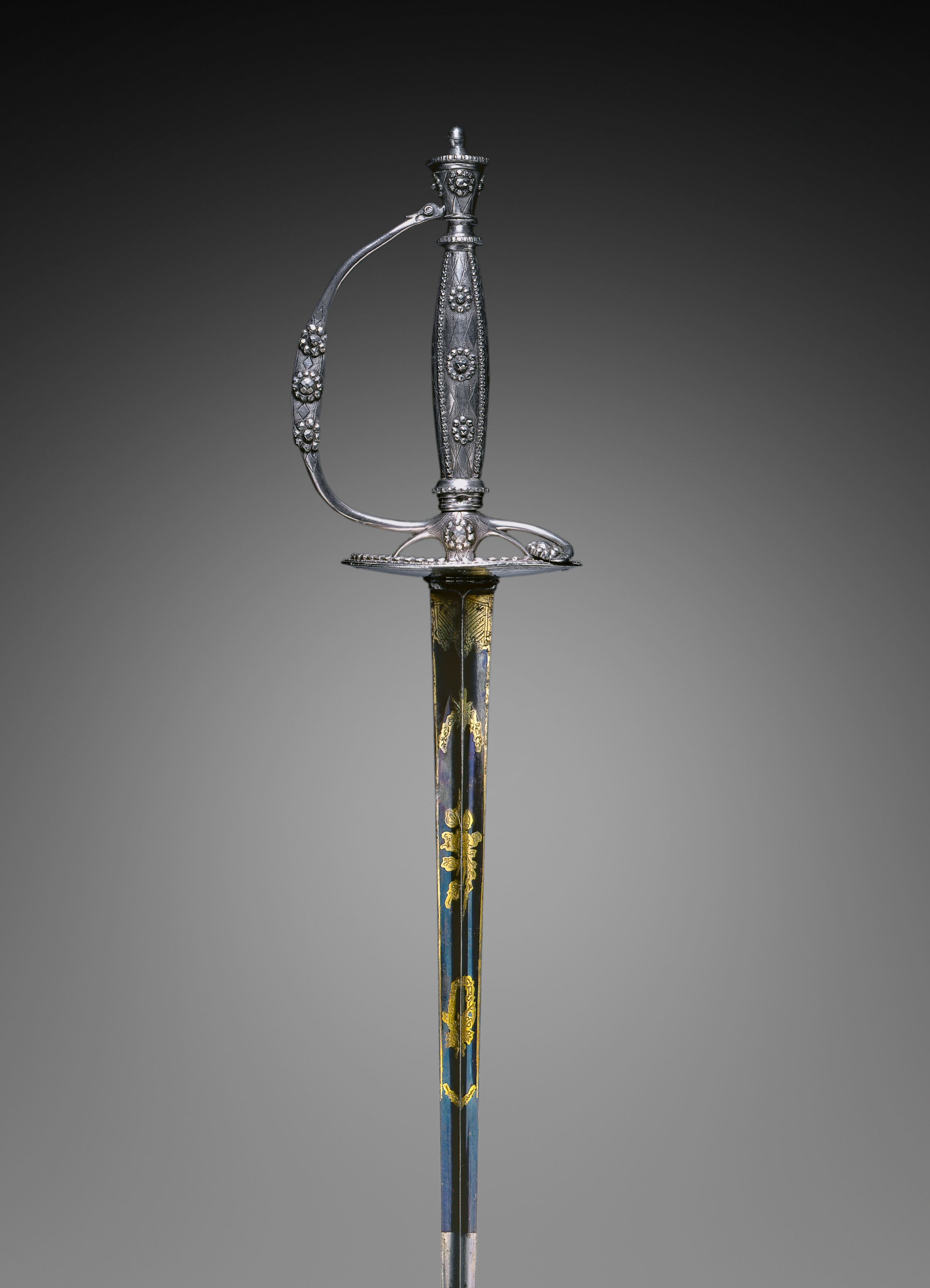
The court sword, a ceremonial accessory of the late 18th-century English aristocracy, represents a paradox of elegance and violence. For Zoey Fashion Lab, this artifact is not merely a historical relic but a deconstructive blueprint for avant-garde design. Originating from the workshops of London or Birmingham, this sword—with its polished and faceted silver hilt, partially blued and gilded steel blade—embodies a tension between refined craftsmanship and latent aggression. As the Chief Fabric Deconstructionist, I propose to dissect this object through five lenses: material dissonance, structural fragmentation, surface manipulation, symbolic inversion, and the "New DNA Strand" of contemporary fashion.
Material Dissonance: Silver and Steel as Fabric Analogues
The court sword’s core materials—silver and steel—offer a rich vocabulary for textile deconstruction. Silver, polished and faceted, suggests a luminous, reflective surface that mimics the sheen of high-thread-count silk or metallic organza. In avant-garde fashion, this translates to fabrics with a liquid, mirror-like finish, such as liquid lamé or iridescent PVC. However, the faceting introduces a disruptive element: the hilt’s geometric cuts create a fractured light that breaks the uniformity of the surface. For Zoey Fashion Lab, this inspires garments with asymmetrical panels, cutouts, or laser-etched patterns that catch and scatter light unpredictably, challenging the conventional smoothness of evening wear.
The steel blade, partially blued and gilded, presents a different material narrative. Bluing—a chemical process that oxidizes steel to a deep blue-black—evokes shadow and depth, while gilding adds traces of gold. This duality mirrors the use of burnout velvet, where a pattern of sheer and opaque areas creates visual tension. Alternatively, consider a fabric that combines matte black neoprene with gold-thread embroidery, or a digitally printed textile that transitions from a dark, stormy blue to a metallic gold gradient. The partial application of these treatments (not the entire blade) suggests a strategic incompleteness, a design principle where adornment is localized rather than total.
Structural Fragmentation: The Hilt as a Deconstructed Silhouette
The hilt of a court sword is a complex assembly of guard, grip, and pommel, each with distinct proportions and functions. In deconstructive fashion, this translates to a garment where traditional structural elements—collars, sleeves, hems—are disassembled and recontextualized. For example, the faceted guard could inspire a sharp, angular shoulder piece or a detachable collar that juts outward, echoing the protective function of the hilt. The grip, often wrapped in wire or wood, suggests a tactile, layered texture—imagine a sleeve constructed from overlapping strips of leather or bonded fabric, mimicking the grip’s tactile grip.
The pommel, a counterweight at the base, can be reimagined as a weighted hem or a pendant-like structure at the back of a jacket. This fragmentation emphasizes the garment’s architecture, making visible the joints and connections that are usually hidden. For a ready-to-wear piece, this could mean exposed seams, snap-fasteners as decorative elements, or sleeves that detach via magnetic closures—a nod to the sword’s removable nature. The avant-garde goal is to create a silhouette that is both functional and symbolic, where each part references the original object while standing independently.
Surface Manipulation: The Blade’s Patina and Gilding
The blade’s partial bluing and gilding introduce a time-worn aesthetic that is highly relevant to deconstructive fashion. Bluing is a controlled form of corrosion, a patina that speaks to age and use. In fabric, this can be replicated through techniques like shibori dyeing, where indigo creates uneven, organic patterns, or through acid-washing denim to achieve a mottled, faded effect. The gilding, applied in thin layers, suggests a precious overlay that is deliberately incomplete—a golden streak that cuts across a dark field. For Zoey Fashion Lab, this inspires garments with metallic foil stamping applied in asymmetrical stripes, or embroidery that uses gold thread only on certain sections, leaving others bare.
The contrast between blued and gilded areas also speaks to the juxtaposition of matte and shine. A deconstructed dress might combine a matte, textured base—such as wool crepe or raw silk—with glossy, reflective inserts made from vinyl or patent leather. This surface manipulation creates a visual rhythm that guides the eye across the garment, much like the blade’s gradient from blue to gold. The partial application ensures that the treatment does not overwhelm the form, maintaining a balance between decoration and restraint.
Symbolic Inversion: From Weapon to Ornament
The court sword was a symbol of status and readiness for combat, yet its ceremonial use rendered it largely decorative. For avant-garde fashion, this inversion of function is a powerful tool. The sword’s blade, once a weapon, becomes a metaphor for sharpness in silhouette—think of a dress with a knife-pleated skirt or a jacket with razor-sharp lapels. The hilt, once a handle, becomes a framing device for the body, like a structural corset or a harness that defines the waist. By inverting the sword’s purpose, Zoey Fashion Lab can create pieces that are both protective and vulnerable, hard and soft.
Consider a garment that incorporates blade-like elements—such as metal spikes or rigid plastic inserts—but softens them with flowing fabrics like chiffon or organza. This juxtaposition echoes the court sword’s dual nature: a beautiful object that could also kill. Alternatively, the sword’s sheath, often made of leather or velvet, could inspire a second skin—a body-hugging jumpsuit with a hard, protective outer layer that can be removed, revealing a delicate undergarment. This symbolic inversion challenges the wearer to reconsider the relationship between adornment and armament.
The New DNA Strand: Avant-Garde Integration
The "New DNA Strand" reference suggests a genetic recombination of design elements—a fusion of historical form with contemporary technology. For Zoey Fashion Lab, the court sword’s DNA can be encoded into a collection through digital fabrication. For example, 3D-printed components that mimic the hilt’s faceting can be integrated into garment structures, such as a collar or belt. Laser-cutting technology can reproduce the blade’s blued and gilded patterns on fabric, creating a precise, repeatable motif that retains the handcrafted feel.
Moreover, the sword’s linear form—a straight blade with a curved hilt—can influence the silhouette of a collection. Think of a dress that follows a single, unbroken line from shoulder to hem, interrupted only by a sharp, angular cutout at the waist. This line becomes a narrative thread that ties together disparate pieces: a coat with a blade-like back seam, a skirt with a diagonal slash, or a top with a faceted neckline. The avant-garde approach is to treat the sword not as a costume piece but as a generative source for new forms, materials, and meanings.
Conclusion: A Deconstructive Blueprint for Zoey Fashion Lab
The 18th-century court sword, with its silver hilt and blued steel blade, offers a rich lexicon for deconstructive fashion. By dissecting its materials, structure, surface, and symbolism, Zoey Fashion Lab can create avant-garde pieces that are historically resonant yet radically contemporary. The key is to treat the sword as a fragment—a broken whole that can be reassembled in unexpected ways. Whether through reflective fabrics, angular silhouettes, or patinated surfaces, the court sword’s DNA can be woven into a new strand of fashion that challenges conventions and redefines elegance. This analysis serves as a starting point for a collection that is both a tribute to craftsmanship and a rebellion against it—a true deconstruction of the past for the future.