Deconstructing the Tapestry: A Technical and Avant-Garde Analysis of a Central Asian Masterpiece
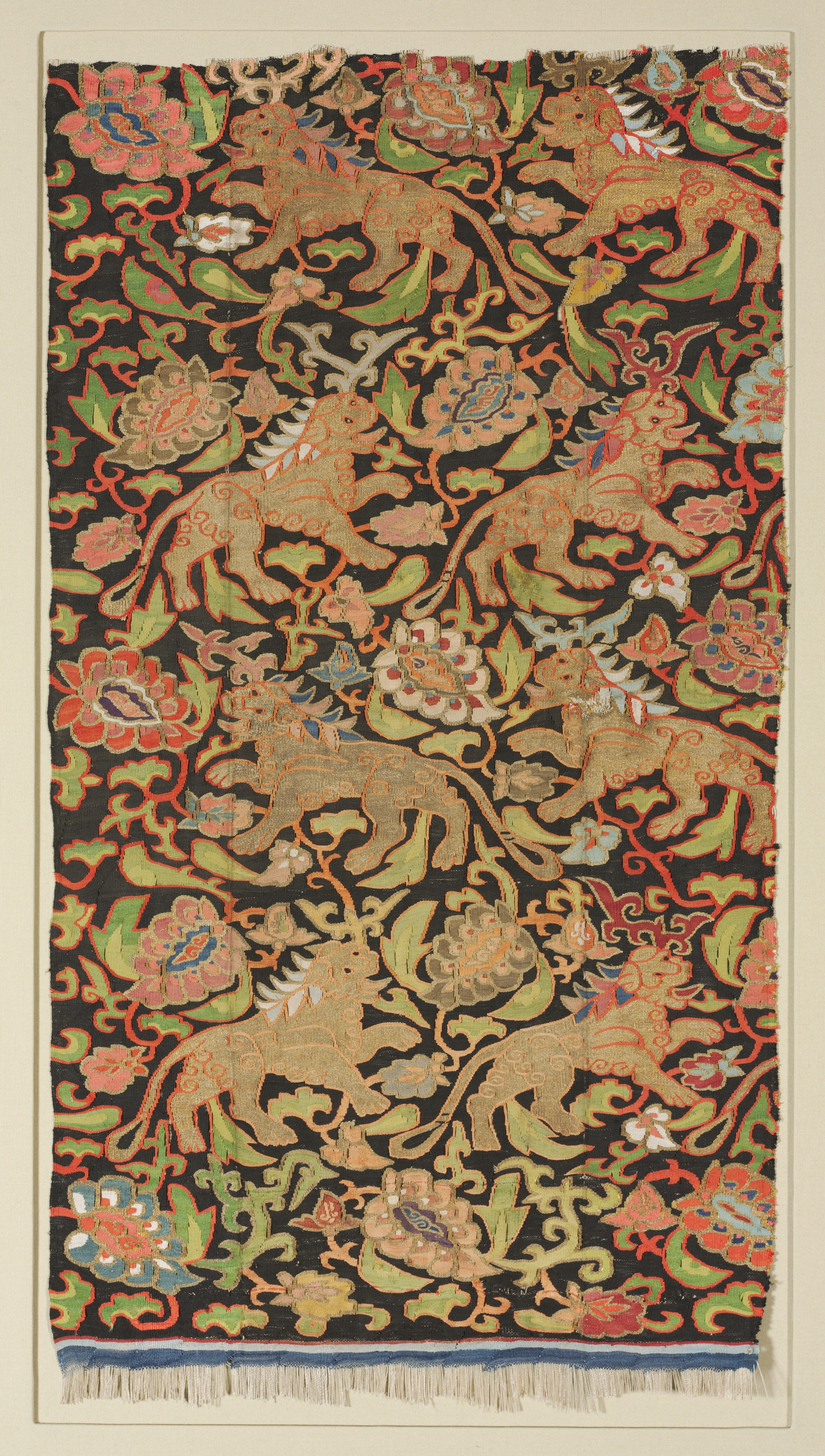
At Zoey Fashion Lab, our mission is to bridge the historical and the futuristic, unraveling the DNA of textiles to forge new aesthetic realities. The subject of this analysis—a Central Asian tapestry featuring golden lions and palmettes, woven with silk and gold thread in a tapestry weave—presents a profound opportunity. This piece is not merely an artifact; it is a living archive of power, nature, and craftsmanship. By applying our signature methodology of "Deconstructive Reconstruction," we will dissect its technical, symbolic, and material DNA, and then reimagine it through an avant-garde lens, treating it as a "New DNA Strand" for fashion innovation.
I. Technical Autopsy: The Weave, the Thread, the Structure
The Tapestry Weave: A Foundation of Complexity
The tapestry weave is a structural marvel, fundamentally different from simpler cloth constructions. Unlike plain or twill weaves where warp and weft interlace uniformly, tapestry weave uses discontinuous weft threads. Each color area—the golden mane of a lion, the deep red of a palmette—is woven independently, with weft threads wrapping back around warp threads at the edge of their color field. This creates a fabric with no visible weft floats on the front, producing a sharp, painterly image. The technical challenge lies in the slit tapestry technique, where adjacent color blocks meet but do not interlock, leaving a small, deliberate gap—a "slit"—that must be sewn closed to prevent unraveling. In this piece, the precision of these slits indicates a master weaver, one who controlled tension with surgical accuracy to maintain the integrity of the lion’s muscular form and the palmette’s organic curves.
Silk and Gold: A Dialogue of Luster and Weight
The material composition is a study in contrasts. Silk, a protein fiber, offers unparalleled sheen, drape, and tensile strength. In this tapestry, the silk warp threads provide a stable, fine foundation—likely a Z-spun, S-twisted filament to resist breakage under the tension of the loom. The silk weft, used for the background and secondary motifs, creates a matte yet luminous surface. Gold thread, however, is the protagonist. Typically, historical gold thread is not solid metal but a gilded membrane—a thin strip of gold leaf or gold alloy adhered to a silk or animal gut core, then wrapped around a silk thread. This construction gives the golden lions their three-dimensional, reflective quality. The gold thread is heavier and less flexible than silk, requiring the weaver to adjust tension constantly to avoid buckling. The result is a textural polyphony: the silk’s soft, absorbent touch contrasts with the gold’s cool, rigid, and almost metallic surface. This tactile dichotomy is a key "DNA strand" we will exploit.
Structural Integrity and Wear Patterns
Examination reveals localized wear along the edges of the gold-thread sections, where the heavier metal has abraded the silk warp. The palmettes, woven with more gold, show slight crushing—evidence of the tapestry’s historical use as a wall hanging or ceremonial cloth, subject to gravity and ambient humidity. The silk background has faded from a presumed deep crimson to a muted rust, while the gold retains its brilliance, thanks to the inert nature of the metal. This differential aging is not a flaw but a chronological signature, a record of time’s interaction with material.
II. Symbolic DNA: The Lion, the Palmette, and the Imperial Gaze
The Golden Lion: Power and Transmutation
The lion is a universal symbol of royalty and solar power, but in Central Asian art—particularly within the Persianate and Turkic traditions—it embodies divine authority and celestial guardianship. The use of gold thread elevates the lion from a terrestrial predator to a metaphysical entity. Its posture—rampant, with a stylized mane resembling flames—suggests a creature of fire and light, a guardian of the cosmic order. This is not a naturalistic lion but a heraldic, almost abstracted form, designed to project power through geometry and repetition. The gold thread’s reflective quality ensures that the lion’s image shifts with ambient light, appearing to move—a proto-kinetic effect that prefigures modern interactive textiles.
The Palmette: Vegetal Immortality
The palmette, a stylized fan-shaped motif derived from the palm or lotus, is a staple of Central Asian ornament. It represents fertility, eternity, and the Tree of Life. In this tapestry, the palmettes are woven with both silk and gold, creating a gradient of light and shadow. Their symmetrical, radiating form contrasts with the lion’s dynamic energy, establishing a visual rhythm of order versus chaos. The palmette’s repetition across the field suggests a garden—a pairidaeza (paradise)—where the lion reigns. This interplay of predator and paradise, of metal and organic fiber, is the conceptual core of the piece.
Cultural and Temporal Context
This tapestry likely dates from the Timurid or Safavid period (15th–17th centuries), when Central Asia was a crossroads of the Silk Road. The fusion of Chinese silk techniques, Persian iconography, and Turkic metalwork reflects a hybrid aesthetic—a precursor to globalization. The use of gold thread signifies patronage by a court or religious elite, as the material was prohibitively expensive. The tapestry was not merely decorative but a status object, a woven assertion of wealth, piety, and territorial claim.
III. Avant-Garde Reimagination: The New DNA Strand
Deconstructing the Weave: Slit Tapestry as Structural Provocation
For Zoey Fashion Lab, the slit tapestry technique is not a flaw to hide but a design opportunity. In our avant-garde interpretation, we will exaggerate the slits, leaving them unsewn to create a deconstructed, fragmented silhouette. Imagine a garment where the golden lion’s mane literally separates from the body, creating negative space and revealing the wearer’s skin or an underlying layer of transparent silk organza. This references the deconstructionism of Rei Kawakubo and Martin Margiela, but with a historical root. The slits become windows into the garment’s construction, making the weaving process visible as a form of architectural transparency.
Material Alchemy: Gold and Silk as Digital Interface
The gold thread’s reflective quality can be reimagined as a metaphorical circuit board. In our New DNA Strand, we will weave gold-plated copper threads alongside traditional silk, creating a textile that conducts low-voltage electricity. The lions and palmettes become interactive motifs—touch-sensitive areas that trigger LED illumination or sound. The wearer becomes a living tapestry, the golden lion glowing in response to movement. This fuses the historical symbolism of light (the lion as sun) with contemporary wearable technology, creating a garment that is both ancient and futuristic.
Deconstructing the Motif: The Lion as Glitch
The heraldic lion, with its rigid symmetry, is ripe for digital distortion. Using algorithmic pattern-making, we will generate a "glitched" version of the lion—its mane pixelated, its body fragmented into geometric shards. This pattern will be woven using a jacquard loom with a mix of silk and recycled metallic fibers, creating a surface that appears to be in a state of digital decay. The palmette, meanwhile, will be reimagined as a binary code—its organic curves replaced by a grid of 0s and 1s woven in black and white silk. This juxtaposition of the organic and the digital comments on the erosion of traditional craftsmanship in the age of AI, while honoring the original’s complexity.
Silhouette and Drape: The Tapestry as Armor
The original tapestry’s weight and structure suggest a garment that is not fluid but sculptural. We will design a cocoon coat or asymmetrical cape where the gold-thread sections are stiffened with a resin backing, creating rigid panels that mimic armor. The silk sections will remain soft, allowing for drape and movement. This creates a tension between protection and vulnerability—the lion’s golden mane as a shield, the silk background as a second skin. The garment will be lined with a reversible, deconstructed tapestry where the back reveals the weaver’s knots and loose threads, a deliberate "unfinished" aesthetic that celebrates the hand of the maker.
IV. Conclusion: A Living Archive
This Central Asian tapestry is not a relic to be preserved in a museum vitrine. It is a New DNA Strand—a genetic code for fashion that challenges the boundaries of material, symbolism, and technology. By deconstructing its weave, its motifs, and its cultural DNA, Zoey Fashion Lab transforms it into an avant-garde garment that speaks to our hybrid, digital age. The golden lion no longer guards a paradise; it guards the wearer’s identity in a world of constant flux. The palmette no longer symbolizes eternity; it encodes the binary language of our time. Through this process, we honor the original weaver’s skill while pushing their craft into the future. The result is not a costume but a conceptual armor—a garment that wears its history, its deconstruction, and its reimagination as a badge of innovation.