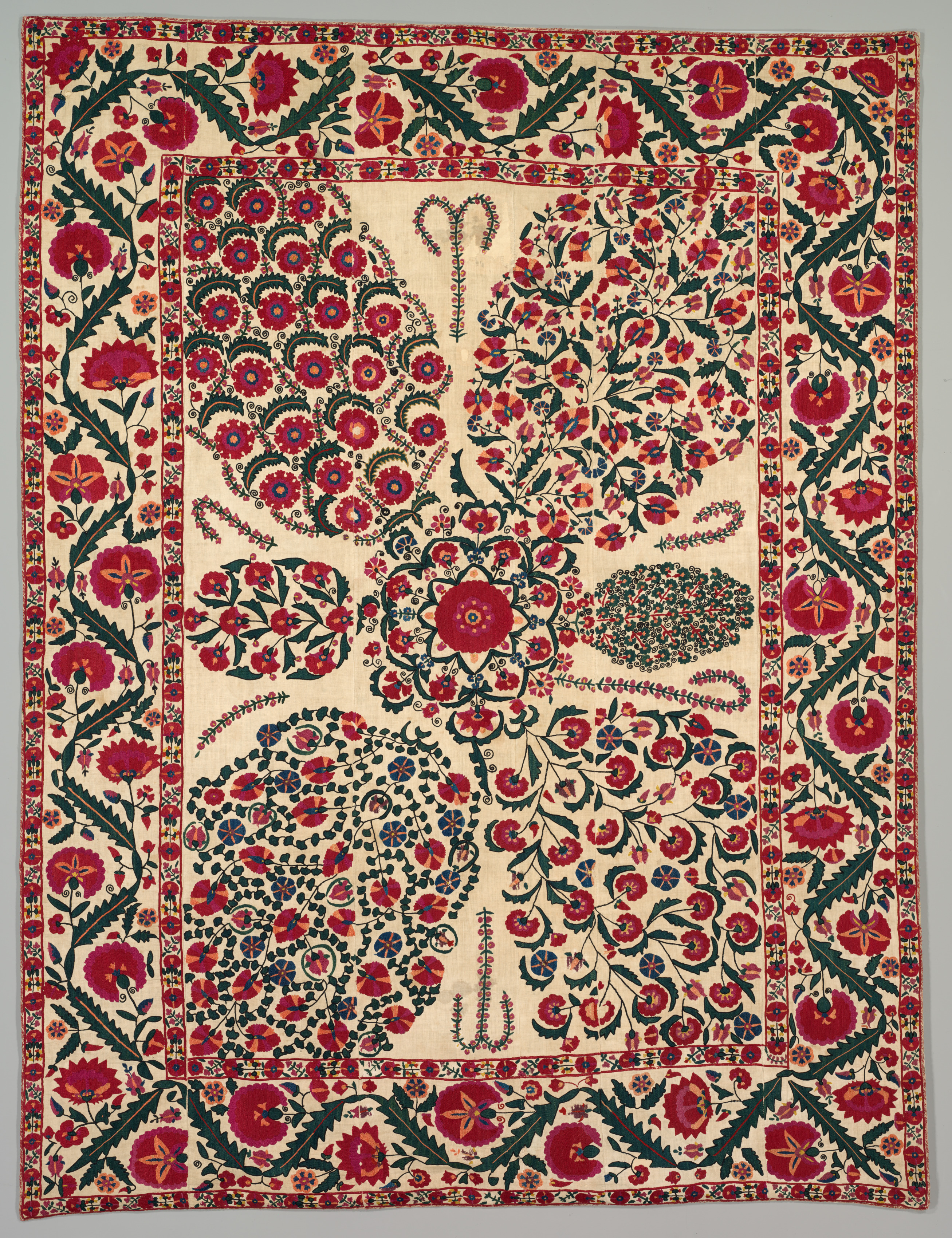
Deconstructing the Avant-Garde: A Technical and Stylistic Analysis of a Shakhrisyabz Suzani for Zoey Fashion Lab
As Chief Fabric Deconstructionist for Zoey Fashion Lab, my role is to dissect textiles not merely as historical artifacts, but as living, breathing sources of design DNA. The subject of this analysis—a Suzani from South West Uzbekistan, specifically the Shakhrisyabz region—presents a paradox of immense value to our avant-garde ethos. While rooted in centuries-old Central Asian tradition, its technical construction and symbolic language offer a radical blueprint for deconstruction, reconstruction, and recontextualization. This report will dissect the Suzani’s technical DNA, its cultural coding, and its potential to be transmuted into a new, disruptive fashion narrative.
Technical Deconstruction: The Fabric as a System
The foundation of this Suzani is a cotton plain weave, composed of six distinct strips sewn together. This is not a flaw, but a structural choice. In traditional Central Asian textile production, the width of the loom dictated the fabric’s size; multiple panels were joined to create the large surface required for a bedspread or ceremonial textile. For our lab, this multi-panel construction is a critical design element. It suggests a modular, almost architectural approach to surface. The seams between the strips are not merely functional; they are latent lines of fragmentation that an avant-garde designer can exploit. We can envision these seams as intentional tears, or as points for insertion of contrasting materials—transparent organza, metallic mesh, or even laser-cut leather—creating a hybrid textile that honors its modular origins while subverting its unity.
The embroidery technique is where the Suzani’s true technical complexity lies. The primary stitch is kanda xajol, a dense, chain-like filling stitch that creates a raised, almost sculptural surface. This is not a flat, two-dimensional decoration. It is a topographical map of thread, building volume and shadow. The secondary stitch, bosma, is used occasionally, likely for finer details or outlines. The outlining stitch, ilmoq, provides a crisp, linear boundary. This hierarchy of stitch types—filling, occasional accent, and outlining—is a complete system of mark-making. For Zoey Fashion Lab, this is a three-dimensional drawing language. We can deconstruct these stitches: the kanda xajol can be isolated and scaled up, transformed into a chunky, hand-embroidered relief on a deconstructed denim jacket; the bosma can be sampled as a delicate, machine-embroidered trace on a sheer silk sleeve; the ilmoq can become a raw, exposed edge finish, a thread that is not hidden but celebrated as a boundary line.
Symbolic Coding: Floral Sprays as Avant-Garde Motifs
The subject of the embroidery is floral sprays. In traditional Suzani iconography, these are not merely decorative. They are potent symbols of fertility, life, and paradise—a garden in thread. The stylized, often symmetrical, floral forms are a coded language of abundance and protection. For our avant-garde lens, we must strip this meaning and rebuild it. The floral spray is not a representation of a real plant; it is a graphic system of curves, dots, and radiating lines. It is a pattern that can be abstracted to its pure geometry.
Consider the asymmetry of tradition. While the overall composition may appear balanced, close examination reveals subtle variations in the placement of buds, leaves, and stems. This is not a machine-perfect repeat. It is a human, hand-made rhythm. This intentional irregularity is a goldmine for the avant-garde. We can treat the floral spray as a mutating motif. One sleeve can feature a dense, traditional spray; the other, a deconstructed, exploded version where the petals have become abstract, floating shapes. The stem can become a structural seam, the leaves can become pockets, and the buds can become three-dimensional appliqués that move with the body.
From Tradition to Disruption: The New DNA Strand
Our reference, “New DNA Strand,” is the guiding principle for this transformation. We are not replicating the Suzani; we are extracting its genetic code and splicing it with contemporary, often conflicting, elements. The Suzani’s DNA is dense, heavy, and rooted in domestic, ceremonial function. Our new strand must be light, mobile, and confrontational.
Proposed Avant-Garde Applications:
- Deconstructed Silhouette: A long, columnar dress made from the original Suzani fabric, but with the six strips deliberately unstitched and re-joined at irregular intervals, creating gaps that reveal a contrasting, high-tech inner layer (e.g., a silver metallic mesh). The dense embroidery becomes a focal point, not a uniform surface.
- Hybrid Garment: A tailored blazer, where the left panel is the original Suzani, and the right panel is a stark, black, high-gloss vinyl. The floral spray is sampled and embroidered onto the vinyl using a digital embroidery machine, but with the kanda xajol stitch scaled to 200% size, creating a jarring, oversized relief.
- Accessory as Architecture: A sculptural collar or cuffs made from the Suzani’s most densely embroidered sections, mounted on a rigid, laser-cut acrylic frame. The embroidery becomes a freestanding, wearable sculpture, divorced from its fabric base.
- Deconstruction of Stitch: A garment where the embroidery is the only structural element. The cotton base is cut away, leaving only the kanda xajol and ilmoq stitches to hold the shape. This creates a fragile, lace-like, yet incredibly durable textile that is pure thread.
Conclusion: The Suzani as a Radical Source
This Shakhrisyabz Suzani is not a relic to be preserved in a museum. For Zoey Fashion Lab, it is a radical source of design strategies. Its modular construction, hierarchical stitch system, and abstracted floral iconography provide a complete toolkit for creating work that is both deeply informed by tradition and aggressively forward-looking. By deconstructing its technical DNA—the six strips, the kanda xajol, the ilmoq, the floral spray—we can reassemble them into garments that challenge the very definition of embroidery, surface, and silhouette. The result is not a costume, but a new living artifact—a fashion object that carries the weight of its origins while sprinting toward an undiscovered future. The floral spray will not bloom; it will explode. The stitches will not hold; they will define. This is the avant-garde imperative.