Deconstructing the Safavid Fragment: A Blueprint for Avant-Garde Textile Innovation
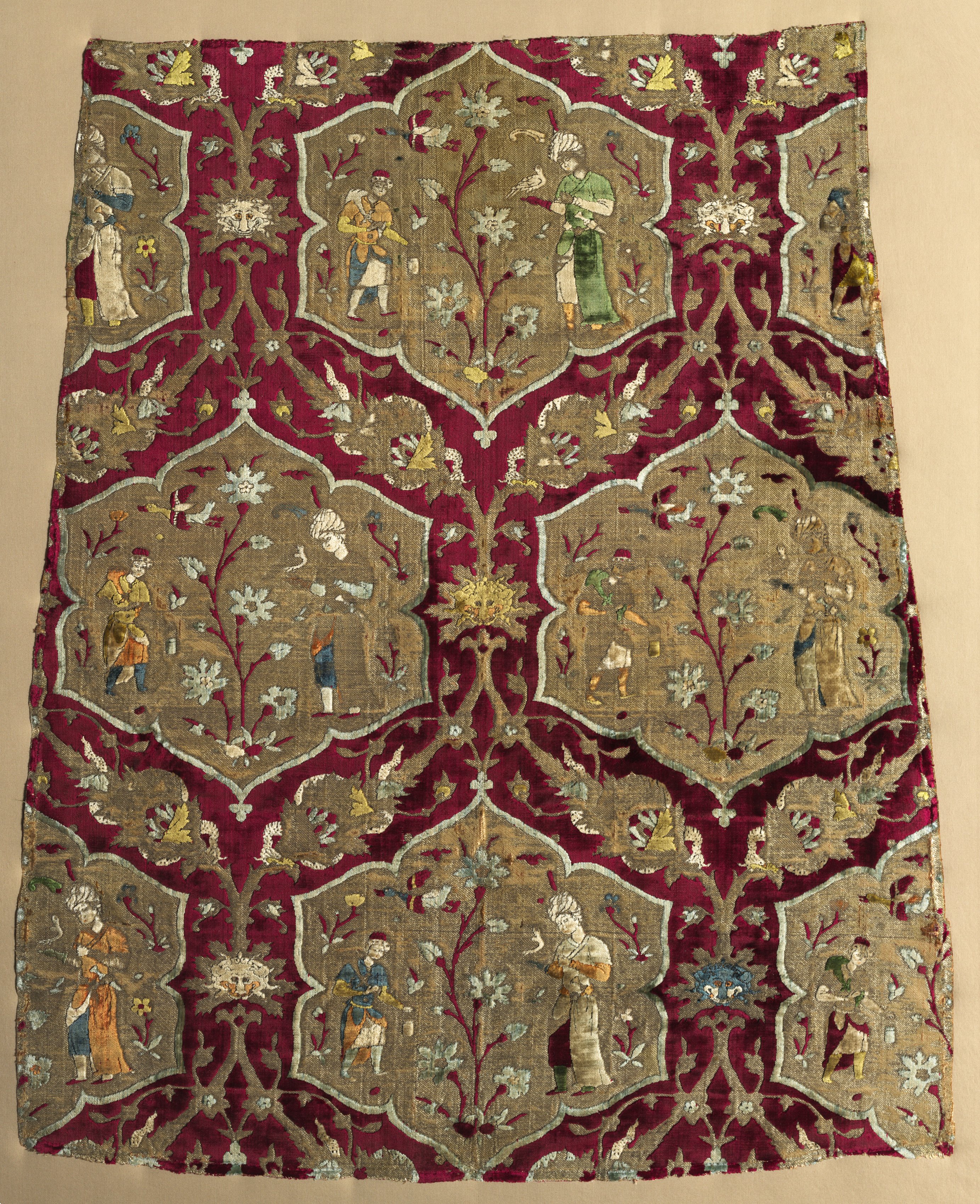
At Zoey Fashion Lab, we approach historical textiles not as relics, but as living blueprints. The subject of this analysis—a fragment from a Safavid robe, likely produced in Kashan, Iran, between the 16th and 18th centuries—presents a rare opportunity to decode a masterwork of technical and aesthetic complexity. This fragment, depicting a falconer and attendant within an animated lattice, is executed in silk velvet with brocaded details, pile-warp substitution, and gilt-metal thread. For our avant-garde design philosophy, this piece is not merely a historical artifact; it is a new DNA strand—a genetic code of texture, motion, and structural rebellion that we can splice into contemporary fashion. Below, we deconstruct its material, compositional, and symbolic elements to propose a radical reinterpretation for the modern runway.
Material Alchemy: Velvet, Brocade, and the Gilt-Metal Thread
The fragment’s technical foundation is a masterclass in material paradox. The silk velvet base offers a plush, absorbent surface that captures light in deep, shadowy pools. This is not a flat fabric; it is a topography of pile and void. The velvet’s density is achieved through pile-warp substitution, a technique where additional warp threads are woven to create raised loops, then cut to form the velvet’s signature softness. For Zoey Fashion Lab, this three-dimensionality is a direct challenge to the flatness of modern digital prints. We envision translating this technique into avant-garde garments where the pile is selectively shorn or left long, creating a tactile landscape that shifts with movement—a dress that feels like a living, breathing surface.
Interwoven with the velvet is brocading, a supplementary weft technique that introduces the falconer and attendant figures in crisp, raised detail. The use of gilt-metal thread—silver or gold wrapped around a silk core—adds a reflective, almost metallic sheen. This thread was likely produced by hammering gold into thin sheets, cutting it into strips, and winding it around a silk filament. The result is a shimmer that is both opulent and fragile. In our avant-garde context, we see this as a material dialogue between permanence and decay. We propose a modern iteration using recycled metallic threads or even laser-cut, biodegradable foil, creating garments that emulate the fragment’s luminosity while embracing sustainability. The gilt thread’s tendency to tarnish over centuries becomes a design feature—a garment that changes color and reflectivity with wear, echoing the passage of time.
Compositional Dynamics: The Animated Lattice and the Falconer
The fragment’s design is dominated by an animated lattice—a geometric framework of interlocking arabesques and floral motifs that appears to pulse with energy. This lattice is not static; it is punctuated by the figures of a falconer and his attendant, who seem to move within the grid. The falconer, often depicted with a bird of prey on his wrist, symbolizes nobility, control, and the tension between nature and civilization. The attendant, smaller and subservient, reinforces a hierarchical narrative. For Zoey Fashion Lab, this lattice is a metaphor for the structural constraints of fashion—the seams, darts, and patterns that define a garment’s shape. We propose deconstructing this lattice in our designs: cutting the geometric pattern into separate, floating panels that are connected by delicate chains or transparent mesh. The falconer and attendant become motifs that appear and disappear as the wearer moves, creating a sense of unpredictability and liberation.
The “animation” of the lattice is achieved through subtle asymmetries in the repeating pattern—a leaf that curves slightly left, a vine that twists right. This is not a rigid, computer-generated grid but a hand-drawn, organic system. Our avant-garde interpretation would exaggerate this asymmetry, using it to create garments that are deliberately off-kilter. For example, a jacket might have sleeves that are slightly different lengths, or a skirt whose hemline follows the wave of the lattice. The falconer figure, traditionally static, could be rendered as a kinetic embroidery—a motif that shifts when the fabric is stretched or twisted, using conductive threads and micro-sensors to respond to the wearer’s movements. This transforms the historical narrative into a contemporary performance of power and freedom.
Symbolic Resonance: Power, Motion, and the Avant-Garde Ethos
The Safavid fragment is a product of its time—a symbol of courtly luxury, religious identity, and imperial ambition. The falconer represents the Safavid shah’s mastery over the natural world, while the lattice echoes the geometric patterns of Islamic architecture, such as the iwan and muqarnas. For Zoey Fashion Lab, these symbols are not to be replicated but recontextualized. The falconer becomes a metaphor for the modern individual’s struggle to control their environment—a theme that resonates in an age of climate anxiety and digital overload. The lattice, with its infinite repetition, suggests the algorithms and data streams that shape our lives. Our avant-garde collection would use these motifs to critique or celebrate this dynamic, depending on the garment’s intent.
Motion is key. The fragment’s “animated” quality is not just visual but physical; the velvet’s pile catches light differently as the fabric bends, and the gilt thread flashes with movement. For our designs, we would engineer garments that amplify this kinetic energy. Imagine a coat with layers of velvet and brocade that are cut on the bias, allowing them to sway and ripple with each step. The falconer and attendant could be printed with thermochromic inks that change color with body heat, creating a living narrative on the fabric. This aligns with the avant-garde ethos of fashion as a medium for exploring time, space, and identity—not just as clothing, but as a wearable experience.
Technical Translation: From Fragment to Future
To realize this vision, Zoey Fashion Lab would employ a hybrid of traditional and cutting-edge techniques. The pile-warp substitution of the original velvet can be replicated using modern jacquard looms, but we would experiment with variable pile heights to create a topographical effect—shorter pile for the lattice, longer pile for the falconer’s robe. The brocading could be replaced by digital embroidery with metallic threads, allowing for precise replication of the figures while reducing waste. The gilt-metal thread, historically heavy and prone to tarnish, would be substituted with lightweight, anodized aluminum or recycled copper, offering a similar luster without the environmental cost.
Most importantly, we would introduce interactivity. The fragment’s lattice is a closed system; our version would be open. Using conductive yarns and embedded microcontrollers, the falconer and attendant could be programmed to “fly” across the garment’s surface when the wearer raises an arm, or to glow when the wearer’s heart rate increases. This transforms the historical narrative of control into a dialog between garment and wearer, past and present. The result is not a costume but a living artifact—a new DNA strand that carries the genetic memory of Safavid craftsmanship into the future of fashion.
Conclusion: The Fragment as Catalyst
This Safavid fragment is more than a decorative textile; it is a technical and conceptual catalyst for Zoey Fashion Lab’s avant-garde practice. By deconstructing its velvet pile, brocaded figures, and animated lattice, we uncover principles of texture, motion, and symbolism that are as relevant today as they were in 16th-century Iran. Our reinterpretation honors the original’s craftsmanship while pushing it into new territory—where garments are not static objects but dynamic systems, where history is not preserved but performed. The falconer and attendant, once frozen in silk and gold, will soar again on the runway, carrying the DNA of a lost empire into the uncharted landscape of modern fashion.