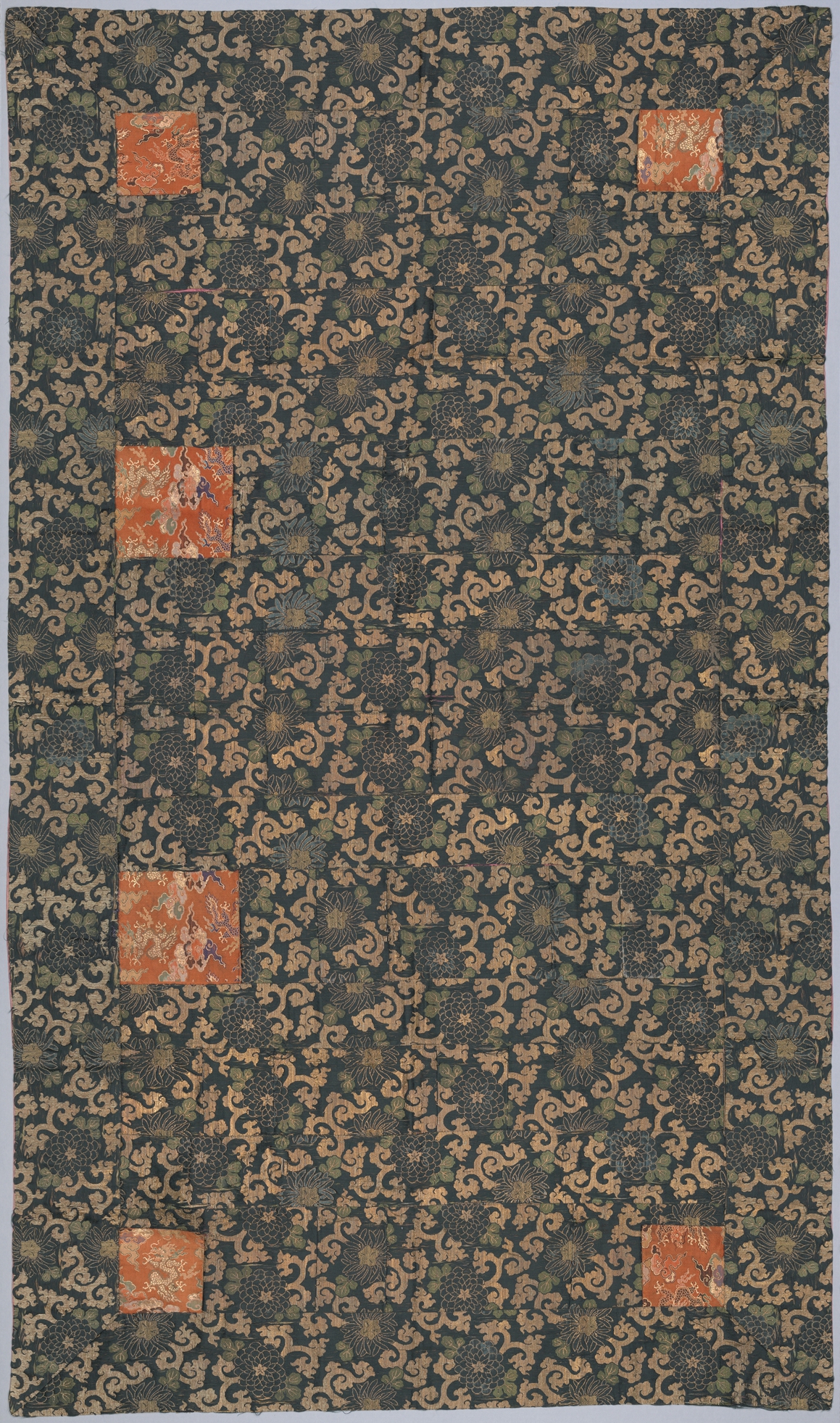
The Kesa Deconstructed: A Futuristic Silhouette Study for SS26
Introduction: The Sacred as a Blueprint for the Secular Future
The Kesa, a Buddhist priest’s robe of Japanese origin, is not merely a garment; it is a manifesto of spiritual geometry. Its traditional form—a rectangular patchwork of silk, often adorned with gold leaf on lacquered paper strips—represents a profound synthesis of material, ritual, and form. For Zoey Fashion Laboratory’s SS26 avant-garde collection, this sacred textile becomes a radical departure point. We are not replicating the Kesa; we are extracting its core structural DNA—its warp-float-faced 4/1 satin weave, its weft-float-faced 1/2 “z” twill interlacings, and its supplementary patterning wefts—to engineer a new language of futuristic silhouettes. This analysis dissects the Kesa’s architecture, reimagining it as a high-concept garment system that challenges conventional draping, weight distribution, and wearability in a post-humanist context.
Material Alchemy: From Ritual Relic to Structural Innovation
The Kesa’s materiality is a study in controlled opulence. The base of silk provides a fluid, almost liquid drape, while the gold leaf on lacquered paper strips introduces a rigid, reflective surface that catches light with every movement. The interlacing of warp-float-faced 4/1 satin weave with weft-float-faced 1/2 “z” twill interlacings creates a dualistic tension: the satin offers a smooth, unbroken plane, while the twill introduces a diagonal, structural ribbing. This is not decorative; it is a load-bearing system. For SS26, we propose a futuristic interpretation where these paper strips are replaced with laser-cut, anodized aluminum filaments embedded into a base of recycled liquid-crystal polymer. The gold leaf is substituted with iridescent graphene oxide, which shifts color under UV light—a nod to both traditional luminosity and cybernetic augmentation. The result is a material that is both sacred and synthetic, a bridge between ancient ritual and speculative fashion.
Silhouette Engineering: The Floating Patchwork System
The Kesa’s traditional form—a rectangular shawl with a central opening—is deconstructed into a modular, gravity-defying architecture. The key innovation lies in the warp-float-faced 4/1 satin weave, which creates a stiff, unidirectional surface. This allows us to engineer cantilevered panels that project outward from the body, mimicking the Kesa’s historical layering but with a futuristic, aerodynamic edge. The weft-float-faced 1/2 “z” twill interlacings act as structural seams, forming a hidden exoskeleton that redistributes weight from the shoulders to the hips. For SS26, we propose a silhouette that appears to float: the primary body is a semi-rigid, cocoon-like shell that hovers above the torso, supported by a lattice of supplementary patterning wefts that create a honeycomb-like internal structure. This is not a garment that clings; it is a garment that encloses space, creating a negative volume between the fabric and the skin. The gold leaf paper strips, now rendered as flexible, light-emitting diodes (LEDs) woven into the twill, trace the body’s contours in a luminous grid, referencing the Kesa’s sacred geometry while projecting a digital, post-human aura.
Structural Innovation: The Secondary Binding Warps as Kinetic Joints
One of the Kesa’s most overlooked elements is the secondary binding warps, which traditionally secure the patchwork pieces together. In our SS26 study, these warps are reimagined as kinetic joints—tension points that allow the garment to transform shape in response to movement. By integrating shape-memory alloys into these warps, the Kesa can shift from a flat, meditative state to a dynamic, sculptural form when activated by body heat. For example, the supplementary patterning wefts—which in the original Kesa create decorative motifs—are now programmed to contract and expand, creating a breathing, organic surface that mimics the rise and fall of respiration. This is a garment that responds to its wearer, blurring the line between clothing and living architecture. The 1/2 “z” twill interlacings are reinforced with carbon-fiber microfilaments, providing the tensile strength needed to support these dynamic shifts without compromising the silk-like drape. The result is a wearable kinetic sculpture that honors the Kesa’s meditative stillness while embracing the fluidity of motion.
Futuristic Silhouette: The Asymmetrical, Weightless Mantle
The final silhouette for SS26 is a deconstructed mantle that breaks free from the Kesa’s symmetrical origins. The warp-float-faced 4/1 satin weave is used to create a single, sweeping panel that cascades from the left shoulder, wrapping around the back and pooling at the right hip. This asymmetry is intentional: it creates a dynamic visual tension that echoes the Kesa’s historical layering but with a futuristic, angular precision. The weft-float-faced 1/2 “z” twill interlacings are concentrated at the garment’s edges, forming a rigid frame that holds the shape in place, even when the wearer is in motion. The gold leaf paper strips are replaced with thin, flexible photovoltaic cells that harvest ambient light, powering the LED lattice embedded in the twill. This is not just a garment; it is a wearable energy system, a nod to the Kesa’s role as a vessel for spiritual energy, now repurposed for a technologically driven future. The supplementary patterning wefts are used to create pockets of negative space—openings that allow the skin to breathe while maintaining the garment’s structural integrity. This creates a silhouette that is both armored and ethereal, a perfect synthesis of protection and vulnerability.
Conclusion: The Kesa as a Proto-Futuristic System
The Kesa is not a relic; it is a blueprint for avant-garde garment architecture. By deconstructing its traditional materials and weaves—the warp-float-faced 4/1 satin, the weft-float-faced 1/2 “z” twill interlacings, and the supplementary patterning wefts—we have uncovered a system of structural innovation that is inherently futuristic. For Zoey Fashion Laboratory’s SS26 collection, the Kesa becomes a wearable manifesto: a garment that challenges the boundaries between sacred and secular, static and kinetic, organic and synthetic. The asymmetrical, weightless mantle we propose is not a costume; it is a functional sculpture that redefines how we interact with space, light, and movement. As we move toward a future where fashion must be both sustainable and technologically integrated, the Kesa offers a profound lesson: the most radical innovations often lie hidden in the most ancient forms. This is not a revival; it is a reinvention—a sacred geometry for the post-human age.