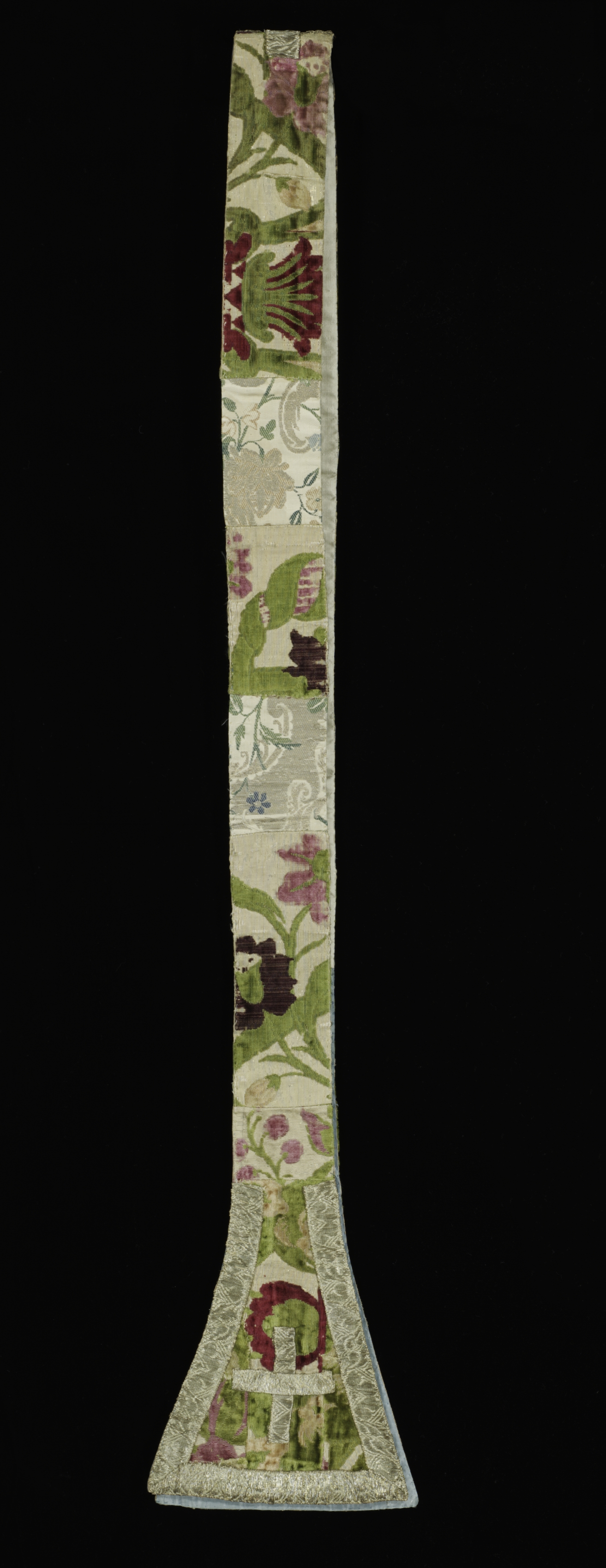
Deconstructing the Genoese Stole: A New Avant-Garde DNA Strand for Zoey Fashion Lab
As Chief Fabric Deconstructionist at Zoey Fashion Lab, my role is to dissect not merely the physical threads of a garment, but the narrative, the technique, and the latent potential embedded within its weave. The subject of this analysis—a stole originating from Genoa, Italy, constructed from a complex interplay of cut and uncut velvet, silk, and metal thread—presents a profound opportunity. This is not a simple accessory; it is a textile fossil, a snapshot of 16th-century opulence. However, for Zoey Fashion Lab, we must view it through a different lens: as a New DNA Strand. Our objective is to extract its genetic code of luxury and rigidity, and re-engineer it into an avant-garde statement that challenges the very definition of wearability and form.
I. The Historical Genome: Cut vs. Uncut Velvet and the Genoese Legacy
The stolen artifact’s technical foundation—a Genoese velvet—is a masterpiece of tension. To understand our avant-garde intervention, we must first honor its origin. Genoa, in its mercantile prime, was the undisputed master of velvet weaving, particularly the soprarizzo technique. This is where the critical distinction between cut and uncut velvet resides. Uncut velvet, or ciselé, features loops of pile that remain intact, creating a matte, granular texture that catches light softly. Cut velvet, or allucciolato, has these loops sheared open, producing a dense, plush, and intensely reflective surface. The interplay between these two—the raised, glowing pile against the recessed, looped ground—is a dialogue of light and shadow, of texture and void.
Adding the third element—metal thread, typically a gilt silver or gold wound around a silk core—elevates this dialogue to a symphony. This thread, often woven into the ground or used as a supplementary weft, introduces a rigid, reflective metallic line that fractures the softness of the velvet. The resulting fabric is a paradox: plush yet structured, soft yet metallic, sacred yet imperial. For our deconstruction, this paradox is the primary genetic marker. It represents a historical DNA strand that codes for opulence, status, and a specific, static form—a stole meant to drape with solemnity.
II. The Deconstruction Protocol: Extracting the Avant-Garde Code
To transform this historical stole into a New DNA Strand for Zoey Fashion Lab, we must perform a radical deconstruction. We are not interested in replication; we are interested in mutation. The avant-garde demands that we break the fabric’s original syntax—its structure, its weight, its intended silhouette—and reassemble it into something unrecognizable yet deeply resonant. Our protocol involves three key interventions:
1. Disruption of the Pile Hierarchy: The traditional velvet relies on a clear hierarchy: the cut pile dominates the visual field, while the uncut pile provides a subtle ground. We will invert this. Using laser-cutting and selective chemical dissolution (a technique we have refined in the Lab), we will remove the cut pile in specific, irregular patterns, exposing the uncut loops and the metal thread beneath. This creates a topographical map of decay, where the plush surface is eroded to reveal the rigid, metallic skeleton. The stole’s original softness becomes a memory, replaced by a harsh, architectural grid of exposed thread and loop.
2. Re-engineering the Drape: The stole’s traditional drape is linear and horizontal—it hangs from the shoulders. Our new DNA strand demands verticality and torsion. We will incorporate the metal thread not as a decorative element, but as a structural armature. By cutting the velvet into long, ribbon-like strips and re-weaving them with monofilament and additional metal wire, we create a textile exoskeleton. The resulting form is not a stole; it is a wearable sculpture that resists gravity. It can be twisted, tied, and locked into angular, geometric configurations, referencing both medieval armor and futuristic circuitry. The soft, plush velvet becomes a memory, a ghost texture clinging to the rigid metal structure.
3. The Uncut Loop as Biological Node: The uncut velvet loops, traditionally a background texture, will be amplified into three-dimensional, tactile nodes. Using a heat-setting process, we will permanently fix these loops into raised, almost organic protrusions. They will no longer be flat; they will become sensory receptors on the fabric’s surface. When combined with the metal thread, these loops resemble the nodes of a neural network or the base pairs of a DNA helix. This is the core of our New DNA Strand concept: the stole is no longer a finished garment, but a living, mutable system of texture and structure, capable of being reprogrammed by the wearer.
III. The Avant-Garde Manifestation: From Stole to System
The final piece for Zoey Fashion Lab is not a stole in the traditional sense. It is a deconstructed textile system. Imagine a garment that begins as a dense, plush stole but, through the interventions described, transforms into a series of articulated panels, connected by exposed metal thread and raised uncut loops. The wearer can manipulate these panels—locking them together via magnetic clasps hidden within the loops, or allowing them to cascade asymmetrically. The metal thread, now exposed and oxidized, creates a patina of age and industrial decay.
This is the avant-garde DNA we have extracted: a code that codes for malleability over stasis, structure over softness, and process over product. The original Genoese stole was a symbol of fixed wealth. Our new creation is a symbol of dynamic potential. It is a garment that questions the line between fabric and architecture, between ornament and armature. The cut and uncut velvet no longer speak of Renaissance luxury; they speak of a future where textiles are intelligent, responsive, and self-constructing.
For Zoey Fashion Lab, this analysis is not an end, but a beginning. The New DNA Strand we have isolated from this Genoese stole will be the foundational code for an entire collection. We will continue to mutate this code, applying it to other historical textiles, extracting their genetic potential, and re-engineering them into the avant-garde. The stole is dead. Long live the system.