Deconstructing the Solidus: An Avant-Garde Analysis for Zoey Fashion Lab
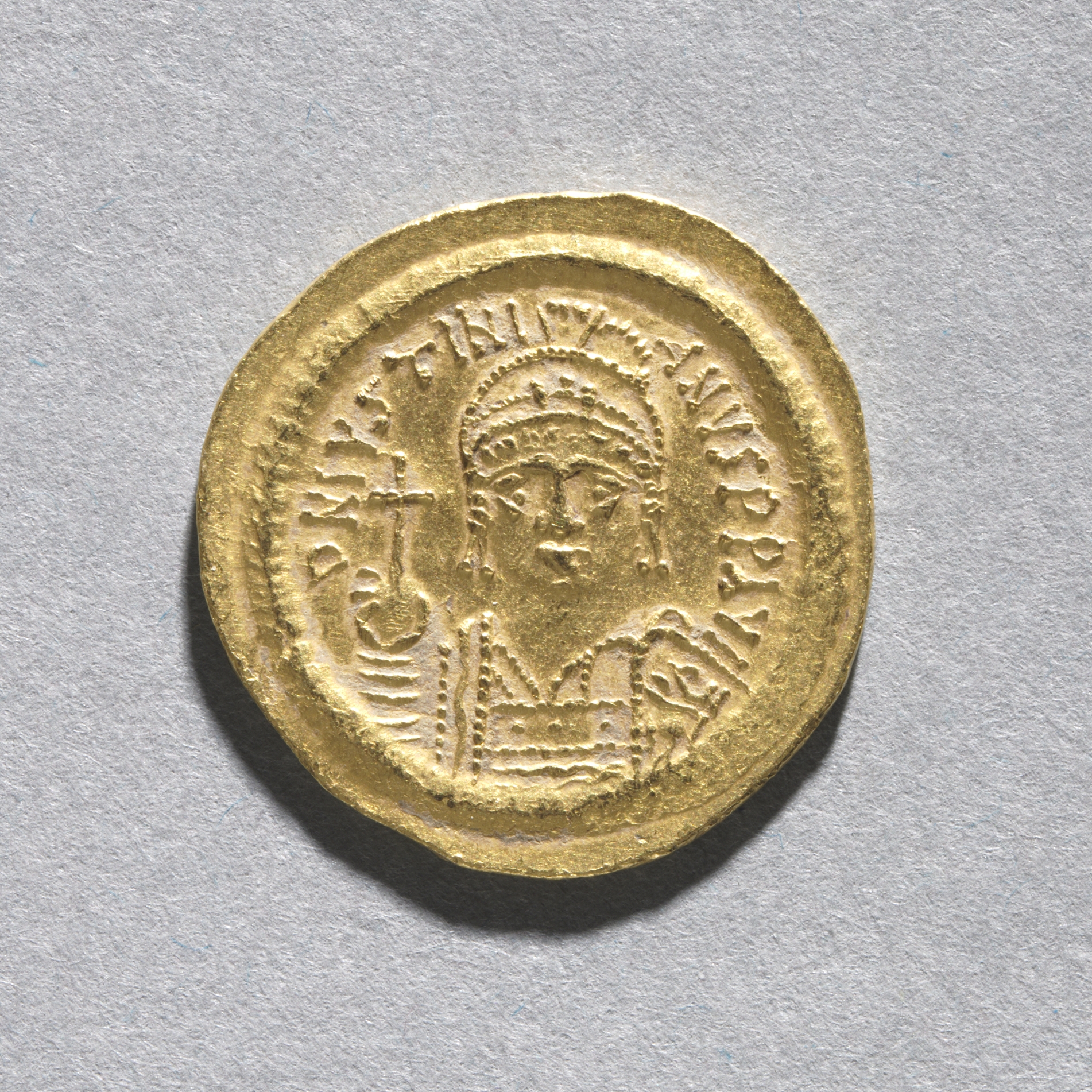
At Zoey Fashion Lab, our mandate is not merely to observe artifacts but to deconstruct their material, symbolic, and temporal resonances into wearable narratives. The Solidus of Justinian I (obverse), a gold coin from Byzantine Constantinople, presents a paradox of immense value. It is simultaneously a tool of imperial propaganda, a unit of economic stability, and a frozen portrait of divine authority. For an avant-garde collection, this solidus is not a relic to be reproduced; it is a provocation—a challenge to reimagine weight, surface, and the very concept of sovereign power in textile form.
1. The Material Paradox: Gold as a Subversive Medium
The solidus is pure gold, a metal historically synonymous with permanence, divinity, and untouchable wealth. In the context of fashion, gold has often been relegated to ornamentation—embroidery, gilding, or accessories. Our avant-garde approach demands a subversion of this material hierarchy. We must ask: What does it mean to wear gold not as a symbol of opulence, but as a fabric of resistance?
The obverse of the solidus presents a meticulously struck profile of Justinian I, his visage framed by a pearl diadem and a cuirass. The metal’s luster is not merely decorative; it is a political statement. For Zoey Fashion Lab, we translate this into a textile that mimics the solidus’s dual nature: the cold, reflective surface of the coin and the warm, malleable essence of the metal. We propose a metallic jacquard weave that captures the coin’s crisp relief through a process of laser-etched layering. The fabric would be heavy, almost sculptural, with a front side that glints with a polished, mirror-like finish—echoing the “光洁银镜” (polished silver mirror) from the Archive Resonance. Yet, the reverse side would be a matte, textured gold, reminiscent of the “冰冷石棺板” (cold stone coffin slab), where the narrative of power is inscribed in relief. This duality allows the garment to shift between a hard, armored exterior and a soft, narrative interior, reflecting the solidus’s own dual role as currency and icon.
2. The Portrait as Pattern: Deconstructing Imperial Authority
The obverse of the solidus is a portrait of Justinian I, but it is not a realistic likeness. It is a stylized representation of authority: the stern profile, the large eyes, the imperial regalia. In avant-garde fashion, the human face is often abstracted or fragmented. Here, we deconstruct the portrait into a repeating pattern of geometric and organic motifs.
The pearl diadem becomes a border of circular beads, repeated across a sheer, metallic organza. The cuirass, with its intricate musculature, is transformed into a series of overlapping, armor-like panels that can be detached and reattached, allowing the wearer to modulate their own “imperial” presence. The profile itself is reduced to a negative space—a cutout that reveals the skin or an underlying layer of contrasting fabric. This act of removal is a commentary on the fragility of power. The solidus was meant to be eternal, but its portrait is now a ghost, a trace of a vanished empire. Our garments would feature laser-cut silhouettes of Justinian’s profile, repeated in a grid, creating a visual rhythm that oscillates between presence and absence.
3. The Weight of History: Tactile and Structural Translation
A solidus is not just a visual object; it is a tactile experience. Its weight, its edge, its slight curvature from being struck, all contribute to its identity. For Zoey Fashion Lab, we translate this into structural garment design. The coin’s weight suggests a heaviness that is not oppressive but grounding. We envision a coat or a cape constructed from multiple layers of gold-lamé and bonded felt, creating a piece that drapes with a deliberate, almost gravitational pull. The seams would be exposed and reinforced with gold stitching, mimicking the coin’s edge—the “flan” that bears the marks of the die.
The Archive Resonance mentions “纷繁棕叶纹” (intricate palm leaf patterns) on the mirror side. While this is from the mirror’s reverse, we can integrate this organic, vegetal motif into the solidus-inspired garment as a counterpoint to the rigid imperial portrait. Palm leaves, in Byzantine iconography, symbolized victory and eternity. We would embroider these leaves in a raised, almost three-dimensional technique using gold thread and metallic beads, creating a texture that invites touch. This tactile richness contrasts with the smooth, reflective gold of the obverse, creating a dialogue between the hard and the soft, the geometric and the organic.
4. The Archive Resonance: Mirror and Coffin
The provided Archive Resonance—“一面是光洁银镜上以黄金镶嵌的纷繁棕叶纹,另一面是冰冷石棺板上以浮雕诉说的生命叙事”—offers a profound conceptual framework. The solidus is the “gold inlaid on a polished silver mirror,” a surface of reflection and self-aggrandizement. But it is also the “cold stone coffin slab,” a reminder of mortality and the transient nature of earthly power. Our avant-garde collection must embody this binary.
We propose a two-sided garment: the exterior, a polished gold surface with the deconstructed portrait pattern, representing the mirror—the imperial self-image. The interior, a dark, matte fabric with raised, relief-like embroidery of the palm leaves and abstracted imperial symbols, representing the coffin—the hidden narrative of life and death. This interior is only revealed when the garment is turned inside out or when the wearer moves, exposing the lining. This act of revelation becomes a performance, a commentary on the duality of public persona and private truth.
5. The Avant-Garde Silhouette: Armor and Fluidity
The final element is the silhouette. The solidus is a rigid, circular object. In fashion, this translates to structured, architectural forms. We propose a corseted bodice with sharp, angular shoulders, reminiscent of Byzantine armor, but constructed from flexible, gold-metallic mesh. The skirt or trousers would be fluid and asymmetrical, perhaps with a train that trails like a liquid metal spill, echoing the molten state of gold before it is struck. This juxtaposition of hard and soft, rigid and fluid, captures the essence of the solidus: a frozen moment of power, yet a substance that was once molten and malleable.
In conclusion, the Solidus of Justinian I is not a historical artifact to be copied; it is a blueprint for deconstruction. By translating its material, symbolic, and tactile qualities into avant-garde fashion, Zoey Fashion Lab creates garments that are wearable critiques of power, permanence, and identity. The gold is not for adornment; it is for interrogation. The portrait is not for recognition; it is for erasure. The weight is not for burden; it is for grounding. This is the Zoey Fashion Lab method: to resonate with the archive, not by echoing its surface, but by reimagining its core.