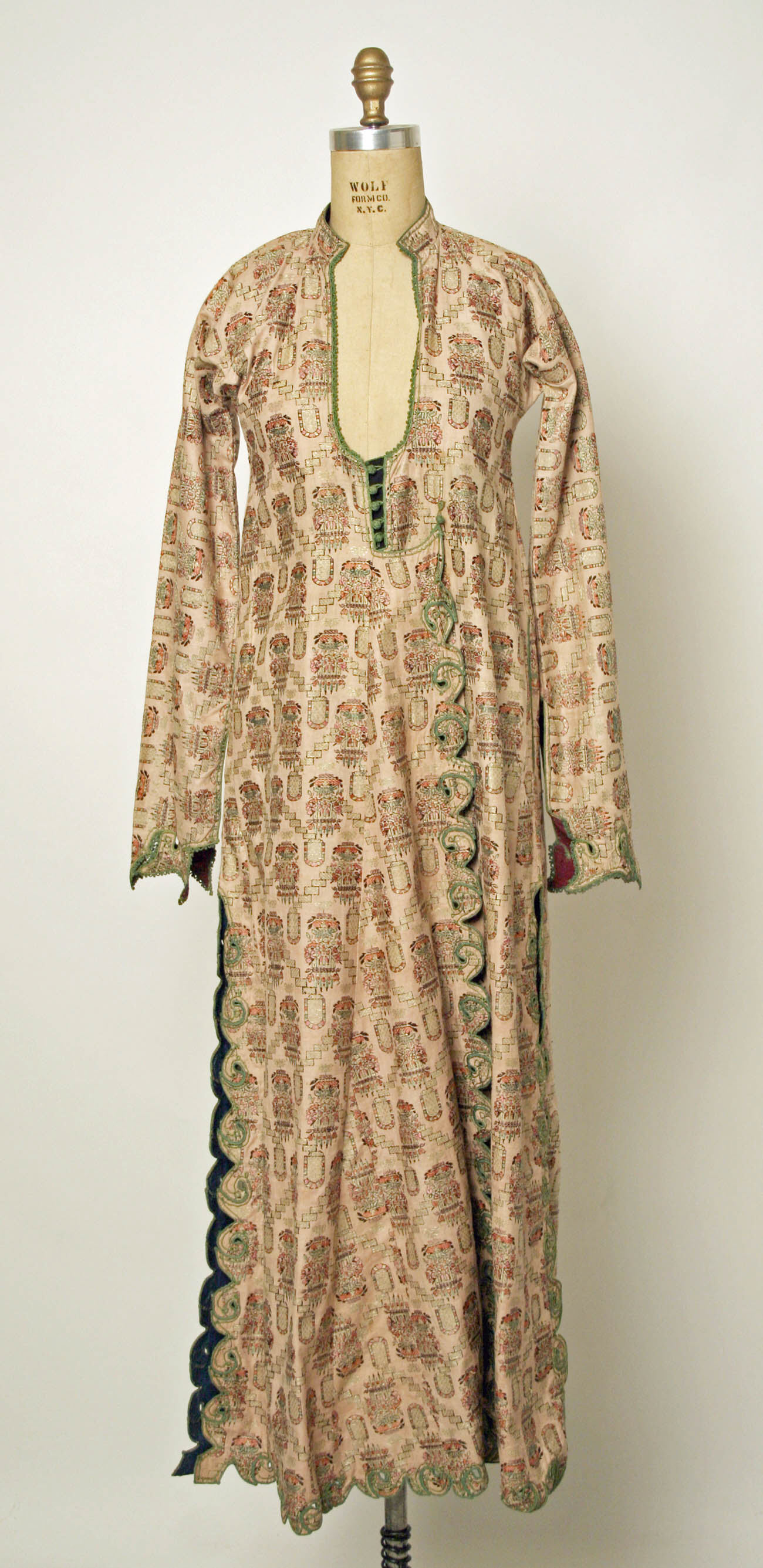
Deconstructing the Global Frontier: Uçetek Entari as a Structural Manifesto for SS26
The contemporary fashion landscape, perpetually oscillating between nostalgia and novelty, finds its most compelling expression at the intersection of heritage and hyper-modernity. Zoey Fashion Laboratory’s analysis of the Uçetek Entari—a garment originating from the Global Frontier—presents a definitive case study in avant-garde couture for the Spring/Summer 2026 season. This is not a mere garment; it is an architectural proposition. Constructed from the dialectical triad of cotton, silk, and metal-wrapped thread, the Uçetek Entari transcends its traditional folkloric roots to become a manifesto for futuristic silhouettes and radical structural innovation. Our examination will deconstruct its material logic, spatial configuration, and kinetic potential, positioning it as a pivotal piece in the laboratory’s pursuit of a new sartorial vernacular.
I. Material Dialectics: The Alchemy of Cotton, Silk, and Metal
The chosen materials are not arbitrary; they are a deliberate orchestration of opposing forces. Cotton, the humble workhorse of global textiles, provides the foundational mass and grounding. Its porous, matte surface absorbs light, creating a visual anchor. In contrast, silk introduces a fluid, luminous counterpoint—a whisper of opulence that moves with the body’s breath. Yet, the true transformative agent is the metal-wrapped thread. This is not decorative embellishment; it is structural reinforcement. By weaving metallic filaments into the cotton-silk matrix, the fabric acquires a new property: controlled rigidity. The thread acts as a micro-architecture, allowing the garment to hold engineered folds, cantilevered drapes, and sharp, angular breaks that defy gravity. For SS26, this material dialectic enables a silhouette that is simultaneously soft and armored, organic and synthetic. The cotton breathes, the silk flows, and the metal defines—a trinity of function, sensuality, and futurism.
II. Silhouette as Territory: The Uçetek Entari’s Spatial Grammar
The Uçetek Entari’s traditional form—a long, open-front coat with side slits—is reimagined through a lens of negative space and volumetric expansion. Our avant-garde analysis focuses on the garment’s ability to define territory around the body. The futuristic silhouette emerges from a radical reinterpretation of the side slits. Instead of passive openings, they become active seams of release. The metal-wrapped thread is concentrated along these seams, allowing the fabric to flare outward in a controlled, geometric arc. The result is a silhouette that oscillates between a cocoon-like enclosure and a wing-like expansion. The shoulders are sharpened, not by padding, but by a cantilevered structure born from the cotton-silk composite. The hemline, traditionally linear, is fractured into a series of asymmetrical, laser-cut panels that create a sense of perpetual motion. This is not a garment that merely covers; it generates space, transforming the wearer into a living sculpture. The silhouette is a dialogue between the body’s core and the garment’s periphery, a study in controlled chaos.
III. Structural Innovation: The Architectonics of Drape and Tension
The true innovation of the Uçetek Entari lies in its tension-based structural system. Traditional couture relies on seams, darts, and boning to create form. Our laboratory proposes a new paradigm: dynamic tensioning. The metal-wrapped thread is woven into a latticework pattern across the back and shoulders, functioning like a tensile cable system. When the garment is worn, the wearer’s movement activates these threads, pulling the fabric into predetermined folds and creases. This creates a living, responsive architecture. The cotton provides the compressive strength; the silk offers the tensile flexibility; the metal thread provides the memory. The garment can be programmed to hold a specific silhouette—a sharp, angular shoulder, a cascading waterfall of fabric—through the strategic placement of these metallic fibers. For SS26, this means the Uçetek Entari is not static. It can be adjusted, folded, and reconfigured by the wearer, offering a modular approach to couture. The structural innovation is not in the construction but in the relationship between material and motion.
IV. The Global Frontier: A Narrative of Displacement and Reconstruction
The Uçetek Entari’s origin from the Global Frontier—a concept that dissolves geographic boundaries—is central to its avant-garde identity. This garment is a palimpsest, overwriting traditional cultural codes with a futuristic, non-linear narrative. The cotton and silk reference ancient trade routes; the metal thread evokes industrial networks. The result is a garment that belongs to no single place or time. It is a nomadic architecture, designed for a world of constant flux. The traditional entari was a garment of modesty and layering; our version is one of exposure and concealment, a game of reveals. The side slits, now engineered with metallic thread, open and close with the body’s rhythm, offering glimpses of the skin beneath. This is a deliberate strategy of disruption. The garment challenges the viewer to question origin, ownership, and the very definition of “traditional.” It is a statement on cultural hybridity, where the past is not preserved but reassembled into a new, speculative future.
V. Kinetic Potential: The Garment as Performance
Finally, the Uçetek Entari must be understood as a kinetic artifact. For SS26, the laboratory prioritizes garments that are not merely worn but performed. The metal-wrapped thread creates a subtle, audible rustle—a sonic signature. The cotton-silk composite catches the light differently with each movement, creating a shifting visual texture. The silhouette, with its engineered flares and cantilevered panels, is designed to be activated by motion. The garment is incomplete without the wearer’s kinetic input. This aligns with our vision of avant-garde couture as a collaboration between designer, material, and body. The Uçetek Entari is not a static object for display; it is a tool for transformation. It empowers the wearer to sculpt space, to command attention, to become a protagonist in a narrative of their own making. This is the definitive avant-garde study: a garment that is both a product of its materials and a generator of new possibilities.
In conclusion, the Uçetek Entari from the Global Frontier represents a quantum leap in structural innovation for SS26. Through the alchemical combination of cotton, silk, and metal-wrapped thread, it achieves a silhouette that is simultaneously futuristic and grounded. It is a testament to the power of deconstructive aesthetics and high-concept garment architecture. Zoey Fashion Laboratory presents this analysis not as a final statement, but as an invitation—a call to reimagine the boundaries of couture, one thread at a time.