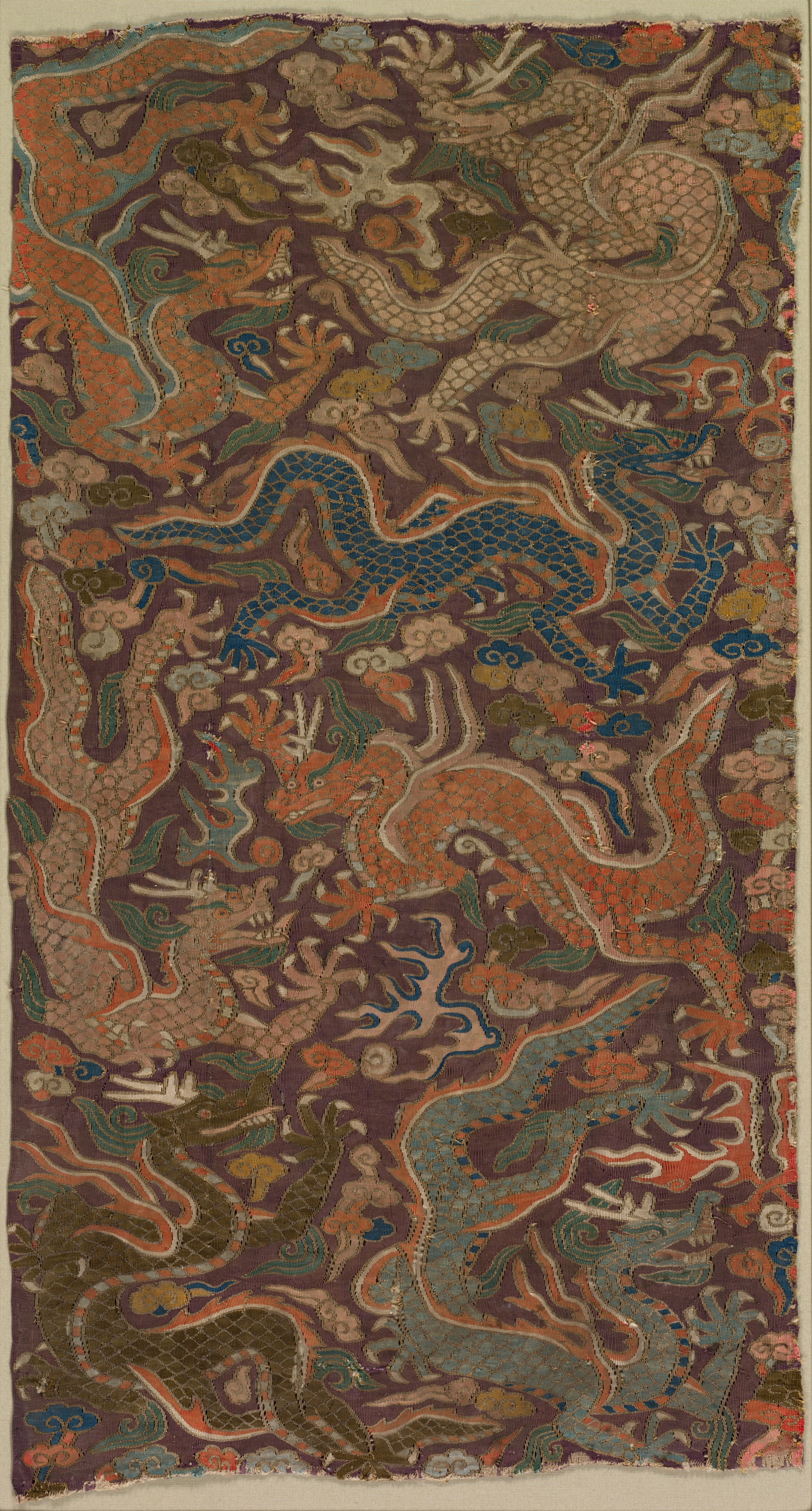
Deconstructing the Divine Chase: Dragons, Pearls, and the Avant-Garde Lens
At Zoey Fashion Lab, our practice of Fabric Deconstruction is not merely about taking things apart; it is an archaeological excavation of meaning. We unearth the narratives woven into historical textiles and reassemble them within the crucible of contemporary avant-garde fashion. The subject before us—a Central Chinese tapestry from the 16th-17th century, executed in silk and gold thread, depicting Dragons Chasing Flaming Pearls—presents a profound challenge and an extraordinary opportunity. This is not a relic; it is a living document of cosmic ambition, material power, and aesthetic tension. Our analysis will dissect its technical, symbolic, and historical layers to extract a blueprint for a future-facing, disruptive collection.
Technical Mastery: Silk, Gold, and the Logic of the Loom
The tapestry’s construction is a feat of extreme precision. Silk, a filament of unparalleled luster and tensile strength, provides the ground. Gold thread, typically a gilded paper or membrane wrapped around a silk core, introduces a rigid, metallic element. This is not a passive background; it is a deliberate dialogue between fluidity and structure. The weaver had to manage these contrasting materials on a vertical loom, where every weft shot (the horizontal thread) is a decision. The kilim-style slit tapestry weave used in Central China creates sharp, geometric color blocks, but the silk’s natural drape and the gold’s reflective surface introduce an optical illusion of movement.
For the avant-garde, this technical tension is a primary design vector. The deconstructionist eye sees not a finished image, but a process. The warp threads (the vertical foundation) can be read as the skeletal structure of a garment—the spine, the ribcage. The weft (the silk and gold) is the flesh, the skin. Our analysis proposes a de-coupling of this weave. Imagine a garment where the warp is exposed as a structural cage, while the weft is fragmented into floating, embroidered panels. The gold thread, too, should not remain pristine. We can oxidize it, fray it, or weave it into a non-linear, chaotic pattern that disrupts the original, orderly chase. The silk, historically a symbol of smooth, unblemished luxury, can be slashed, burned, or chemically treated to introduce a post-industrial texture—a scarred, beautiful surface that speaks of time and conflict, not static perfection.
Symbolic Resonance: The Dragon, the Pearl, and the Eternal Chase
The iconography is potent and layered. The Dragon, a composite beast of power, is not a monster of Western lore but a cosmic force—a regulator of rivers, rain, and celestial energy. The Flaming Pearl is the orb of enlightenment, the moon, the sun, or the philosopher’s stone—an object of ultimate desire and spiritual attainment. The chase itself is the eternal cycle of life, the quest for wisdom, and the dynamic balance of yin and yang. The dragons do not capture the pearl; they pursue it. The tension is the point.
From an avant-garde perspective, this is a perfect metaphor for unfulfilled desire and the deconstruction of power. The dragon, a symbol of imperial authority, is locked in a perpetual, unending pursuit. This is not a triumph; it is a state of being. Our deconstruction will invert this hierarchy. The pearl will no longer be a passive, floating object. It will become the central, active element of the garment—perhaps a rigid, mirrored orb embedded in a corset, or a series of glowing, fragmented pearls that seem to escape the dragon’s grasp. The dragon itself will be decomposed. Its scales, claws, and whiskers will be abstracted into geometric, angular appliqués that appear to be in a state of decay or transformation. The chase becomes a frozen, violent moment captured in textile.
Archive Resonance: The 16th-17th Century as a Threshold
The reference to the 16th-17th century is critical. This was a period of intense cultural collision in Central China. The Ming dynasty was in decline, and the Qing was rising. Trade routes brought European influences, while internal philosophical shifts (Neo-Confucianism, Daoism, and Buddhist syncretism) were in flux. The tapestry, therefore, is not a pure, static artifact. It is a hybrid object—a product of a world in transition. The silk and gold speak of imperial wealth, but the subject matter (a cosmic chase) hints at a deeper, more anxious spirituality. The Archive Resonance text reminds us that objects and paintings are "silent witnesses" of cultural collision. This tapestry is a witness to anxiety, ambition, and the search for meaning in a changing world.
Our avant-garde collection must channel this threshold energy. We are not recreating the 17th century; we are using its fractured, hybrid nature as a model for our own times. The garments should feel like they are caught between two eras—part ancient ritual robe, part cybernetic exoskeleton. The silhouette can be exaggerated and asymmetrical, drawing from the dragon’s serpentine form but twisting it into a modern, architectural shape. The color palette should be decomposed: the deep imperial reds and golds of the original must be broken down with muted, industrial tones—ash grey, oxidized copper, deep indigo stained with rust. The gold thread should be used not for opulence, but for strategic, disruptive accents—a single, frayed gold line tracing a dragon’s spine, or a cluster of gold filaments that seem to be burning out, like embers.
Avant-Garde Synthesis: The Garment as a Deconstructed Tapestry
How do we translate this analysis into a physical garment? The core concept is the fragmented chase. The garment will not depict a full dragon or a perfect pearl. Instead, it will be a three-dimensional deconstruction of the tapestry’s logic.
Structure: The base of the garment is a skeletal, warp-like framework made of blackened, stiffened silk organza. This is the loom. Onto this, we attach floating panels of hand-woven silk and gold, but these panels are cut, slashed, and re-stitched in a non-linear pattern. They do not follow the original composition; they explode it. A dragon’s claw might be isolated on a shoulder, while a fragment of the pearl’s flame appears on a trailing hem.
Surface Treatment: The gold thread is oxidized to a dull, greenish-black in some areas, while in others it is left bright and reflective. The silk is burned with a laser to create a pattern of scales that are not painted but scorched into the fabric. This introduces a sense of violence and transformation. The pearl is represented by a single, large, iridescent resin orb that is partially embedded in the fabric, as if it is emerging from or being swallowed by the garment. It is not static; it is mounted on a subtle, hidden mechanism that allows it to tilt and catch the light, simulating the eternal, restless chase.
Silhouette: The overall shape is asymmetrical and elongated, reminiscent of a dragon’s winding body. One sleeve is long and sinuous, the other is cropped and angular. The hem is uneven, with trailing threads that mimic the frayed edge of a tapestry. The garment is designed to be worn as a second skin—a piece of armor that is also a confession of vulnerability. It is a monument to the chase, not its resolution.
In conclusion, this tapestry is not a static image of power and desire. It is a dynamic, unresolved equation. By deconstructing its materials, inverting its symbols, and channeling its historical anxiety, Zoey Fashion Lab can forge a garment that is both a tribute to Central Chinese artistry and a radical, avant-garde statement for the future. The dragons still chase the pearls, but now they do so on a field of shredded silk and oxidized gold, caught in an eternal, beautiful, and terrifying moment of becoming.