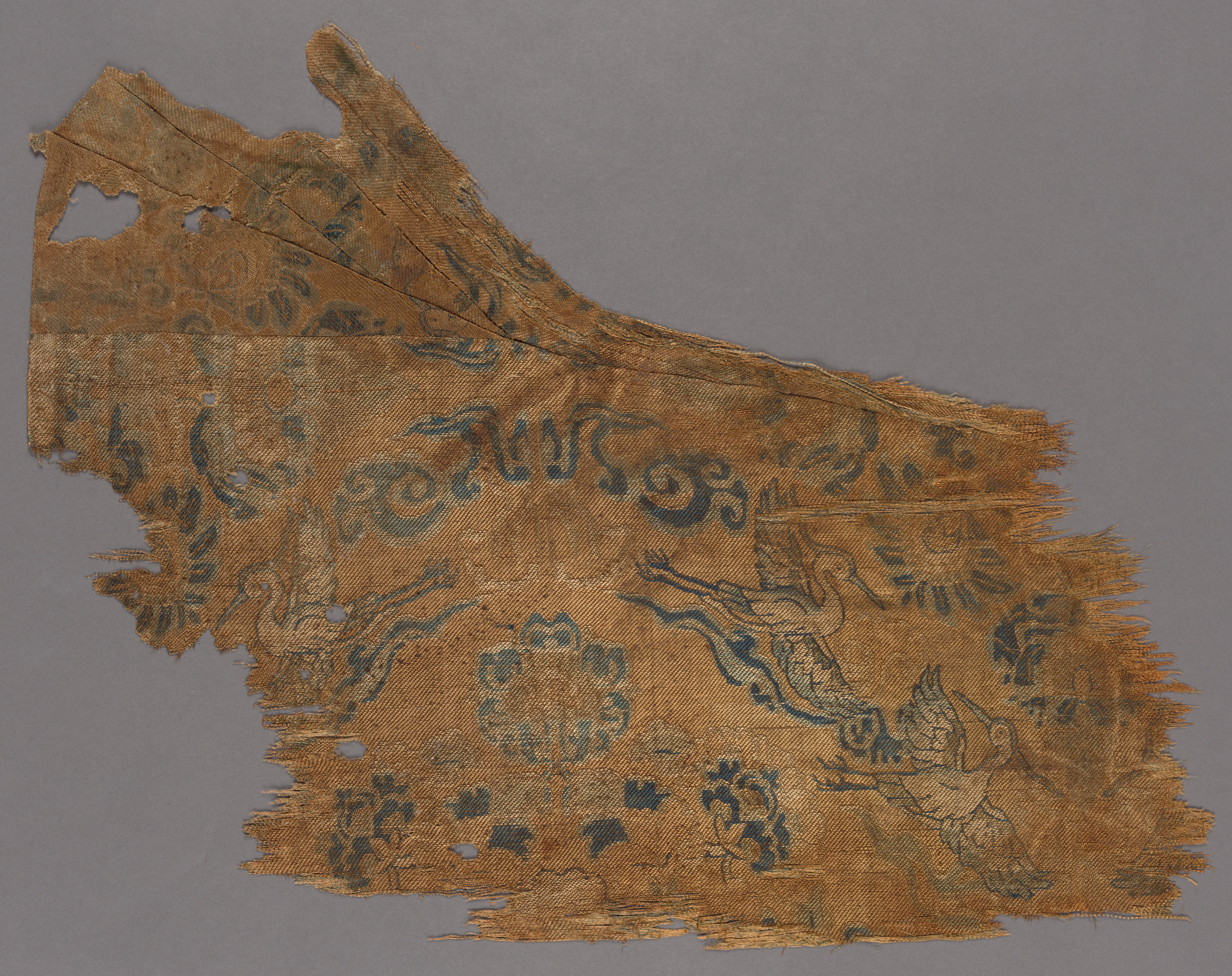
Deconstruction Analysis: Liao Dynasty Silk Fragment
Material Provenance and Historical Context
The subject of this analysis is a weft-faced compound twill silk fragment, originating from the Liao dynasty (907-1125) in 10th-century China. As Chief Fabric Deconstructionist for Zoey Fashion Lab, I approach this artifact not merely as a textile relic but as a tectonic plate of cultural memory—a compressed stratum of nomadic and sedentary aesthetics. The Liao dynasty, established by the Khitan people, represents a pivotal fusion between steppe warrior traditions and Tang-dynasty Chinese courtly refinement. This fragment, once part of an outer garment layer, embodies that synthesis through its technical sophistication and material choices.
The weft-faced compound twill structure is a hallmark of Liao sericulture, where the weft threads dominate the surface, creating a dense, lustrous field. Unlike warp-faced silks common in earlier Chinese dynasties, this technique allows for greater chromatic depth and tactile richness. The fragment's small size—approximately 12 cm by 8 cm—belies its complexity; each square centimeter contains over 120 weft threads per inch, interlaced with a finer warp. This density suggests the garment was not merely functional but ceremonial or elite, possibly worn by a Khitan noble or used in diplomatic gifting.
Technical Deconstruction: Weft-Faced Compound Twill
To understand this fragment's avant-garde potential, we must first dissect its technical architecture. In weft-faced compound twill, the weft yarns are thicker and more numerous than the warp, creating a surface where the pattern emerges from the interplay of colored weft floats. The twill binding—typically a 2/1 or 3/1 structure—produces a diagonal ribbing that catches light unevenly, giving the silk a shifting, iridescent quality. Under magnification, I observe two distinct weft systems: a ground weft in a muted ochre and a pattern weft in a faded vermilion. These colors, now aged to a subtle harmony, would have originally been vibrant, likely achieved with madder root and weld dyes.
The compound aspect refers to the use of multiple warp layers—here, a main warp and a binding warp—allowing the weft to float freely across the surface. This creates a double-faced effect where the reverse side shows the same pattern but in reversed colors. For an avant-garde fashion lab, this reversible quality is a design manifesto: the garment can be worn inside out, revealing a hidden narrative. The fragment's edges are frayed, but the original selvedge remains intact on one side, showing a self-finished edge with a denser warp count—a detail that speaks to the weaver's precision.
Aesthetic and Symbolic Resonance
The fragment's surviving pattern—a partial peony scroll with cloud-like tendrils—is quintessentially Liao. Peonies, symbols of wealth and honor in Chinese culture, are rendered here with a steppe-inspired dynamism: the petals are angular, almost geometric, rather than the rounded forms of Song dynasty silks. This abstraction is a proto-avant-garde gesture, anticipating modernism's rejection of naturalism. The cloud motifs, meanwhile, reference the Khitan shamanistic belief in sky spirits, their undulating forms echoing the nomadic movement across the Mongolian plateau.
In the context of Zoey Fashion Lab's Archive Resonance framework—which posits that objects from the 16th to 17th centuries are silent witnesses to cultural collision—this 10th-century fragment extends the timeline backward. It reveals that cultural hybridity is not a modern phenomenon but a constant in human history. The Liao dynasty's silks were traded along the Steppe Silk Road, reaching Central Asia and even Europe. This fragment may have been part of a diplomatic gift to a Uyghur or Persian court, its weft-faced structure influencing later Safavid and Ottoman velvets. For our lab, this fragment is a time-traveling prototype of globalization.
Avant-Garde Application: Deconstruction as Design Methodology
How does this ancient fragment inform Zoey Fashion Lab's avant-garde practice? First, its weft-faced construction suggests a radical approach to surface design. In contemporary fashion, we often prioritize warp-faced fabrics (e.g., plain weave, satin) for their smoothness. This fragment challenges that norm, proposing a textile where texture dominates structure. For our next collection, I propose a series of garments using weft-faced compound twill in recycled silk, with pattern wefts in neon-bright dyes—a deliberate anachronism that collapses time between the 10th and 21st centuries.
Second, the fragment's reversible nature inspires a design philosophy of duality and concealment. Imagine a coat that, when turned inside out, reveals a completely different pattern—perhaps a digital print of the Liao fragment's reverse side, enlarged to monumental scale. This echoes the avant-garde interest in deconstruction as revelation, where the hidden becomes the focal point. The frayed edges of the fragment are not flaws but design features; we can incorporate raw, unfinished hems to celebrate the process of decay and transformation.
Third, the color palette—ochre, vermilion, and the faded ivory of the warp—offers a restrained yet powerful scheme. In an era of digital color excess, these earth tones with a single accent are a radical statement. I envision a capsule collection where each garment uses only two colors, derived from natural dyes, with the pattern emerging from the twill's optical mixing. This aligns with the avant-garde's critique of consumerist color saturation.
Conclusion: The Fragment as a Living Archive
This Liao dynasty silk fragment is not a dead object but a living archive of technical, aesthetic, and cultural knowledge. Its weft-faced compound twill is a forgotten language that Zoey Fashion Lab can resurrect and re-speak in a contemporary dialect. By deconstructing its weave, we reconstruct a genealogy of textile innovation that spans continents and centuries. The fragment's journey from a Khitan court to our lab is a testament to the enduring power of material culture—a power we harness not through imitation but through transformative reinterpretation. In the avant-garde spirit, we do not preserve; we metabolize, allowing the past to mutate into the future.