Deconstructing the Spectral Silhouette: The Comtesse de La Tour-Maubourg as a Blueprint for SS26
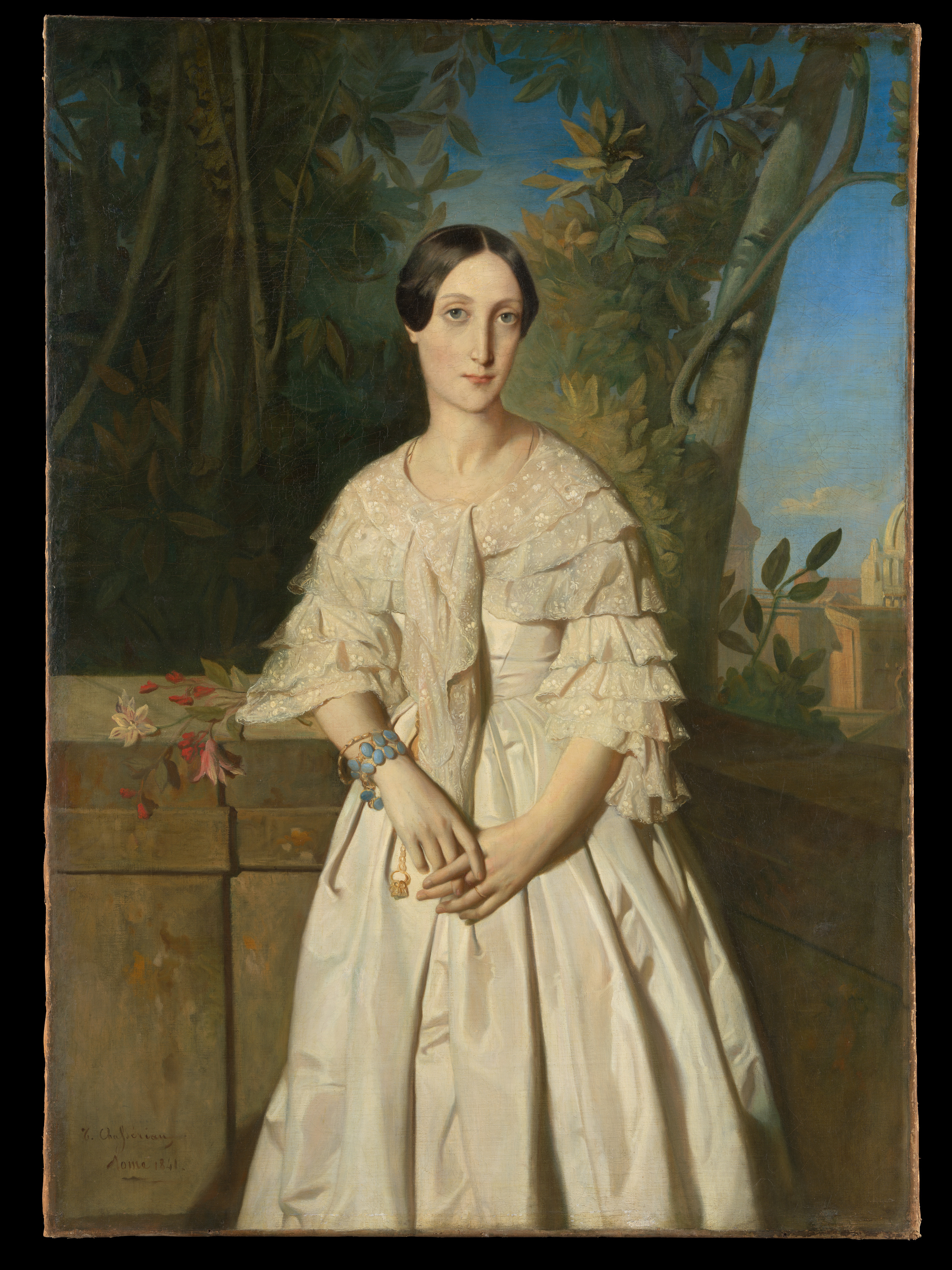
The annals of fashion history are replete with figures whose static portraiture belies a dynamic, almost prophetic, sartorial energy. Among them, the Comtesse de La Tour-Maubourg (Marie-Louise-Charlotte-Gabrielle Thomas de Pange, 1816–1850), captured in oil on canvas, emerges not merely as a subject of 19th-century romanticism, but as a radical, unacknowledged precursor to the deconstructive aesthetics of the 21st century. For Zoey Fashion Laboratory's SS26 collection, this portrait is not a historical reference; it is a material manifesto. We will extract the Comtesse’s spectral presence—her rigid posture, her melancholic gaze, and the architectural tension of her era—and transmute it into a series of futuristic silhouettes that challenge the very notion of garment construction. This is not a revival; it is a structural exhumation.
The Architecture of Absence: Reinterpreting the Canvas as a Pattern
The Comtesse’s portrait is defined by its negative space. The deep, almost abyssal black of her gown absorbs light, creating a void that paradoxically defines her form. For SS26, we invert this principle. Our starting point is the “Absence Silhouette”—a garment that exists as a series of suspended, oil-black panels that never fully connect. The canvas’s texture, with its subtle cracks and impasto, is translated into a laser-cut, bio-resin composite that mimics the aged, brittle surface of paint. The dress is not worn; it is inhabited. The wearer’s body becomes the missing piece, the living pigment that completes the composition. The structural innovation lies in the magnetic seam system, allowing the panels to be reconfigured in real-time, echoing the mutable nature of painted light. This is a garment that is perpetually in a state of becoming, a direct challenge to the static nature of the original portrait.
Futuristic Silhouettes: The Rigidity of Gaze, the Fluidity of Form
The Comtesse’s pose—a slight turn of the head, a hand resting on a balustrade—suggests a tension between rigidity and flow. We capture this dichotomy in two distinct silhouette archetypes for SS26.
1. The “Balustrade Frame”: This is a shoulder-less, architectural cage constructed from a lightweight, carbon-fiber lattice. It mimics the balustrade in the portrait, but is worn as an exoskeleton. The lattice is asymmetrically draped with a single, continuous piece of liquid-silver silk, anchored at the left hip and cascading to the floor. The effect is one of controlled chaos—the rigid structure of the frame contrasts with the fluid, almost gelatinous drape. The seam where the silk meets the lattice is raw, unfinished, deliberately frayed, echoing the cracked canvas. This is not a dress; it is a wearable sculpture of constraint and release.
2. The “Melancholy Gaze” Silhouette: Inspired by the Comtesse’s direct, unsettling stare, this silhouette is about optical illusion and distortion. We use a holographic micro-pleated organza that shifts from deep charcoal to a spectral violet as the wearer moves. The garment is a single, voluminous column that is deconstructed at the spine. The back is completely open, revealing a complex harness system of elasticated, phosphorescent cords that hold the front of the dress in place. The effect is of a ghostly, two-dimensional presence that becomes three-dimensional only when in motion. The collar is exaggerated into a high, semi-transparent ruff that obscures the lower face, forcing the viewer to engage only with the eyes. This is a direct homage to the portrait’s psychological depth, translated into a garment that withholds as much as it reveals.
Material Alchemy: From Oil to Air
The material innovation for SS26 is rooted in the alchemy of the painting’s medium. The oil on canvas is not just a surface; it is a chemical reaction of pigments, linseed oil, and time. We replicate this process through a new textile we call “Petrified Silk.” This is a traditional silk that is then treated with a bio-ceramic resin, which hardens into a semi-rigid, matte finish. The resin is applied in uneven, brushstroke-like layers, creating a surface that resembles the crust of old paint. The result is a fabric that is simultaneously luxurious and industrial, soft and brittle. It can be folded, but it will retain a memory of the fold, much like the cracks in the canvas. This is a material that remembers its own history.
Furthermore, we introduce the “Void Pigment”—a black so deep that it absorbs 99.8% of visible light. This pigment is applied to the interior of all garments, creating an internal black hole that makes the wearer’s body appear to dissolve into the garment. This is the ultimate deconstruction: the body as absence, the garment as the only tangible form. The Comtesse’s black dress was a symbol of mourning and status; our version is a symbol of entropy and the dissolution of the self.
Structural Innovation: The Seam as a Fracture
In traditional couture, the seam is a point of connection. In our SS26 analysis, the seam is a point of fracture. We reject the notion of a clean finish. All seams are exposed, raw, and often inverted. The stitching is done with a metallic, shape-memory thread that, when heated by body temperature, contracts slightly, pulling the fabric into unexpected puckers and folds. This creates a living topography on the garment’s surface, a direct echo of the craquelure on the canvas. The zipper is replaced by a series of interlocking, magnetic ceramic tiles that snap together with a distinct click. These tiles are painted with the Void Pigment, making them nearly invisible against the fabric. The closure is not a fastening; it is a ritual of assembly.
The Global Frontier: A Synthesis of Time and Place
The Comtesse de La Tour-Maubourg is a product of her time—a French aristocrat in a period of immense social change. For Zoey Fashion Laboratory, she is also a global citizen of the future. Her portrait is not bound by geography; it is a data point in a trans-temporal network. We have sourced the bio-ceramic resin from a lab in Tokyo, the phosphorescent cords from a textile mill in Milan, and the carbon-fiber lattice from a aerospace supplier in Seattle. This is a garment that is assembled from the global frontier, a patchwork of advanced materials that transcend national boundaries. The Comtesse herself becomes a cyborg figure, her painted flesh replaced by these hyper-modern composites. This is not appropriation; it is transmutation.
Conclusion: The Garment as a Portrait of Entropy
SS26 is not a collection of clothes. It is a series of portraits in three dimensions. Each garment is a deconstructive study of the Comtesse de La Tour-Maubourg, a conversation between the static and the kinetic, the historical and the futuristic. We have taken her oil on canvas and melted it down, re-cast it as a wearable architecture of absence and presence. The result is a silhouette that is both a tribute and a repudiation—a recognition that the most profound avant-garde statement is often found in the silence between the brushstrokes. The Comtesse is no longer a subject; she is the very structure of our future. This is the definitive analysis for the Zoey Fashion Laboratory: a garment that does not clothe the body, but redefines its very existence.