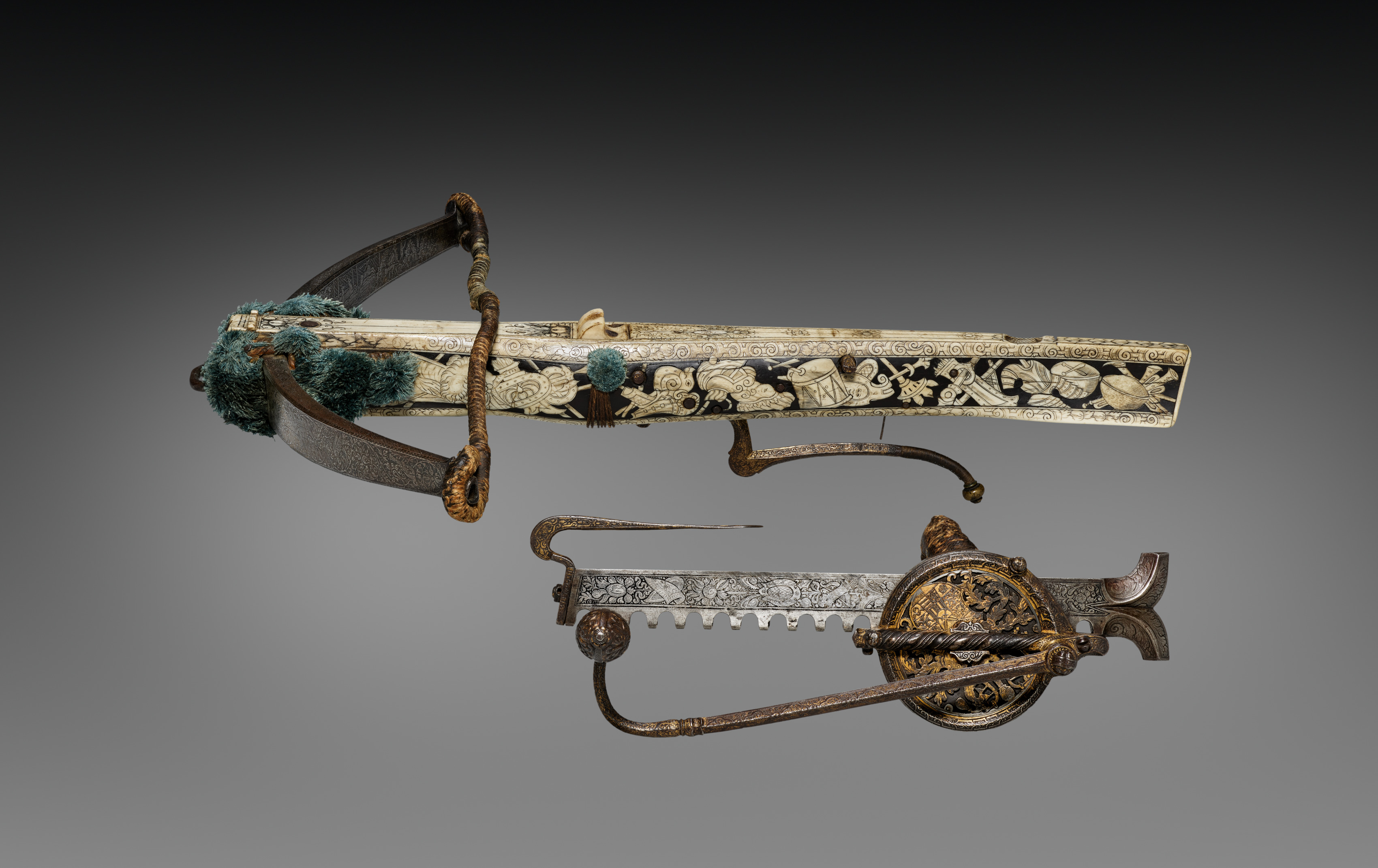
Deconstructing the Crossbow and Cranequin of Elector Augustus I: A Zoey Fashion Lab Analysis
At Zoey Fashion Lab, our mission is to unravel the structural and aesthetic DNA of historical artifacts, reimagining them through an avant-garde lens. The Crossbow and Cranequin of Elector Augustus I of Saxony (16th century, Germany) is not merely a weapon; it is a sophisticated statement of power, precision, and ornamental excess. This analysis dissects its material composition, mechanical logic, and decorative language, proposing a radical reinterpretation that aligns with contemporary avant-garde fashion principles.
Material DNA: From Armor to Adornment
The crossbow’s primary structure—likely walnut wood—offers a foundation of organic warmth and durability. For Zoey Fashion Lab, walnut represents a tactile paradox: it is both a structural backbone and a canvas for intricate carving. The bone veneers introduce a skeletal, almost architectural quality, reminiscent of exoskeletal fashion pieces. In an avant-garde context, these veneers could be reimagined as segmented, laser-cut panels that articulate with the body, creating a second skin that is both protective and fluid.
The flax cord is the tension engine of the crossbow, a material of humble origin elevated to functional art. In our deconstruction, flax becomes a metaphor for tensile strength and woven complexity. We envision it as a netting system that binds garment layers, or as a structural element in corsetry, where the tension of the cord mirrors the draw of the bow. The steel components—etched and gilded—are the most overtly luxurious. The etching, with its traces of gold, suggests a narrative of conquest and craftsmanship. For fashion, this translates into metalized textiles or gilded hardware that serve as functional closures or decorative accents, echoing the crossbow’s blend of utility and opulence.
The woolen pompoms are a surprising, almost whimsical addition. They soften the weapon’s aggressive silhouette, introducing texture and color. In an avant-garde collection, pompoms could be scaled up or multiplied, used as tactile embellishments on shoulders, hems, or as standalone accessories that challenge the viewer’s expectations of a “weaponized” aesthetic. They are the soft counterpoint to the hard steel and wood, embodying the tension between violence and play.
Mechanical Logic: The Cranequin as a Wearable System
The cranequin—the mechanical winch used to draw the bow—is a masterpiece of gear-based engineering. Its ratcheting mechanism, with toothed wheels and a winding handle, represents a closed-loop system of force and release. For Zoey Fashion Lab, this is a direct parallel to modular fashion systems where components interlock, adjust, and transform. We propose a cranequin-inspired garment featuring articulated joints, pulleys, and tension-adjustable panels. The wearer becomes the operator, able to modify silhouette or fit through manual interaction—a fusion of performance art and functional design.
The crossbow’s stock, decorated with inlaid trophies of arms, tells a story of conquest and status. These trophies—miniature shields, swords, and armor—are not merely decorative; they are narrative markers. In fashion, this translates to embroidered or appliquéd motifs that reference historical weaponry, but recontextualized as symbols of personal power or resistance. The inlay technique itself—intricate, time-consuming—suggests a slow fashion ethos, where craftsmanship is paramount.
Avant-Garde Reinterpretation: The New DNA Strand
Our New DNA Strand for this artifact is a collection concept titled "Elector's Tension." It deconstructs the crossbow’s elements into wearable, sculptural forms. The walnut wood is reinterpreted as laser-cut plywood corsets, stained and polished to a high gloss, with bone veneer inserts that echo the original’s articulation. The flax cord becomes a web of macramé harnesses that crisscross the body, adjustable via brass cranequin-inspired buckles. The steel is transformed into etched metal mesh panels, gilded with gold leaf, that serve as both armor and transparency, revealing the body beneath.
The woolen pompoms are scaled into giant, fluffy orbs attached to the shoulders and hips, creating a silhouette that is both menacing and absurd. They are dyed in deep Saxony blues and burgundies, referencing the Elector’s heraldry. The trophy inlays are reimagined as 3D-printed charms—miniature crossbows, gears, and shields—that dangle from chains, creating a clattering, kinetic soundscape as the wearer moves.
Silhouette and Structure: Tension and Release
The original crossbow’s silhouette is defined by its horizontal tension—the bow arms spread wide, the stock a rigid spine. Our garments mimic this through asymmetrical draping and cantilevered forms. A jacket might have one exaggerated shoulder extending outward like a bow arm, while the opposite side is cinched tight. The cranequin’s gears inspire circular cutouts and spiral seams that guide the eye around the body, creating a sense of mechanical motion. The overall effect is a deconstructed armor that protects and reveals, a dialogue between the historical and the futuristic.
Color Palette and Texture: Gilded Tension
The palette is drawn from the artifact’s materials: rich walnut brown, bone white, oxidized steel gray, and tarnished gold. The woolen pompoms introduce muted jewel tones—crimson, emerald, and sapphire—as accents. Textures are deliberately conflicting: smooth polished wood against rough flax, cold steel against soft wool. This tactile dissonance is central to the avant-garde ethos, challenging the wearer and observer to reconsider what is “precious” versus “functional.”
Conclusion: The Weapon as Wardrobe
The Crossbow and Cranequin of Elector Augustus I is not a relic of violence but a blueprint for wearable engineering. Zoey Fashion Lab’s deconstruction reveals a system of tension, ornament, and narrative that translates seamlessly into avant-garde fashion. By honoring its materials—walnut, bone, flax, steel, wool—and recontextualizing its mechanics—the cranequin’s gears, the trophy inlays—we create a collection that is both a historical homage and a future-forward statement. The wearer becomes the Elector, not of a territory, but of their own physical and aesthetic domain, armed with a wardrobe that is as precise, powerful, and paradoxical as the original weapon. This is the New DNA Strand: a fusion of craft and concept, where the past is not preserved but reloaded.