Deconstructing the Dervish’s Dowry: A Fabric Analysis of Mughal Miniature and Avant-Garde Deconstruction
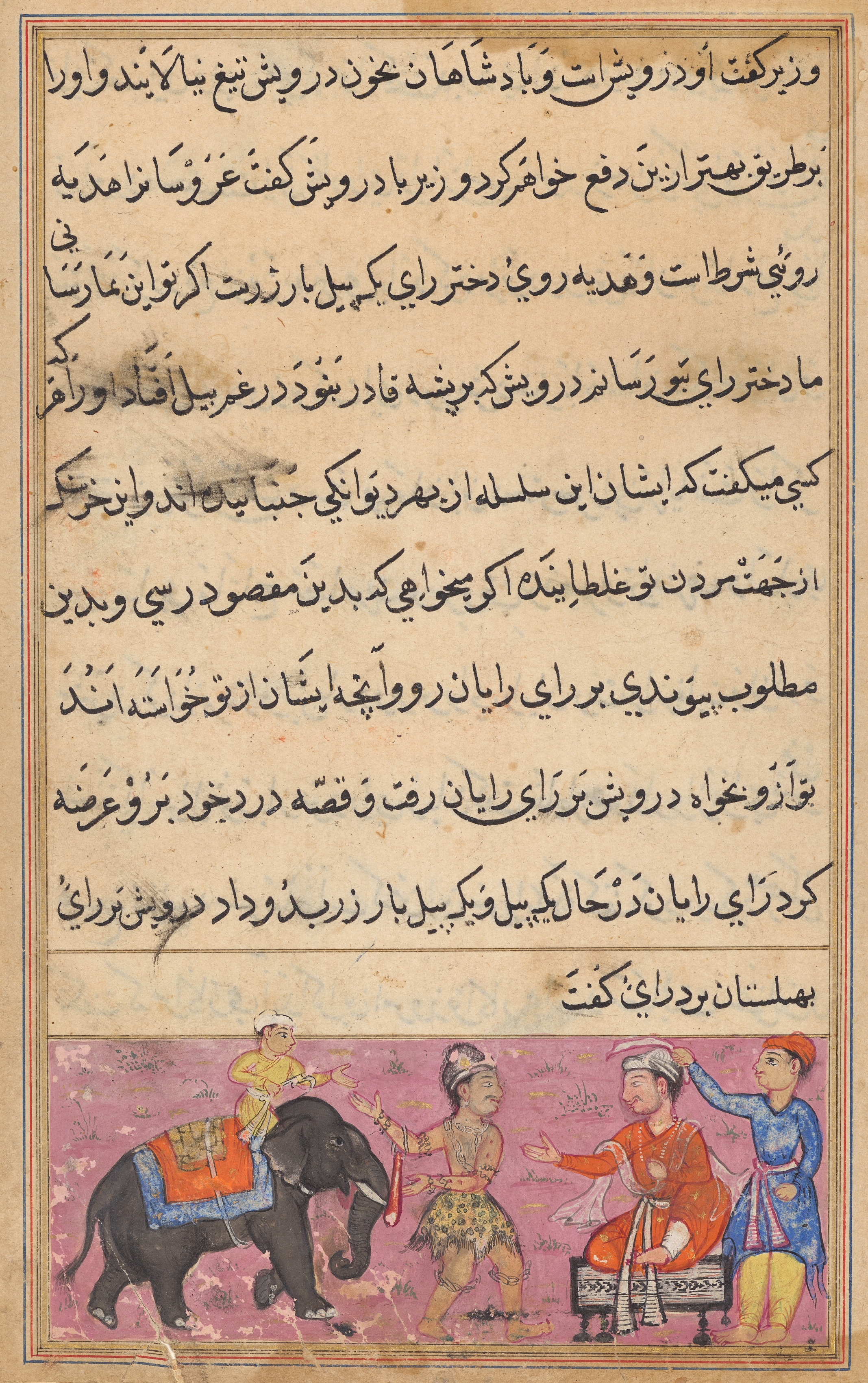
At Zoey Fashion Lab, we do not merely observe historical artifacts; we interrogate their material and symbolic fibers. The subject of this analysis—a folio from the Tuti-nama (Tales of a Parrot), specifically depicting “The dervish brings in as dowry an elephant laden with gold,” created in Mughal India during the court of Akbar (1556–1605)—is not a static relic. Through the lens of avant-garde deconstruction, we treat this miniature as a garment, a textile of power, and a narrative fabric waiting to be unstitched. The technical medium—gum tempera, ink, and gold on paper—becomes our primary textile, while the cited archive resonance, “一面是光洁银镜上以黄金镶嵌的纷繁棕叶纹,另一面是冰冷石棺板上以浮雕诉说的生命叙事” (one side a smooth silver mirror inlaid with gold palm leaf patterns, the other a cold sarcophagus slab narrating life in relief), serves as our deconstructionist’s blueprint. We will unravel this elephant’s burden, layer by layer, to expose the tensions between opulence, mortality, and narrative structure.
1. The Elephant as a Garment of Sovereignty
The elephant, laden with gold, is not merely a beast of burden but a fabric of imperial authority. In the Mughal court, the elephant symbolized the weight of empire—its strength, its capacity for destruction, and its ability to bear immense wealth. The dervish, a wandering ascetic, paradoxically brings this creature as a dowry, a transaction that disrupts the expected social fabric. The elephant’s skin, rendered in gum tempera with meticulous brushwork, becomes a textured surface—each wrinkle a fold in the narrative of power. The gold adorning the elephant is not just pigment; it is a thread of sovereignty, woven into the paper’s fibers to signify divine right and earthly opulence.
From an avant-garde perspective, we deconstruct this elephant as a wearable object. Imagine a deconstructed garment that mimics the elephant’s form: a voluminous, structured coat with gold-thread embroidery that cascades like the animal’s trappings. The gold leaf, applied in the original miniature with precision, becomes metallic appliqué on a deconstructed silhouette—perhaps a jacket with asymmetrical panels, one side heavy with gold, the other left raw and unfinished. This duality echoes the archive resonance: the gold palm leaf patterns on one side (the mirror of imperial glory) and the cold sarcophagus slab on the other (the reality of death and decay). The elephant’s burden, then, is not just gold but the weight of narrative itself—a story that the garment must both carry and critique.
2. The Dervish and the Dowry: A Narrative of Contradiction
The dervish, a figure of renunciation, bringing a dowry of immense wealth, creates a fabric of contradiction. In the Tuti-nama, the parrot narrates tales to delay a wife’s infidelity, and this story within a story within a story is itself a layered textile. The dervish’s action—offering an elephant laden with gold as a dowry—subverts the ascetic ideal, suggesting that even the most detached individuals are entangled in material transactions. This contradiction is the seam where the fabric of the narrative begins to fray.
In avant-garde fashion, we interpret this as a double-layered garment: an outer layer of coarse, unbleached linen (representing the dervish’s renunciation) with an inner lining of gold silk (the hidden wealth). The garment’s construction would be deliberately exposed—raw edges, visible stitching, and unfinished hems—to reveal the process of narrative construction. The dowry, then, is not a gift but a burden, and the garment must reflect this weight. A deconstructed dress might feature a gold-laden train that drags behind, heavy and impractical, while the bodice remains simple and austere. This tension between the ascetic and the opulent mirrors the archive’s dual nature: the silver mirror (reflecting surface beauty) and the sarcophagus slab (the underlying truth of mortality).
3. The Technical Medium: Gum Tempera, Ink, and Gold as Textile
The materials of the miniature—gum tempera, ink, and gold on paper—are themselves a textile of pigments. Gum tempera, a water-based medium, creates a matte, velvety surface that absorbs light, while gold leaf reflects it. This interplay of absorption and reflection is the fabric of perception. The ink provides the structural lines, the skeleton of the composition, while the gold adds the embellishment, the surface ornamentation.
Deconstructing this medium, we imagine a fabric that behaves like pigment: a silk organza that is matte on one side and metallic on the other, echoing the archive’s mirror-sarcophagus duality. The gold leaf of the miniature becomes gold thread embroidery on a deconstructed jacket, but the thread is left loose, unraveling at the edges, suggesting that the narrative is always in the process of coming undone. The ink lines become structural seams—black thread that outlines the garment’s shape but also reveals the pattern’s construction. This garment would be a deconstructed map of the miniature, with the elephant’s form translated into a series of abstract, angular panels that overlap and intersect.
4. The Archive Resonance: Mirror and Sarcophagus
The archive resonance provided—“一面是光洁银镜上以黄金镶嵌的纷繁棕叶纹,另一面是冰冷石棺板上以浮雕诉说的生命叙事”—is the key to our deconstruction. The silver mirror with gold palm leaf patterns represents the surface of the narrative: beautiful, reflective, and deceptive. The sarcophagus slab with its relief carving represents the depth of the narrative: cold, fixed, and telling a story of life that is already dead. In the Tuti-nama miniature, the elephant laden with gold is the mirror—the opulent surface that distracts from the underlying reality of the dervish’s renunciation and the tale’s moral ambiguity.
In an avant-garde garment, this duality is expressed through reversible construction. One side of the garment is a smooth, reflective silver fabric with gold palm leaf embroidery—a surface that dazzles and distracts. The other side is a rough, stone-colored wool with embroidered reliefs that tell a story: the elephant’s journey, the dervish’s poverty, the gold’s weight. The garment can be worn either way, but the wearer must choose which narrative to present. This reversible garment is a deconstruction of truth, suggesting that every story has two sides, and that the fabric of reality is always double-faced.
5. Avant-Garde Deconstruction: Unstitching the Elephant
Finally, we apply the avant-garde method of unstitching. The elephant, laden with gold, is not a complete entity but a collection of fragments—the trunk, the tusks, the howdah, the gold coins. In deconstruction, we separate these elements and reassemble them in a new order. Imagine a deconstructed suit: the jacket’s sleeve becomes the elephant’s trunk, extending and curling; the trousers are split into panels that mimic the elephant’s legs; the gold coins are scattered as metallic studs across the fabric, not in a pattern but in a random, chaotic distribution that suggests the randomness of wealth and narrative.
The seams are left raw, the lining exposed, and the structure collapsed. This garment is not meant to be worn in a traditional sense but to be exhibited as a deconstructed narrative. It asks the viewer: What is the weight of a story? Can a garment carry the burden of an elephant’s gold? The archive’s mirror-sarcophagus duality is resolved in this deconstruction: the garment is both a reflection of opulence and a tomb for the narrative, a cold slab that tells the story of life through its very unraveling.
Conclusion: The Fabric of the Seventh Night
In this analysis, the Tuti-nama miniature is not a historical artifact but a living textile that we, as Chief Fabric Deconstructionists, have unstitched and rewoven. The elephant laden with gold becomes a garment of contradiction, the dervish a seam of narrative tension, and the technical medium a fabric of perception. The archive resonance of mirror and sarcophagus guides our deconstruction, revealing that every story is both a surface reflection and a deep, cold narrative. At Zoey Fashion Lab, we do not preserve history; we deconstruct its fibers to reveal the threads that bind power, wealth, and mortality. The dervish’s dowry is not a gift but a burden, and the garment we create is its most honest expression: a deconstructed, double-faced, and unraveling tale of gold and dust.