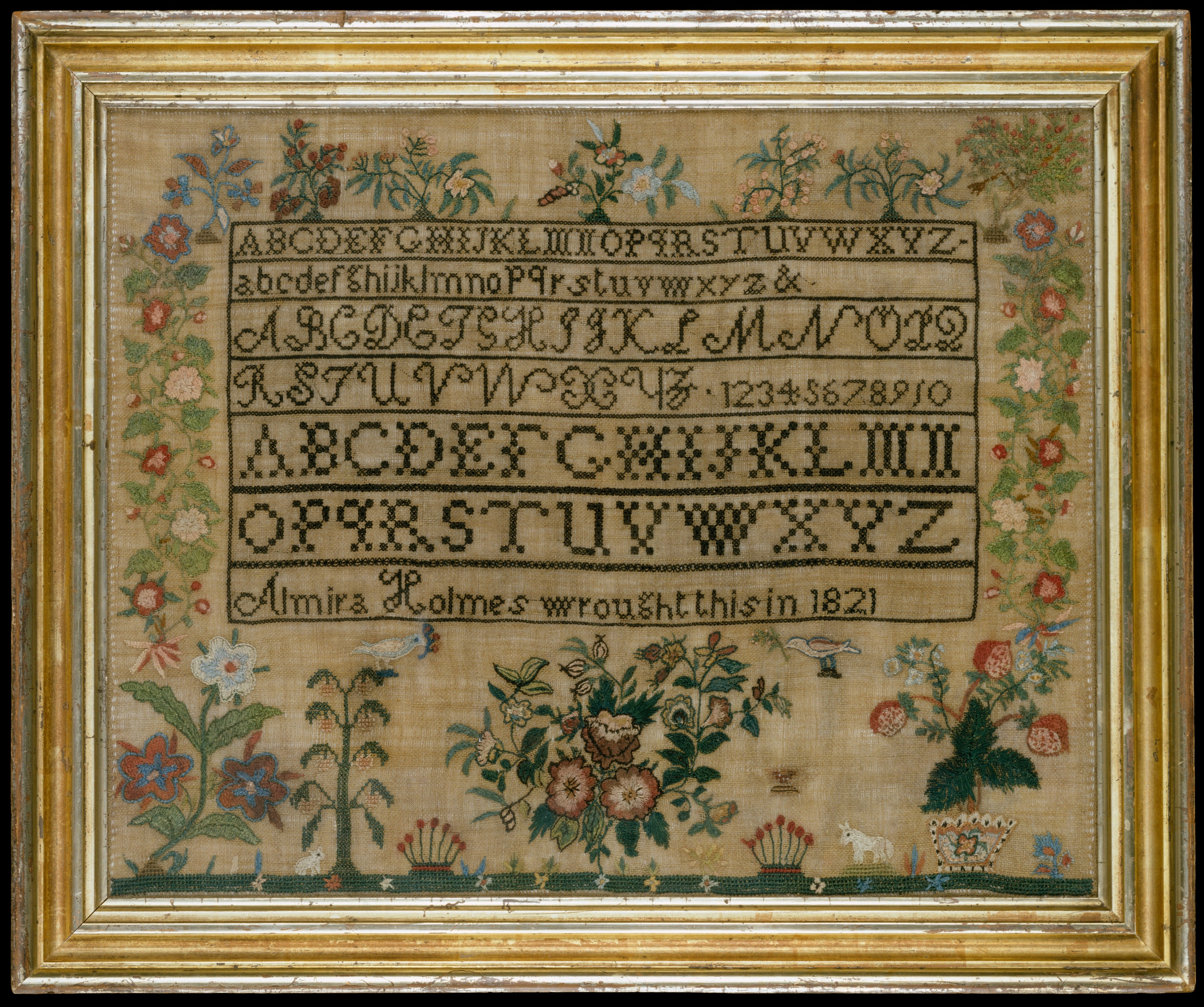
The Sampler Deconstructed: An Avant-Garde Lexicon for SS26
In the hallowed halls of Zoey Fashion Laboratory, where the past is not revered but repurposed as raw material for the future, the humble American sampler—a relic of domestic pedagogy and feminine virtue—undergoes a radical transmutation. For Spring/Summer 2026, this artifact of silk embroidery on linen is extracted from its historical amber and subjected to a rigorous deconstructive analysis. The result is not a nostalgic revival but a futuristic silhouette that redefines the very architecture of the garment. This avant-garde study positions the sampler as a generative grammar for structural innovation, where every stitch becomes a code, every motif a load-bearing element in a new sartorial syntax.
I. The Sampler as Proto-Code: From Decorative Motif to Structural Logic
The traditional American sampler, typically executed by young women in the 18th and 19th centuries, was a demonstration of needlework proficiency and moral instruction. Its alphabets, numerals, and pictorial scenes—flowers, houses, trees—were arranged in a rigid, symmetrical grid. For Zoey Fashion Laboratory, this grid is not a constraint but a pre-digital matrix. In the SS26 collection, the sampler’s embroidery is liberated from the flat plane of the linen ground. The silk threads are reimagined as tensile architectural cables, pulling and shaping the fabric into three-dimensional, futuristic silhouettes.
Consider a gown where the linen base is cut away, leaving only the embroidered network of alphabets and flora. This negative-space technique transforms the sampler into a wearable exoskeleton. The letters—once static—become structural ribs that articulate the bodice, while the floral motifs morph into dynamic, cantilevered panels that flare at the hip. The silk thread, with its intrinsic luster and tensile strength, is tensioned to create asymmetrical drapes and cantilevered volumes, echoing the principles of tensile fabric architecture. The result is a silhouette that appears to defy gravity, suspended between the historical artifact and the future.
II. Futuristic Silhouettes: The Sampler as a Generative Algorithm
The SS26 avant-garde study rejects the notion of the sampler as a finished object. Instead, it is treated as a generative algorithm—a set of instructions for creating form. The laboratory’s design process begins with the digitization of the sampler’s embroidery pattern. Each stitch is mapped as a data point; each motif is translated into a parametric curve. This digital twin is then fed into a custom 3D modeling engine that simulates fabric behavior under varying tension and compression.
The resulting silhouettes are biomorphic and alien. A jacket, for instance, uses the sampler’s alphabet as a parametric lattice. The letters ‘A’ and ‘B’ are scaled and rotated to form a repeating hexagonal structure, reminiscent of a carbon-fiber composite. The linen base is replaced by a translucent, bio-engineered film, while the silk embroidery is thickened with a resin to create rigid, protective panels. The silhouette is exaggeratedly broad at the shoulders, tapering to a sharp, asymmetrical hem—a direct reference to the sampler’s border motifs, which are now extruded into three-dimensional, wing-like forms. This is not a dress; it is a wearable architectural model, a prototype for a new species of garment.
III. Material Alchemy: The Dialectic of Silk and Linen
The materiality of the sampler—silk embroidery on linen—is a dialectic of opposites: the silk’s opulent sheen versus the linen’s matte, utilitarian weave; the silk’s fluid drape versus the linen’s crisp, structural hand. For SS26, this opposition is exploited to create tactile and visual dissonance. The laboratory employs a technique of selective degradation: the linen ground is chemically treated to create controlled fraying and tearing, while the silk embroidery is reinforced with a thermoplastic coating. The result is a surface that is simultaneously fragile and resilient, historical and futuristic.
In one key piece, a floor-length coat, the linen is dissolved in specific zones, leaving only the silk embroidery as a lacy, cobweb-like overlay. The underlying garment—a second skin of black, liquid-like polyurethane—is revealed through these voids. The silhouette is voluminous and cocoon-like, with the silk embroidery acting as a tensile membrane that constrains and shapes the polyurethane form. The contrast between the delicate, hand-stitched silk and the industrial, high-gloss polyurethane creates a post-human aesthetic, where the artisan and the machine are in a state of productive tension.
IV. Structural Innovation: The Sampler as a Load-Bearing System
The sampler’s grid is not merely decorative; it is a load-bearing system. In traditional construction, the embroidery threads are secondary to the linen fabric. In the Zoey Laboratory’s avant-garde interpretation, this hierarchy is inverted. The silk embroidery becomes the primary structural element, while the linen is reduced to a temporary scaffold or a sacrificial layer. This is achieved through a process of thread-tensioning: the silk is stitched under high tension, creating a pre-stressed network that can support significant weight without sagging.
Consider a dress where the entire bodice is constructed from a single, continuous silk thread that follows the sampler’s alphabet. The thread is anchored at key points—the shoulders, the waist, the hips—and then tensioned to create a suspension bridge-like structure. The linen is absent; the garment is pure thread. The silhouette is minimalist yet monumental, with the thread forming a series of parabolic curves that echo the arches of a Gothic cathedral. The wearer’s body becomes the landscape upon which this architectural system is erected. This is structural innovation at its most radical: the garment as a tensile fabric structure, a habitable space defined by the forces of tension and compression.
V. The Avant-Garde Imperative: The Sampler as a Portal to the Future
The sampler, in its original context, was a tool of discipline and conformity, teaching young women their place in a patriarchal society. Zoey Fashion Laboratory’s SS26 study reclaims this artifact as a symbol of subversive creativity and technological mastery. The embroidery is no longer a sign of domestic virtue but a code for a new aesthetic order. The futuristic silhouettes—asymmetric, biomorphic, tensile—are not mere flights of fancy; they are prototypes for a post-industrial fashion system, where the garment is both a digital construct and a handcrafted object.
This analysis concludes that the sampler, when subjected to an avant-garde deconstructive methodology, yields a lexicon of forms that is both historically resonant and radically new. The silk embroidery on linen is not a relic but a generative seed, from which spring silhouettes that challenge the boundaries of the body, the material, and the future. For SS26, Zoey Fashion Laboratory does not simply reference the past; it rewrites its code, transforming a humble sampler into a manifesto for the next century of fashion.