Deconstructing the Antelope: An Avant-Garde Analysis of a Hellenic Gold Earring for Zoey Fashion Laboratory SS26
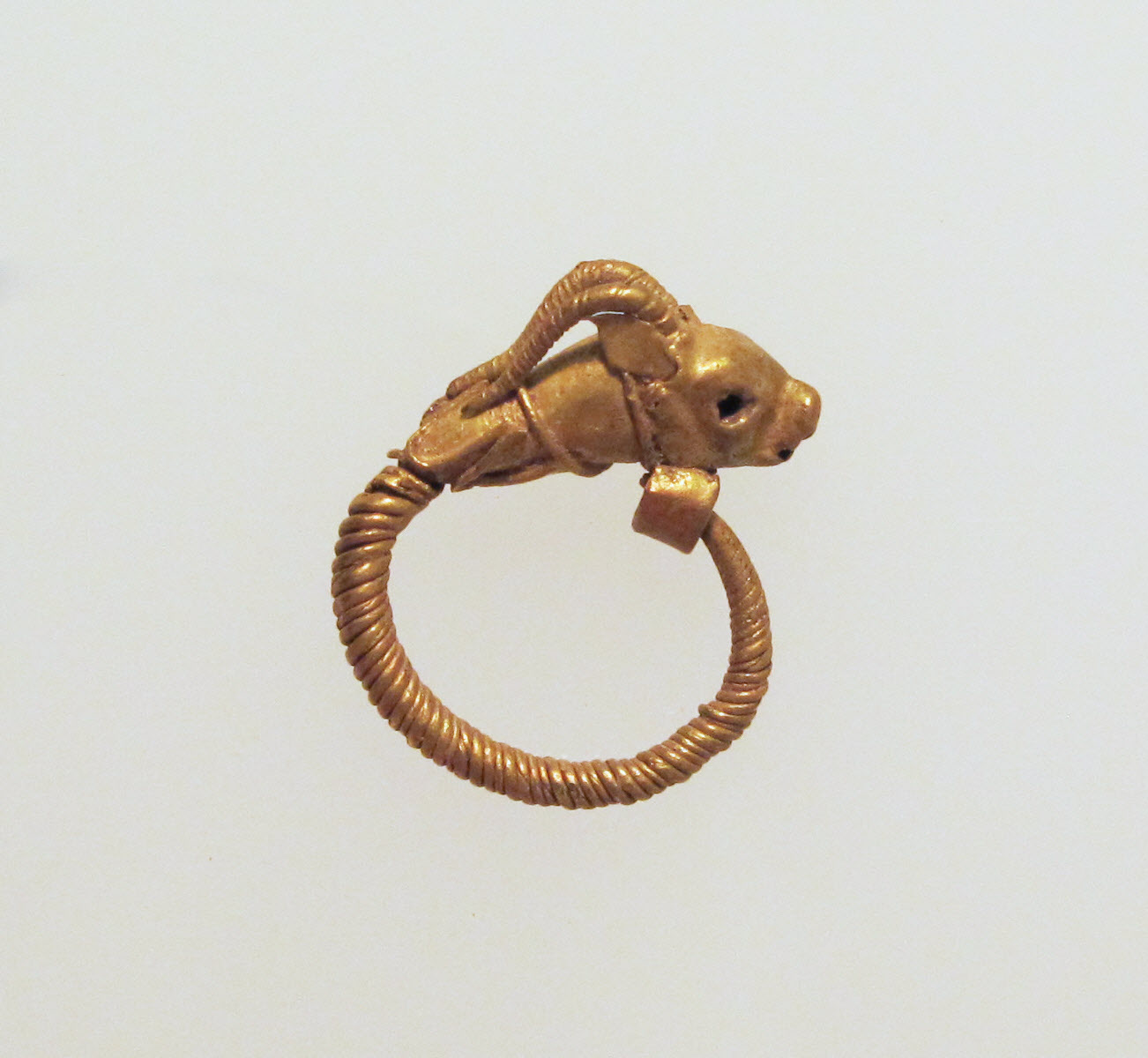
At first glance, the artifact in question—a Greek gold earring terminating in the head of an antelope—appears as a relic of archaic opulence, a whisper from a civilization that mastered the alchemy of metal and myth. Yet, within the context of Zoey Fashion Laboratory’s archive node, which juxtaposes a mirrored surface inlaid with golden palm leaves against a sarcophagus relief narrating life’s transience, this earring becomes a critical catalyst. It is not merely a piece of jewelry; it is a blueprint for SS26’s structural innovation, a manifesto for futuristic silhouettes that dismantle temporality, materiality, and the boundaries between the organic and the engineered. This analysis dissects the earring’s aesthetic DNA, proposing a collection where gold is no longer a symbol of static wealth but a dynamic, deconstructive agent of transformation.
I. The Antelope as an Architectural Node: Silhouette from the Animalistic
The antelope head, with its sweeping, lyre-shaped horns and delicate muzzle, is a study in biomimetic tension. In Hellenic craftsmanship, the gold was hammered and granulated to capture a creature of swiftness and grace, yet the material’s weight imposes a paradoxical stillness. For SS26, we extract this duality: the silhouette must evoke the antelope’s kinetic potential while remaining anchored in a futuristic, almost cyborgian rigidity. The horns, curving outward and upward, are not merely decorative; they are structural armatures that can be translated into exaggerated shoulder cages, articulated spine-like panels, or asymmetrical headpieces that defy gravity.
Consider the “Mirror with Split-Leaf” node: the golden palm leaves, once embedded in a reflective surface, suggest a fragmented, fractal expansion. The antelope’s horns, when multiplied and mirrored, generate a lattice of negative space—a silhouette that is both solid and void. For SS26, this translates into garments where the torso is encased in a golden exoskeleton, with horn-like protrusions that extend from the clavicle to the hip, creating a silhouette that is simultaneously predatory and protective. The material must be lightweight, perhaps using aerospace-grade aluminum coated in 24-karat gold leaf, to allow for mobility while preserving the architectural weight of the original artifact.
II. Deconstructive Aesthetics: The Earring as a Fracture Point
The earring’s function—to adorn the ear, a threshold between the internal and external—is reimagined as a fracture point in the garment’s narrative. The archive node’s duality of the polished mirror (surface) versus the relief sarcophagus (depth) informs a deconstructive approach: the earring is not a finished object but a node of rupture. In SS26, this manifests as garments that appear to be in a state of perpetual unmaking. A jacket, for instance, might feature a single, oversized gold antelope head attached at the shoulder, where the horns tear through the fabric, revealing a lattice of carbon fiber and silk beneath. The earring’s original symmetry is deliberately broken; one horn is extended into a sleeve, the other fragmented into a series of dangling chains that mimic the granulation technique of the original.
This deconstruction is not nihilistic but generative. The “split-leaf” motif from the mirror node suggests a botanical, almost cellular division. The antelope head is split along its vertical axis, with one half becoming a rigid, gold-plated breastplate and the other half dissolving into a fluid, chainmail-like drape. The result is a silhouette that oscillates between the archaic and the interstellar—a cyborg version of a Greek deity, where gold is both armor and wound. The garment’s seams are left raw, exposing the internal wiring of LED filaments that pulse with a bioluminescent glow, echoing the life narrative of the sarcophagus relief.
III. Material Alchemy: Gold as a Futuristic Medium
Gold, in its traditional context, is a symbol of permanence and divine light. For SS26, we subvert this by treating gold as a liquid, malleable interface between the organic and the synthetic. The earring’s surface, with its subtle hammer marks and granulated details, is a textural archive of the artisan’s hand. In the laboratory, we translate this into thermo-responsive gold alloys that shift in opacity and reflectivity when exposed to body heat. A dress might feature a bodice cast from this material, with the antelope’s head rendered as a 3D-printed lattice that opens and closes like a gill, responding to the wearer’s breath.
The archive node’s “cold stone sarcophagus” introduces a counterpoint: the gold’s warmth is juxtaposed against cryogenic finishes. For SS26, garments incorporate panels of gold leaf frozen onto transparent polymer substrates, creating a fractured, icy effect that references the relief’s narrative of mortality. The antelope motif is repeated in miniature, as thousands of gold micro-spheres embedded in a silicone matrix, forming a constellation across a sheer, iridescent tulle. This is not decoration but structural storytelling—each sphere is a node in a network of light, reflecting the palm leaves of the mirror while whispering the stone’s silence.
IV. Silhouette and Movement: The Kinetic Antelope
The antelope is a creature of flight and agility, and its earring form must inspire kinetic silhouettes for SS26. The horns, originally static, are reimagined as articulated joints that allow the garment to transform with movement. A cape, for example, is constructed from overlapping gold scales, each etched with the antelope’s profile, that fan out like the creature’s ears when the wearer turns. The silhouette is not fixed but performative—a dress might appear as a column of gold lamé until the wearer walks, at which point hidden pleats release, revealing a train shaped like the antelope’s tail, trailing a cascade of micro-LEDs that trace the path of the original artifact’s journey from Greece to the laboratory.
The “split-leaf” node further informs a bifurcated silhouette. One shoulder is constructed as a solid, mirrored plane reflecting the palm leaves; the other is a translucent, relief-like structure inspired by the sarcophagus. The antelope head serves as the clasp that binds these two halves, its horns extending into a harness that suspends the garment from the body. This is structural innovation at its most radical: the earring is no longer an accessory but the garment’s central load-bearing element, a golden keystone in an architecture of flesh and fabric.
V. Conclusion: The Earring as a Portal to SS26
This Greek gold earring, with its antelope head, is not a historical curiosity but a prophetic code for Zoey Fashion Laboratory’s SS26. It bridges the archive node’s duality—the mirror’s surface and the sarcophagus’s depth—into a collection that is both futuristic and primal, deconstructive and regenerative. The antelope’s horns become the scaffolding for silhouettes that challenge gravity; its gold becomes a living material that responds to the body; its myth becomes a narrative of transformation. In this analysis, the earring is a portal: through it, we enter a world where fashion is not about clothing the body but redefining its relationship with time, space, and materiality. For SS26, the antelope runs not across the plains of Greece but through the circuits of our imagination, its golden head a beacon for the avant-garde.