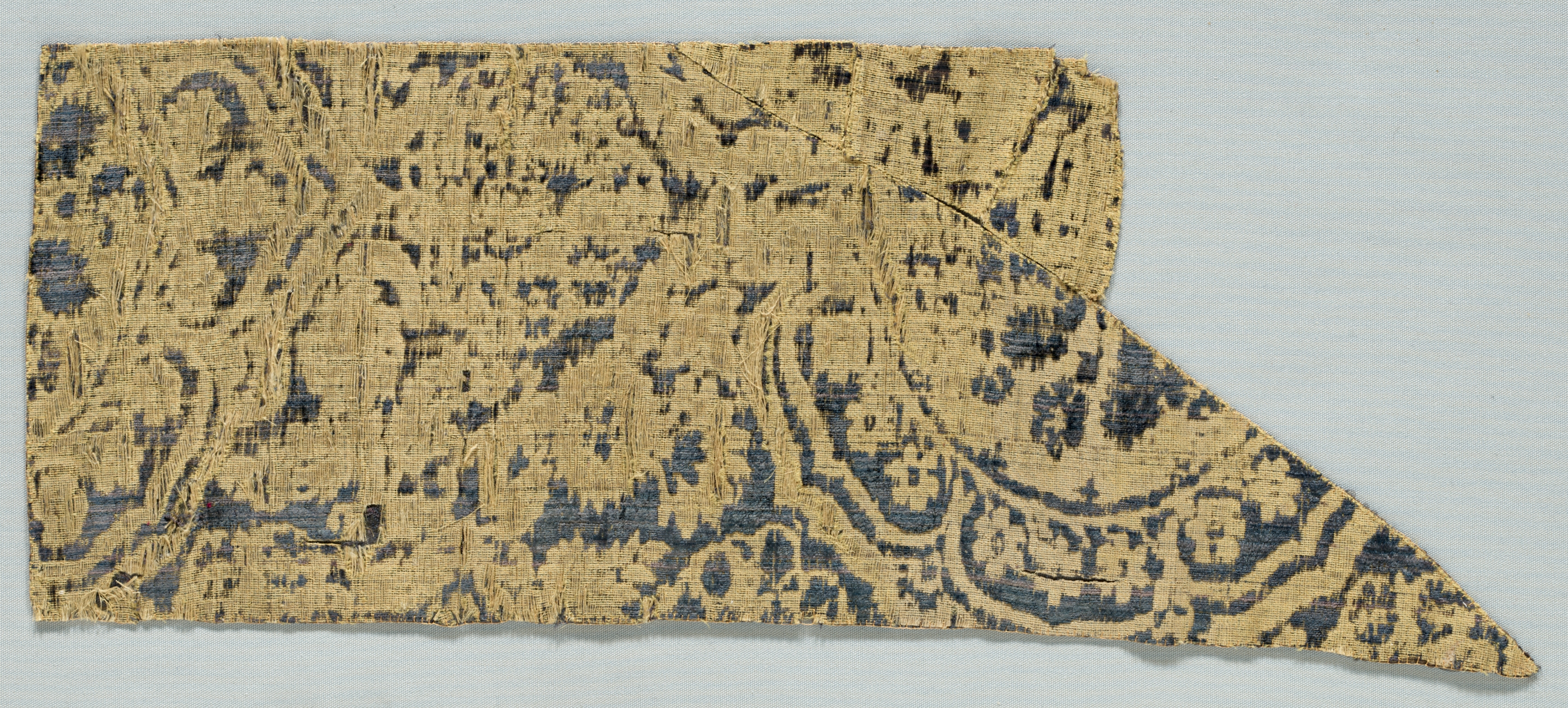
Deconstructing the Velvet Fragment: A 15th-Century Italian Silk as a New DNA Strand for Avant-Garde Design
As the Chief Fabric Deconstructionist for Zoey Fashion Lab, my role is to dissect historical textiles not merely as artifacts, but as living blueprints for radical innovation. The subject of this analysis—a fragment of Italian velvet from the 15th century, crafted from both cut and uncut silk—presents an extraordinary paradox. It is a relic of Renaissance opulence, yet its structural DNA contains the precise genetic code for a new era of avant-garde fashion. This fragment is not a piece of history to be preserved under glass; it is a New DNA Strand, a biological and technical lexicon waiting to be re-sequenced, mutated, and expressed in forms that defy the boundaries of traditional garment construction.
I. The Original Code: Technical Anatomy of the Velvet Fragment
To understand the potential of this fragment, we must first decode its original material and structural language. The textile is a silk velvet, a fabric that represented the pinnacle of medieval luxury. Its technical composition is deceptively simple yet infinitely complex in execution. The base is a silk foundation, likely a plain weave or twill, which provides the structural integrity. Into this ground, two distinct types of pile are woven: cut velvet and uncut velvet (also known as ciselé velvet).
The cut pile is created by weaving loops of silk warp threads over metal rods, which are then sliced open to create a dense, plush surface that absorbs and reflects light with a deep, liquid sheen. The uncut pile, conversely, is left as intact loops, producing a matte, textured surface that catches light differently. This interplay of high and low pile, of gloss and matte, creates a three-dimensional topography—a tactile landscape that is both luxurious and intellectually stimulating. The 15th-century Italian weavers were masters of this technique, using it to create intricate patterns of pomegranates, thistles, or heraldic motifs. In this fragment, the specific pattern is secondary to the fundamental principle: the deliberate manipulation of surface depth and light.
From a deconstructionist perspective, the velvet fragment is a system of oppositional forces: the rigid, structural ground versus the fluid, voluptuous pile; the sharp cut of the sheared loops versus the soft, continuous curve of the uncut loops; the reflective brilliance of the cut surface versus the absorbent stillness of the uncut. This is not merely a fabric; it is a dialectic in cloth.
II. Re-sequencing the Strand: From Historical Pattern to Avant-Garde Mutation
The challenge for Zoey Fashion Lab is not to replicate the velvet’s original form, but to extract its core principles and re-express them through an avant-garde lens. The fragment’s “DNA” is not its pattern or color, but its structural logic: the creation of a textile that is simultaneously a surface and a sculpture, a plane and a topography. To achieve this, we must subject the fragment to a series of conceptual and material mutations.
Mutation 1: Negative Space and Deconstruction
Traditional velvet is a dense, unbroken field. Our first intervention is to introduce systematic voids. Imagine a garment where the cut velvet pile is selectively removed—not through cutting, but through a process of laser ablation or chemical dissolution of the silk pile, leaving the bare ground weave exposed. This creates a pattern of absence, a negative image of the original pile. The uncut loops can be left intact, forming a soft, fuzzy “halo” around these voids. The result is a fabric that is both luxurious and radically incomplete, a deconstructed velvet that reveals its own construction. This technique speaks to the avant-garde’s fascination with process and the unfinished, turning the garment into a visible diagram of its own making.
Mutation 2: Sculptural Draping and Unstable Forms
The velvet fragment’s three-dimensionality is its most potent asset. We can amplify this by using the uncut loops as structural anchors. In a 15th-century context, the loops were purely decorative. In our avant-garde mutation, they become functional. By weaving in shape-memory alloys or thermoplastic threads alongside the silk, the uncut loops can be programmed to lift, curl, or collapse in response to body heat or external stimuli. A dress made from this material would not be static; it would breathe, shift, and reconfigure as the wearer moves. The cut pile, meanwhile, would provide a stable, luminous base. This creates a garment that is a living organism, a kinetic sculpture that blurs the line between fashion and performance art.
Mutation 3: Digital Weaving and Algorithmic Pattern
The original fragment’s pattern was dictated by the weaver’s hand and the limitations of the drawloom. Today, we can use digital jacquard weaving to create patterns that are not static but algorithmic. Imagine a velvet where the ratio of cut to uncut pile is determined by a real-time data stream—for example, the wearer’s heart rate, ambient noise levels, or even social media activity. The fabric becomes a data visualization, a textile that encodes the wearer’s environment and biology. The velvet’s historical identity as a symbol of static wealth is inverted; it becomes a dynamic interface, a screen made of silk and air.
III. The Avant-Garde Synthesis: A New Vocabulary for Zoey Fashion Lab
The 15th-century Italian velvet fragment is not a constraint; it is a liberation. As a New DNA Strand, it provides the foundational code for a collection that is at once deeply historical and aggressively futuristic. The avant-garde style demands that we challenge the very notion of what a garment is. This fragment allows us to do exactly that.
Our proposed collection, tentatively titled “Ciselé Codex,” would explore three key themes:
- Deconstructed Opulence: Garments that use laser-removed cut pile to create patterns of absence, revealing the structural grid beneath. The uncut loops are preserved as soft, tactile “scars.”
- Kinetic Topography: Dresses and coats where the uncut loops are infused with responsive materials, creating a living surface that ripples and shifts. The cut pile provides a stable, luxurious anchor.
- Algorithmic Luxe: Digital jacquard velvets that generate real-time patterns based on data input, turning the garment into a wearable, responsive artwork.
Each piece would be a dialogue between the hand and the machine, between the 15th-century weaver’s precision and the 21st-century designer’s computational logic. The velvet is no longer a symbol of static wealth; it is a dynamic system, a platform for interaction, transformation, and expression.
IV. Conclusion: The Fragment as a Living Archive
In the hands of Zoey Fashion Lab, this 15th-century Italian velvet fragment is not a dead artifact. It is a living archive, a genetic library of textile possibilities. By deconstructing its technical DNA—the interplay of cut and uncut, of light and shadow, of structure and surface—we unlock a new vocabulary for avant-garde fashion. The fragment teaches us that luxury is not about stasis, but about transformation. It is not about preservation, but about mutation. This velvet is not the end of a story; it is the beginning of a new one—a strand of code waiting to be re-written into the future of fashion.