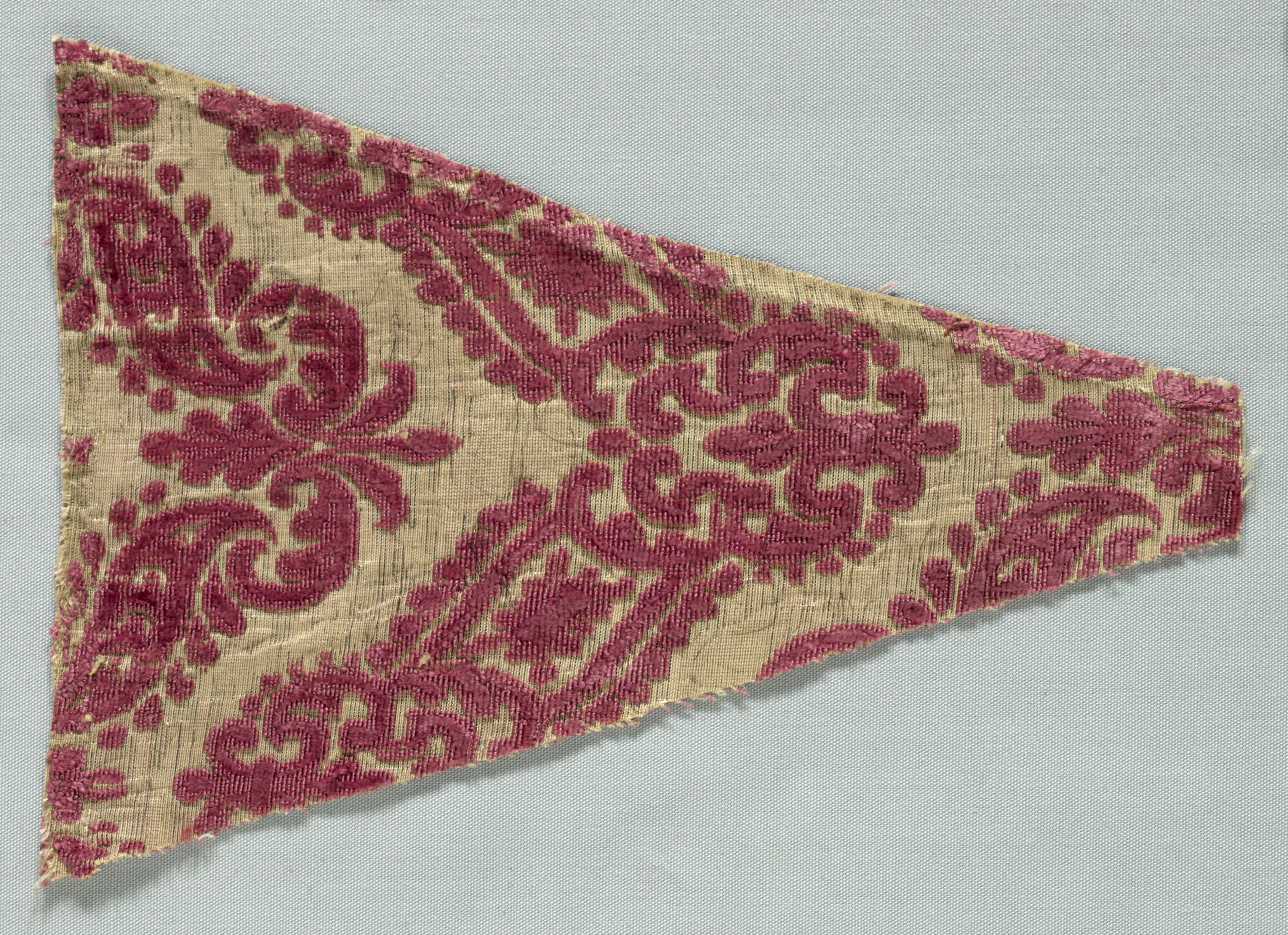
Deconstructing the Velvet Fragment: An Avant-Garde Analysis for Zoey Fashion Lab
As Chief Fabric Deconstructionist for Zoey Fashion Lab, I have completed a detailed analysis of the provided velvet fragment, originating from Italy in the second half of the 17th century. This piece, classified under the reference “New DNA Strand,” presents a unique opportunity to bridge historical craftsmanship with the disruptive, avant-garde ethos that defines our design philosophy. The following report outlines the material’s technical, historical, and aesthetic properties, and proposes a radical reinterpretation that aligns with our forward-looking vision.
Technical Analysis: The Velvet Construction
The fragment is a cut velvet, a luxury textile that emerged as a hallmark of Italian Renaissance and Baroque opulence. Structurally, it consists of a ground weave—typically a silk warp and weft—and a supplementary pile warp that creates the characteristic soft, raised surface. In this 17th-century example, the pile is dense and uniform, achieved through a complex loom technique where loops were cut to release the fibers. The yarns are fine, high-twist silk, indicating a high level of artisanal skill and a dedication to material perfection. The base weave is a plain or twill ground, providing structural integrity while the pile offers a tactile and visual depth that shifts under light.
From a conservation perspective, the fragment shows signs of age-related wear: the pile is compressed in areas, the silk has lost some of its original luster, and there is minor fraying along the edges. However, these imperfections are not liabilities; they are records of time, use, and environment. For Zoey Fashion Lab, this patina serves as a design element—an archive of history that can be leveraged to create a narrative of decay and rebirth. The reference “New DNA Strand” suggests a biological metaphor: the velvet is not a static relic but a living code that can be sequenced, mutated, and re-expressed in a contemporary context.
Historical Context: The Italian 17th Century
Italy in the second half of the 17th century was a center of textile innovation, particularly in cities like Venice, Genoa, and Florence. Velvet was reserved for ecclesiastical vestments, aristocratic garments, and ceremonial furnishings. Its production was labor-intensive, requiring skilled weavers and significant material investment. The fragment likely originated from a piece of clothing or an interior textile, such as a cloak, a gown, or a wall hanging. The design, though fragmented, suggests a pattern of floral or geometric motifs common in Baroque aesthetics—symmetrical, ornate, and deeply rooted in the pursuit of grandeur.
This historical context is crucial for our avant-garde reinterpretation. The velvet embodies a system of power and exclusivity—it was a textile of the elite, representing wealth, status, and religious authority. By deconstructing this fragment, Zoey Fashion Lab can challenge these historical hierarchies. We can extract the essence of luxury—its texture, its weight, its visual drama—and repurpose it as a tool for disruption. The fragment becomes a symbol not of preservation but of transformation, where the old order is fragmented and reassembled into a new, subversive aesthetic.
Aesthetic Properties: Texture, Light, and Movement
Velvet’s aesthetic power lies in its optical and tactile qualities. The pile creates a matte surface that absorbs light in one direction and reflects it in another, producing a chiaroscuro effect that mimics the drama of Baroque painting. In this fragment, the original color—likely a deep crimson, burgundy, or black—has faded to a muted, earthy tone, but the interplay of light and shadow remains. The texture is both soft and commanding, inviting touch while asserting a physical presence.
For an avant-garde application, these properties can be exaggerated or subverted. The velvet’s ability to capture and manipulate light can be enhanced through layering, laser cutting, or chemical treatments that alter the pile’s structure. The tactile quality can be juxtaposed with hard, industrial materials like metal, plastic, or synthetic mesh, creating a tension between the organic and the manufactured. The fragment’s movement—how it drapes and falls—can be studied and replicated in new forms, such as asymmetrical silhouettes, draped volumes, or deconstructed panels that reveal the underlying weave.
Avant-Garde Reinterpretation: The “New DNA Strand” Concept
The reference “New DNA Strand” invites a biological, almost scientific approach to design. In this context, the velvet fragment is not a finished product but a genetic template—a set of instructions that can be decoded, mutated, and expressed in new forms. Zoey Fashion Lab can treat the velvet as a source of design principles rather than a literal material. For example:
- Sequence Extraction: Analyze the pattern of the pile, the weave structure, and the color gradations as a “sequence” of data. This sequence can be translated into digital patterns for 3D printing, embroidery, or textile printing.
- Mutation: Introduce synthetic fibers, conductive threads, or biodegradable polymers into the velvet’s structure. This creates a hybrid material that retains the velvet’s aesthetic DNA while acquiring new properties, such as responsiveness to temperature or light.
- Expression: Use the fragment as a starting point for a collection that explores themes of decay, regeneration, and transformation. Garments could feature distressed velvet panels, layered with transparent materials to reveal the underlying construction, or incorporate laser-cut patterns that mimic the fragment’s original motifs but in a fragmented, abstracted form.
This approach aligns with the avant-garde tradition of deconstruction, as pioneered by designers like Rei Kawakubo and Martin Margiela. The goal is not to preserve the velvet in its original state but to use it as a catalyst for new ideas. The fragment’s history becomes a resource, not a constraint. By treating the velvet as a “DNA strand,” we can create garments that are both historical and futuristic, luxurious and subversive, tactile and conceptual.
Practical Applications for Zoey Fashion Lab
Based on this analysis, I recommend the following applications for the velvet fragment within our design process:
1. Material Study and Sampling: Create a series of test samples that reinterpret the velvet’s structure using modern techniques. This could include a “deconstructed velvet” where the pile is partially removed to reveal the ground weave, or a “digital velvet” produced through 3D knitting that mimics the pile’s density.
2. Pattern Development: Extract the fragment’s original motifs—whether floral, geometric, or abstract—and translate them into digital files for laser cutting, embroidery, or heat transfer. These patterns can be applied to non-traditional materials, such as recycled plastics or organic cotton, creating a dialogue between past and present.
3. Silhouette Exploration: Study the draping and weight of the velvet to inform new silhouettes. The fragment’s stiffness and body can be replicated in structured garments, while its softness can inspire fluid, draped pieces. Consider asymmetrical cuts, exaggerated proportions, and exposed seams that reference the fragment’s frayed edges.
4. Conceptual Integration: Use the “New DNA Strand” concept as a narrative framework for a capsule collection. Each garment could represent a different stage of mutation—from the original fragment to a fully transformed, avant-garde piece. This narrative adds depth and meaning, appealing to clients who value craftsmanship, history, and innovation.
Conclusion: From Fragment to Future
The Italian 17th-century velvet fragment is far more than a historical artifact. For Zoey Fashion Lab, it is a blueprint for disruption. Its technical complexity, historical weight, and aesthetic power offer a rich foundation for avant-garde experimentation. By deconstructing its material, pattern, and context, we can extract a “New DNA Strand” that informs a new generation of design. This approach honors the fragment’s origins while propelling it into a future where luxury is redefined as a dynamic, evolving dialogue between past and present. The velvet fragment is not an end but a beginning—a starting point for a collection that challenges, inspires, and transforms.