Technical Deconstruction & Historical Context: The Safavid Lampas
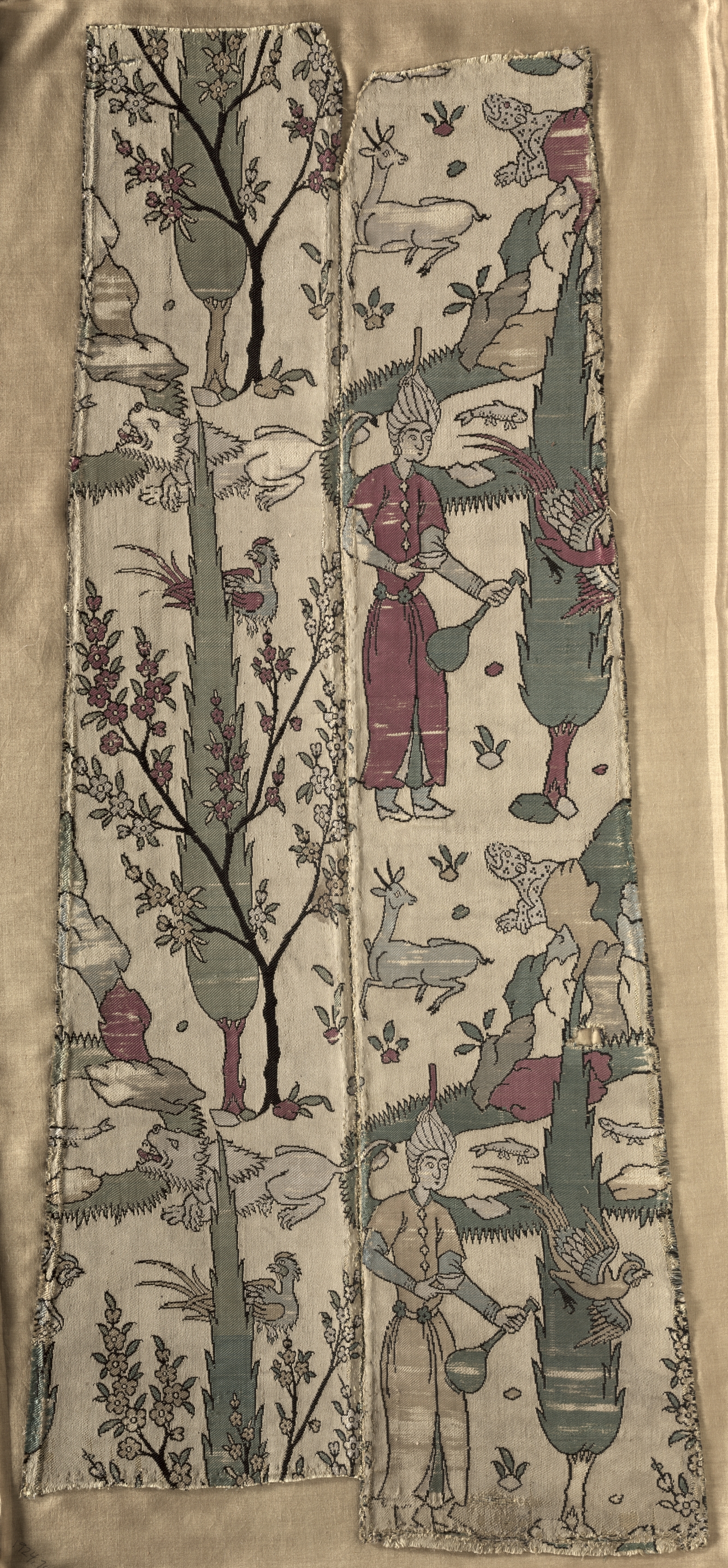
The artifact in question—a fragment depicting wine bearers in a landscape, sourced from a Safavid-era robe—represents a zenith of textile technology and artistic expression. The base structure is a silk lampas, a complex weave that allows for intricate patterning and a rich, reversible fabric ideal for luxurious garments. This technique involves two sets of warps and wefts, creating a compound cloth where a ground weave supports a pattern weave. For the Zoey Fashion Lab, this is not merely historical data; it is a blueprint for structural innovation. The lampas construction speaks to a foundational principle we must embrace: complexity in service of beauty and durability. The fragment’s survival hints at its inherent strength, a marriage of material excellence (high-grade silk) and technical mastery.
The Narrative Code: Iconography as a Design Language
The depicted scene is a key to unlocking its contemporary relevance. Wine bearers in a paradisiacal landscape are staple motifs of Safavid courtly art, symbolizing leisure, poetry, and spiritual intoxication. This is not a literal scene but a coded language of luxury and transcendence. For our avant-garde translation, we must move beyond literal representation. The "wine bearer" transforms into a concept of service, flow, and ceremonial offering. The "landscape" becomes a terrain of texture, contour, and organic growth on the garment's body. Our deconstruction asks: How do we embed narrative not through printed images, but through silhouette, movement, and interaction with the wearer? The robe was a mobile canvas of identity; our creation must be the same.
Avant-Garde Translation: From Silk Fragment to "New DNA Strand"
The directive to reference a "New DNA Strand" is pivotal. It mandates a move beyond superficial homage into generative, molecular-level reinvention. We are not recreating a lampas weave or a Persian miniature. We are splicing the core genetic codes of the original into a new, viable organism for the modern sartorial ecosystem.
Genetic Code 1: Material & Structural Recombination
Silk (Historic DNA): The luxury, sheen, and tensile strength.
New DNA Strand: We hybridize. Consider biotech silk infused with light-responsive pigments that change hue like wine in different lights, or silk-fused with recycled metallic polymers to create a contemporary, textured lampas. The structure itself can be re-engineered using 3D knitting or laser-sintered laminates to create the compound, reversible quality of lampas, but with futuristic properties—ventilation, modularity, or adaptive stiffness.
Genetic Code 2: Motif & Pattern Re-sequencing
Figurative Scene (Historic DNA): The detailed narrative of figures and flora.
New DNA Strand: Abstract the code. The wine bearer's posture and the curve of the amphora become elongated, distorted seam lines or darts that shape the body. The rhythmic repetition of the figures translates into a modular, irregular print or an embroidered algorithm that climbs the garment. The landscape's blossoming trees are not printed but manifested through laser-cut foliage-like layers or tufted textural patches that create a topographic map on a jacket or skirt.
Genetic Code 3: Function & Ceremony Re-imagined
Courtly Robe (Historic DNA): A garment denoting status and participation in a cultural ritual.
New DNA Strand: What is today's court? The digital sphere, the performance of identity. The garment becomes an interactive site. Conduits for wearable tech could trace lines like vineyard rows; subtle sound elements could evoke the ceremony of pouring. The concept of "bearing" is key—could the design incorporate detachable, fluid elements (like modern amphorae) that hold not wine, but personal effects, technology, or light? The robe enveloped the body; our design should create a new relationship between wearer and environment.
Proposed Design Direction for Zoey Fashion Lab
We propose a unisex, multi-layered ensemble titled "The Libation Sequence."
The Base Layer (The Landscape): A dress or jumpsuit in a modern, engineered lampas of recycled silk and copper polyamide. Its surface is a textured, topographic knit, rising in subtle, organic ridges and valleys, mapping the "landscape" onto the body's form. The color palette moves from deep terracotta (earth) to iridescent violet (grapes, twilight).
The Outer Shell (The Bearer): A structured, asymmetric jacket or coat. Its seams are derived from the sweeping curves of amphorae and arms. It features modular, magnetic attachments—abstract, vessel-like pods that can hold items or simply exist as sculptural forms. The fabric here is more technological: a coated, texturized material that shifts pattern under different angles of light or viewer perspective, creating a living, non-static narrative.
The Avant-Garde Gesture (The Pour): This is the conceptual climax. It could be a train of fluid, glass-like silicone strips that cascade from a shoulder or hip, or a sleeve engineered to billow with an internal airflow system, creating a moment of dynamic, ceremonial flourish with movement. This element embodies the act of offering, the flow of the wine, the poetry in motion.
This analysis concludes that the Safavid fragment is not a relic, but a living genome. By isolating its core codes—technical ambition, symbolic depth, and ceremonial purpose—and recombining them with cutting-edge materials and technology, Zoey Fashion Lab can produce a truly avant-garde collection. It will not look Iranian or Safavid, but it will carry the profound, re-sequenced DNA of that legacy, speaking in a wholly new, yet deeply resonant, sartorial language.