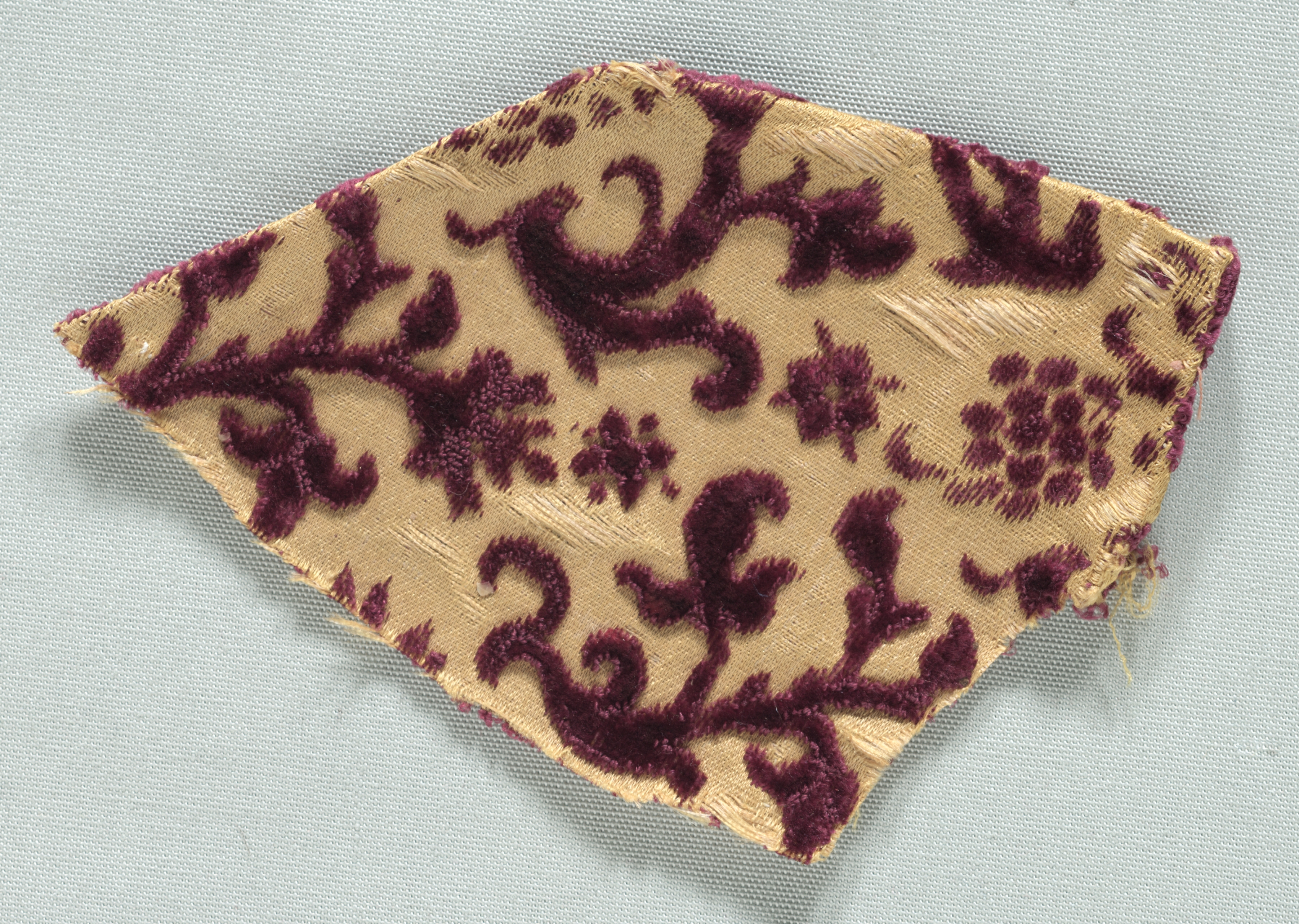
Deconstructing the Velvet Fragment: An Avant-Garde Analysis for Zoey Fashion Lab
At Zoey Fashion Lab, our mission is to unearth the latent narratives embedded within historical textiles, transforming them into catalysts for avant-garde design. This analysis deconstructs a specific artifact: a velvet fragment originating from early 17th-century Italy. We treat this not as a relic but as a New DNA Strand—a foundational genetic code that can be spliced, mutated, and re-expressed through contemporary, disruptive aesthetics. The fragment’s opulence, born from a period of rigid social hierarchy and Catholic grandeur, offers a rich tension against our laboratory’s ethos of deconstruction and reinvention.
Technical Provenance: The Velvet as a Material System
To understand the fragment’s potential, we first analyze its technical constitution. Early 17th-century Italian velvet, particularly from centers like Genoa, Venice, or Florence, was a pinnacle of textile engineering. The fabric is characterized by a complex weave structure: a ground weave (typically silk or linen) supporting a supplementary warp that forms the cut pile. This pile, created by looping and cutting threads over wires, produces the signature soft, dense surface. The fragment likely exhibits a solid or voided velvet pattern, where the pile is selectively cut or left uncut to create contrast between lustrous and matte surfaces.
Key technical attributes include:
- Materiality: Silk filaments, often dyed with natural pigments like cochineal (crimson), woad (blue), or weld (yellow). The fragment’s color—likely a deep burgundy, emerald, or black—would have signified wealth and religious authority.
- Structure: A high-density pile (approximately 100-200 tufts per square centimeter), creating a plush, tactile depth. The ground weave is typically a twill or satin, offering a durable yet flexible base.
- Aging: The fragment exhibits natural patina: fading, pile crushing, and potential fiber degradation from light, humidity, and handling. This is not a flaw but a record of its journey through time.
From an avant-garde perspective, this technical system is a constraint to be broken. The velvet’s density and texture challenge modern manufacturing, which favors speed and uniformity. Our lab can exploit this by introducing deliberate imperfections: laser-cut piles that mimic decay, chemical etching to create transparent zones, or digital printing over the aged surface to superimpose contemporary motifs.
Historical Context: The Velvet as a Social and Aesthetic Artifact
Early 17th-century Italy was a landscape of Counter-Reformation opulence and nascent scientific inquiry. Velvet was not merely a fabric; it was a status symbol and a religious tool. Worn by nobility and clergy, it adorned altars, vestments, and courtly garments. The fragment’s pattern—likely featuring pomegranates, thistles, or acanthus leaves—carried symbolic weight: fertility, eternal life, or divine authority. The velvet’s labor-intensive production (weavers could produce only a few centimeters per day) made it a luxury reserved for the elite.
This historical weight is crucial for our deconstruction. The velvet represents a system of power, tradition, and craftsmanship. In the avant-garde context, we must subvert these associations. For instance:
- De-sacralization: Transform a religious vestment fragment into a streetwear hoodie, challenging the boundary between sacred and profane.
- De-classing: Combine velvet with industrial materials like neoprene or recycled plastics, collapsing historical hierarchy into a democratic, hybrid textile.
- Temporal collapse: Print digital glitch patterns over the velvet’s organic motifs, creating a dialogue between 17th-century labor and 21st-century digital decay.
The fragment’s age is not a limitation but a source of friction. Its fragility demands respect, yet our lab’s ethos is to push materials to their breaking point. We can use this tension to create garments that are both archival and rebellious—pieces that whisper of the past while screaming of the future.
The New DNA Strand: Genetic Re-coding for Avant-Garde Expression
We propose reinterpreting the velvet fragment as a New DNA Strand—a sequence of design genes that can be isolated, amplified, and recombined. This metaphor guides our deconstruction into three actionable strands:
Strand 1: Texture as Disruption
The velvet’s pile is its defining feature. For an avant-garde collection, we can distort this texture. Consider: a velvet jacket where the pile is selectively crushed using heat and pressure, creating topographic patterns that mimic digital noise. Or, a dress where the pile is partially sheared, revealing the ground weave as a second skin. This technique, which we call pile erosion, transforms the fabric from a uniform surface into a textured narrative of decay and renewal.
Strand 2: Pattern Re-synthesis
The fragment’s 17th-century motifs (pomegranates, thistles) can be digitally extracted and mutated. Using AI-driven pattern generation, we can create a new lexicon: the pomegranate seed becomes a pixelated grid; the thistle leaf morphs into a fractal. These patterns can be laser-engraved into the velvet, printed with metallic inks, or embroidered with conductive threads for interactive garments. The result is a hybrid pattern that honors the original while breaking its symbolic constraints.
Strand 3: Structural Subversion
The velvet’s historical use in rigid, structured garments (doublets, gowns) can be inverted. Our lab can deconstruct the fragment into modular components—strips, panels, or irregular shapes—and reassemble them using exposed seams, asymmetric cuts, or non-traditional closures (e.g., magnetic snaps, parachute buckles). This creates a garment that is both a fragment and a whole, a literal deconstruction of historical form into avant-garde silhouette.
Conclusion: The Fragment as a Living Archive
The early 17th-century Italian velvet fragment is not a dead artifact but a living archive of material, social, and aesthetic codes. For Zoey Fashion Lab, it represents a challenge: how to honor its technical mastery while violently reimagining its purpose. By treating it as a New DNA Strand, we can splice its historical DNA with contemporary mutations—digital, industrial, and conceptual. The resulting garments will be neither replicas nor mere inspirations but new species of textile, born from the tension between reverence and rebellion. This is the avant-garde imperative: to deconstruct the past not to destroy it, but to release its latent potential for a future that has not yet been woven.