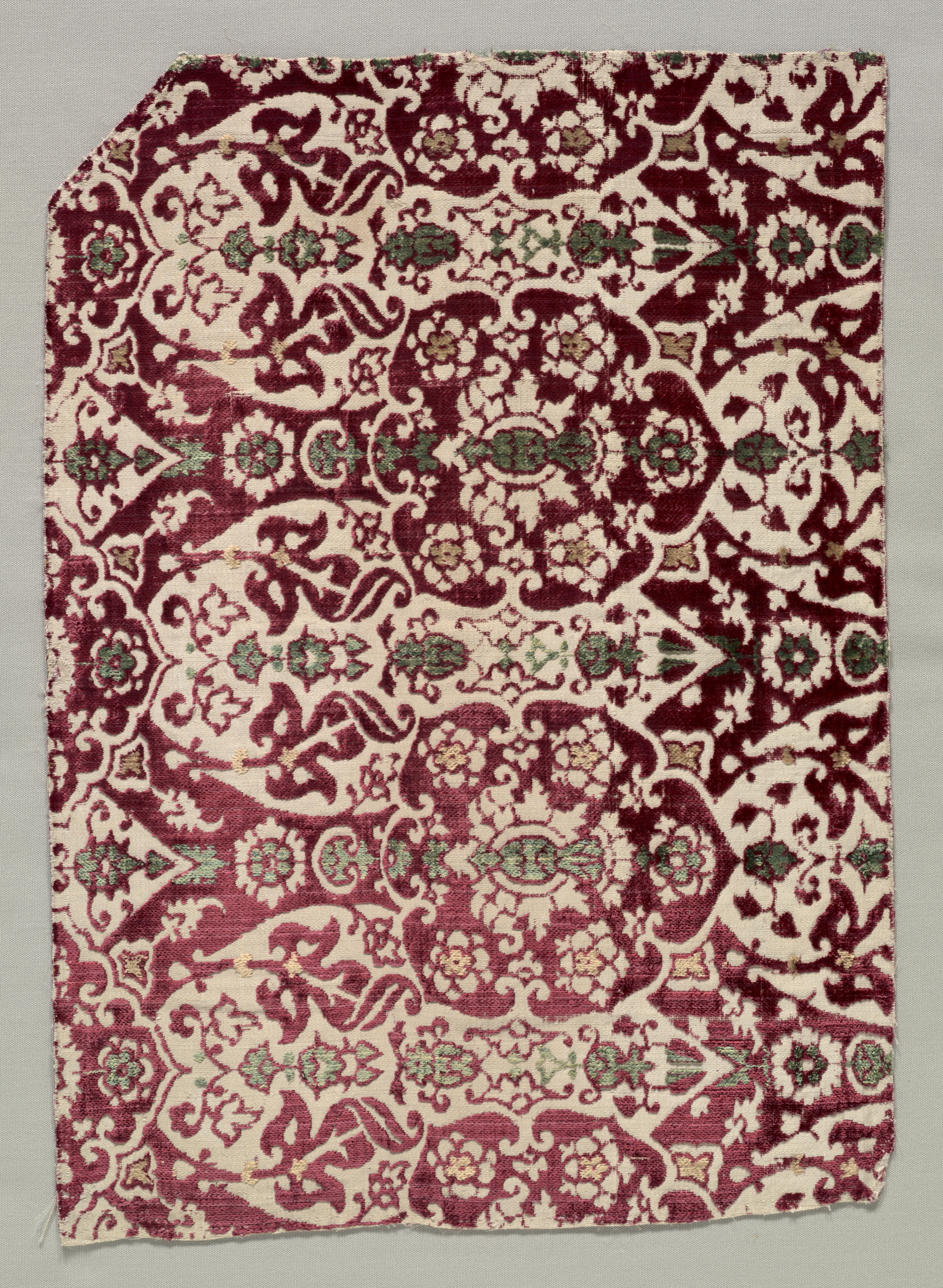
Deconstructing the Bursa Velvet: A 15th-Century Avant-Garde DNA Strand
As the Chief Fabric Deconstructionist for Zoey Fashion Lab, I am tasked with the radical reinterpretation of historical textiles—not as mere artifacts, but as living, mutable codes. The subject of this analysis is a remarkable specimen: a cut and voided silk velvet, originating from Bursa, Turkey, circa the second half of the 15th century. This fabric is not a relic; it is a New DNA Strand—a genetic blueprint for an avant-garde design language that challenges the boundaries of time, texture, and technology. By deconstructing its technical, historical, and aesthetic DNA, we can extract principles that inform a future-forward fashion vocabulary.
Technical Genesis: The Cut and Voided Velvet
The technical foundation of this textile is its construction as a cut and voided velvet. This is not a simple weave; it is a sophisticated interplay of two distinct pile heights and a ground weave. The "cut" refers to the loops of silk pile that have been sheared, creating a dense, plush surface that absorbs light. The "voided" technique involves selectively omitting the pile in specific areas, leaving the ground weave exposed. This creates a stark, deliberate contrast between the matte, structured ground and the luminous, fluid pile. For the avant-garde designer, this is not a decorative motif but a binary system—a dialogue between presence and absence, texture and void, material and negative space.
In the context of Zoey Fashion Lab, we can view this as a prototype for parametric design. The cut pile acts as a "positive" form, while the voided areas become "negative" channels. This principle can be translated into modern fabrication: laser-cut or digitally woven textiles that mimic the velvet's interplay of density and transparency. The 15th-century artisan’s precision in controlling pile height and voided zones foreshadows contemporary 3D-knitting and additive manufacturing, where material is deposited or removed with algorithmic exactitude. The velvet’s DNA is one of controlled chaos—a balance of luxury and restraint that the avant-garde can weaponize.
Historical Context: Bursa as a Silk Nexus
Bursa, in the second half of the 15th century, was the epicenter of Ottoman silk production, a crossroads of trade routes from Persia, China, and the Mediterranean. This velvet was not merely a commodity; it was a political and cultural statement. The voided patterns often featured arabesques, floral motifs, and geometric interlocks—symbols of imperial power and religious cosmology. However, for the avant-garde, these motifs are not sacred. They are mutable symbols that can be deconstructed, fragmented, and reassembled into new narratives.
Consider the velvet’s origin as a hybrid artifact: it is Turkish in manufacture, but its silk likely came from China, its dye techniques from Persia, and its market from Europe. This is a pre-modern example of globalization—a textile that embodies cross-cultural contamination. The avant-garde designer can leverage this DNA to create collections that critique or celebrate cultural fusion. For instance, the voided patterns can be digitally scanned and remapped onto non-woven fabrics, or the pile can be replaced with synthetic fibers that mimic its tactility while subverting its historical weight. The Bursa velvet is not a relic to be preserved; it is a template for cultural hacking.
Aesthetic DNA: The Avant-Garde Lens
To approach this velvet as a New DNA Strand is to see it as a living, evolving code. Its aesthetic DNA is composed of three key elements: texture, light, and tension.
Texture: The cut pile creates a surface that is both soft and assertive. It invites touch but resists easy categorization. In avant-garde fashion, texture is a tool for sensory disruption. This velvet’s pile can be exaggerated, miniaturized, or inverted—creating fabrics that feel like fur, moss, or even liquid. The voided areas, meanwhile, introduce a tactile silence, a pause in the sensory overload. This binary of plushness and flatness is a tactile grammar that can be used to construct garments that communicate through touch, not just sight.
Light: Velvet’s relationship with light is its most avant-garde property. The cut pile absorbs and reflects light unevenly, creating a dynamic, almost kinetic surface. This is not static color; it is chromatic behavior. For Zoey Fashion Lab, this principle can be translated into photochromic or thermochromic textiles that change hue in response to environment. The voided areas, being matte, act as light traps—creating shadows that emphasize the pile’s luminosity. This interplay of light and shadow is a spatial design tool, allowing garments to morph in perception as the wearer moves.
Tension: The velvet’s construction is a study in tension—between the dense pile and the delicate ground, between opulence and restraint. The voided technique introduces a deliberate structural vulnerability. The ground weave is exposed, making the fabric more fragile but also more articulate. This tension is a metaphor for the avant-garde’s core ethos: beauty born from risk. Designers can amplify this by cutting into the velvet, deconstructing its pile, or layering it with transparent materials. The fabric’s historical association with royalty becomes a tool for irony—a critique of power through its own material language.
From Artifact to Algorithm: The New DNA Strand
To treat this velvet as a New DNA Strand is to extract its generative principles rather than its historical form. The cut and voided technique can be algorithmically encoded into a design algorithm. For example, a digital loom can be programmed to replicate the pile-to-void ratio, but with modern variables: pile height, density, and color gradients. The result is a textile that is "descended" from the 15th-century original but evolved for contemporary expression.
Furthermore, the velvet’s structural DNA can be applied to non-textile materials. The cut-and-void principle can inform the design of 3D-printed garments, where "pile" is replaced with flexible filaments and "voids" with negative space. It can inspire the layering of smart textiles, where sensors and LEDs mimic the velvet’s light-absorbing and -reflecting properties. The avant-garde is not about replication; it is about mutation. The Bursa velvet is a progenitor, not a fossil.
Conclusion: The Future of the Past
In deconstructing this 15th-century Bursa velvet, Zoey Fashion Lab uncovers a radical blueprint for the future. Its technical precision, historical hybridity, and aesthetic tension are not constraints—they are catalysts. The cut and voided silk is a language of contrasts: plush and flat, sacred and profane, global and local. As a New DNA Strand, it invites us to rewrite its code, to splice its elements with contemporary technologies and critical theories. The avant-garde is not a rejection of history; it is a conscious re-engineering of its materials. This velvet is not a relic to be admired; it is a strand to be woven into the fabric of tomorrow’s fashion. At Zoey Fashion Lab, we do not preserve the past—we recode it.