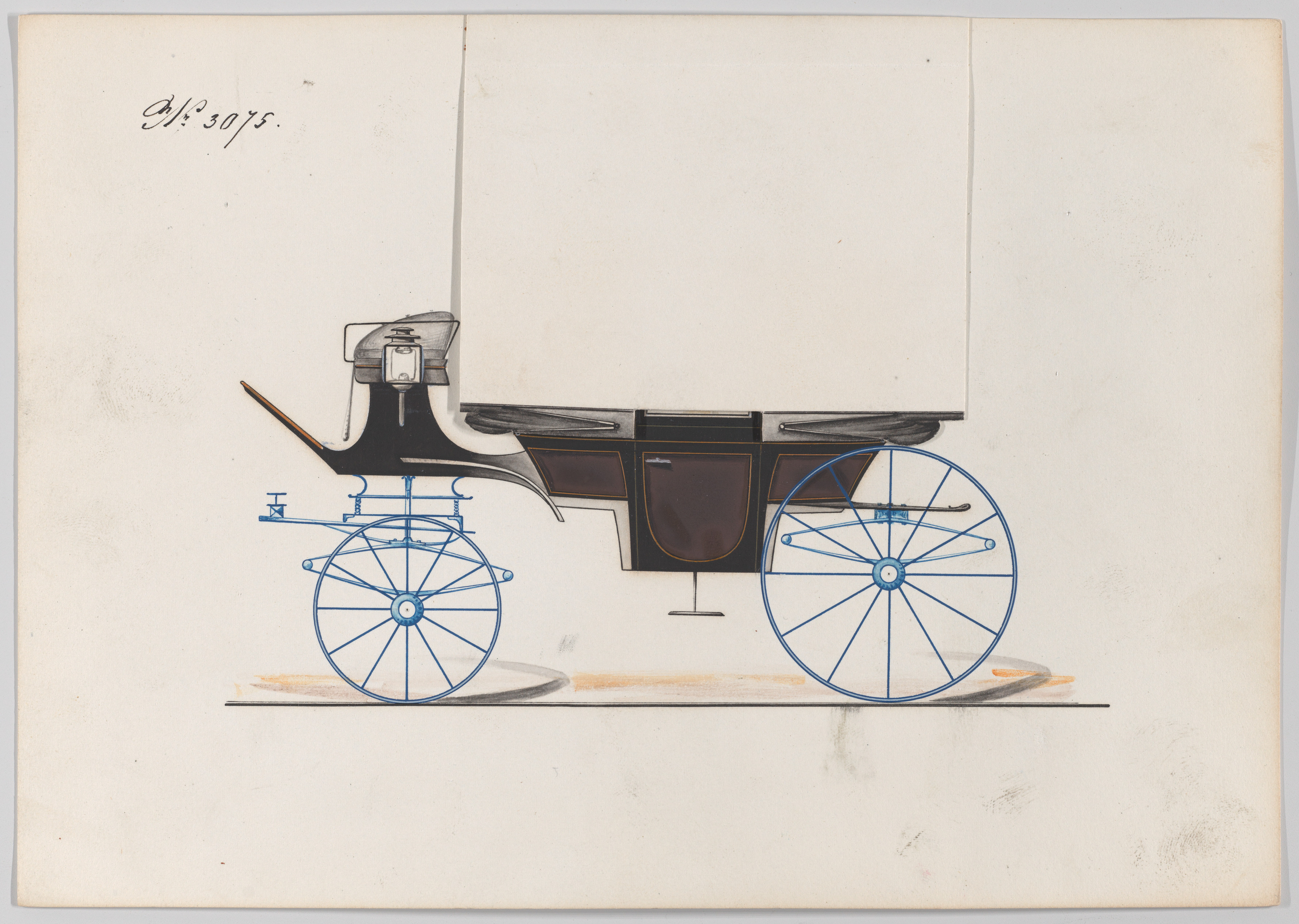
Deconstructing the Frontier: An Avant-Garde Analysis of Design for Landau, No. 3075
The artifact before us, Design for Landau, No. 3075, is not merely a garment study; it is a manifesto. Executed in the unforgiving precision of pen and black ink, tempered by the fluidity of watercolor and gouache with gum arabic, this piece from the Global Frontier transcends the conventional boundaries of fashion illustration. It is a standalone provocation, a blueprint for a future that has already arrived in the mind of the creator. For Zoey Fashion Laboratory, this work represents a critical inflection point in the development of the SS26 collection, demanding a rigorous analysis of its structural innovations and its radical redefinition of the human silhouette. The medium itself—a deliberate interplay of rigid line and aqueous wash—mirrors the core tension of the design: a struggle between architectural containment and organic liberation.
I. The Silhouette as a Spatial Proposition
The most arresting feature of No. 3075 is its rejection of the body as a passive canvas. Instead, the silhouette is proposed as an independent spatial volume, a negative space that actively negotiates with the wearer’s form. The shoulders are not padded; they are cantilevered. The waist is not cinched; it is voided. This is achieved through a series of what we might term “tensioned voids”—areas where the fabric appears to be suspended in a state of perpetual, controlled collapse. The watercolor washes suggest a gradient of density, from opaque, nearly armored panels at the structural apex to translucent, almost spectral membranes at the periphery. This is not draping; it is a form of topological engineering, where the garment’s surface is a continuous, non-Euclidean plane. The gum arabic, typically used to create a glossy, impermeable barrier, is here employed to delineate the precise edges of these negative spaces, turning them into hard, architectural boundaries against the soft, bleeding ink of the background.
II. Structural Innovation: The Pen-and-Ink Skeleton
The black ink work is the skeleton of the design. It is not merely outlining form; it is prescribing a structural logic. The lines are not continuous; they are broken, staccato, almost algorithmic. They suggest a construction method that is closer to modular assembly than traditional sewing. One observes a series of interlocking, asymmetrical panels that appear to be joined by invisible seams or, more provocatively, by the tension of the material itself. This is a radical departure from the Western tailoring tradition. It evokes the logic of digital fabrication—a garment that could be printed, laser-cut, and assembled with minimal human intervention. The watercolor infuses this cold, rational skeleton with organic life. The gouache provides opacity, suggesting areas of structural reinforcement, while the transparent watercolor layers hint at the possibility of embedded technology or reactive textiles. The design proposes a garment that is both a static object and a dynamic system, a piece of wearable infrastructure.
III. Materiality as a Conceptual Field
The choice of media—pen, ink, watercolor, gouache, gum arabic—is not arbitrary. It is a deliberate act of material semiotics. The pen and ink represent the immutable, the programmed, the structural DNA. The watercolor and gouache represent the mutable, the atmospheric, the biological. The gum arabic is the boundary, the interface between these two states. This duality is central to the SS26 thesis: the garment as a hybrid organism. The design suggests a fabric that is not woven but grown, or perhaps programmed to respond to environmental stimuli. The washes of color—a palette of industrial greys, sterile whites, and subtle, almost imperceptible bio-luminescent greens—evoke a post-human landscape. The garment is not meant to be worn in a conventional sense; it is meant to be inhabited, to be a mobile architectural unit for the Global Frontier. The materiality of the drawing itself becomes a prototype for the materiality of the final garment: a synthesis of the rigid and the fluid, the permanent and the ephemeral.
IV. The Global Frontier: A New Context for Couture
The designation “Global Frontier” is not a geographic label; it is a conceptual territory. It signifies a space beyond established fashion capitals, beyond the seasonal calendar, and beyond the binary of East and West. No. 3075 is a garment for this new territory. It is nomadic, adaptable, and fundamentally non-binary in its relationship to the body. The silhouette does not emphasize gender; it emphasizes agency. The structural innovations—the cantilevered shoulders, the tensioned voids, the modular panels—are not decorative. They are functional responses to an unknown environment. They are armor, shelter, and communication device all at once. The design rejects ornamentation in favor of pure structural expression. Every line, every wash, every boundary serves a purpose. This is couture as systems design, where beauty emerges from the elegant resolution of functional and formal constraints.
V. Conclusion: A Blueprint for SS26
Design for Landau, No. 3075 is a masterclass in avant-garde thinking. It is not a finished garment; it is a provocation, a set of principles, a generative algorithm for a new kind of fashion. For Zoey Fashion Laboratory, this study provides the foundational vocabulary for the SS26 collection. The key takeaways are clear: the silhouette must be redefined as a spatial proposition; construction must be modular and algorithmic; materiality must embrace hybridity and reactivity; and the context must be a frontier, not a center. This is fashion as architecture, as engineering, as biological speculation. It is a definitive statement that the future of couture lies not in the refinement of the past, but in the radical re-imagination of the possible. The pen and ink have drawn a line in the sand. The watercolor has washed the old world away. The frontier is open.