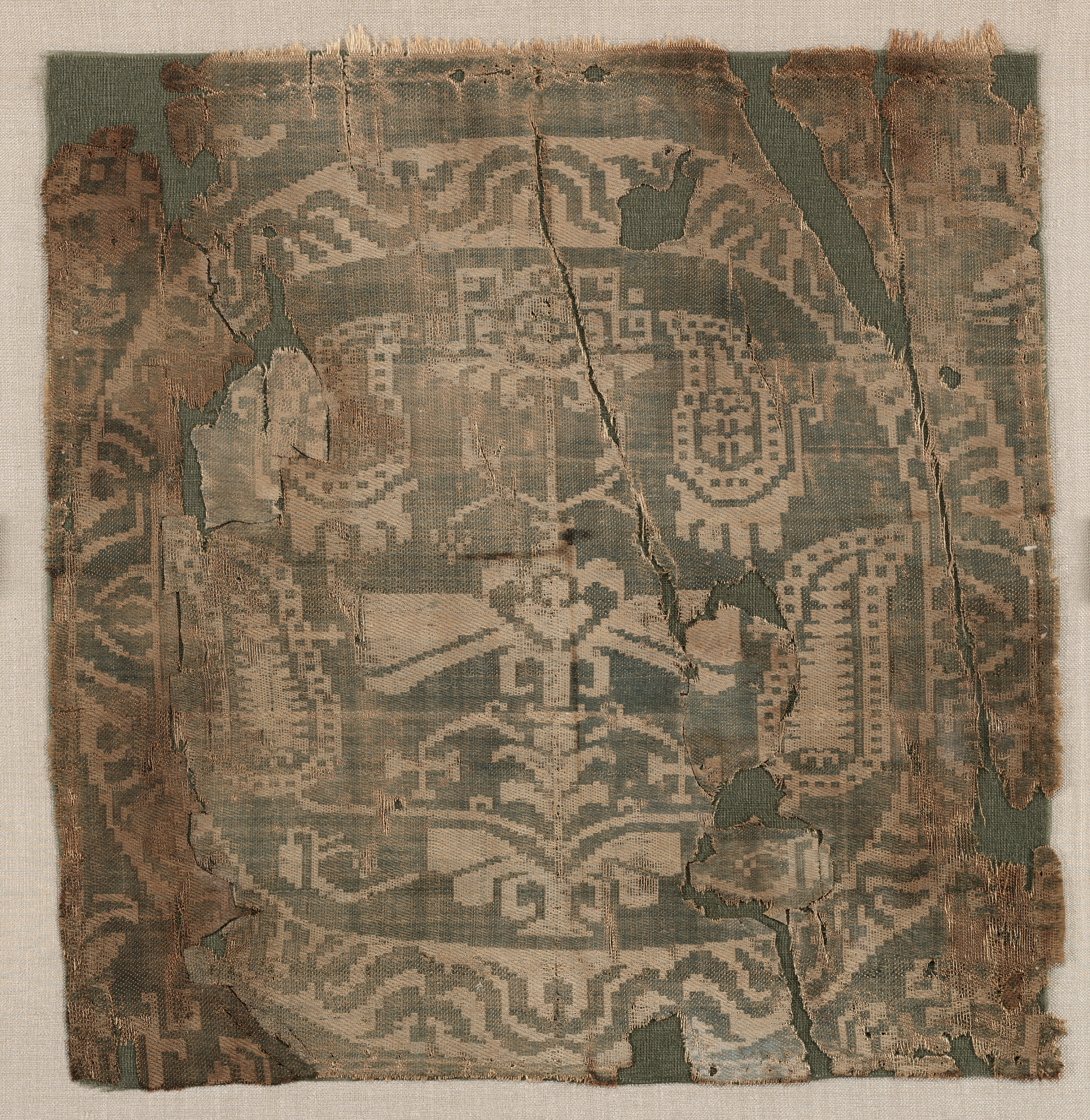
Deconstructing the Silk Roundel: An Avant-Garde Reading of a 16th-17th Century Palmette Tree
As the Chief Fabric Deconstructionist for Zoey Fashion Lab, my role transcends the mere analysis of textile artifacts. It is an act of archaeological excavation, a forensic investigation into the very DNA of a fabric’s existence. The subject before us—a silk roundel from a tunic, bearing a palmette tree, likely originating from Egypt or Syria, and executed in a complex complementary weft-faced twill weave with inner warps (samite)—is not a relic to be preserved in a glass case. It is a living, breathing manifesto of cultural collision, a silent scream of aesthetic ambition that demands to be re-read through the lens of the avant-garde. This roundel, dating from the 16th to 17th century, is a paradox: a product of meticulous, hierarchical craft that contains the seeds of its own radical deconstruction.
The Technical Palimpsest: Samite as a Site of Subversion
To understand the avant-garde potential of this roundel, we must first dissect its technical composition. Samite is not a simple weave; it is a complex structure of power and illusion. The complementary weft-faced twill weave, with its inner warps, creates a dense, almost sculptural surface. The weft threads—the “active” narrative elements—dominate the fabric, while the warps remain hidden, a structural skeleton. This is a fabric of deliberate opulence, where the shimmer of silk is used to create a hierarchy of light and shadow.
From an avant-garde perspective, this technical choice is a form of structural subversion. The inner warps, hidden yet essential, function like the unseen scaffolding of a radical architectural concept. They are the repressed structures of the fabric, the silent forces that enable the visible spectacle. In the context of Zoey Fashion Lab, we would not merely replicate this weave; we would expose it. We would create garments where the inner warps are deliberately pulled, frayed, or left raw, revealing the hidden labor and the precarious balance of the weave. This is not a sign of decay, but a deliberate act of deconstructive honesty, challenging the viewer to see the tension between the surface and the substructure.
Furthermore, the complementary weft-faced nature of the weave creates a dual narrative. The wefts are not just passive fillers; they are active participants, each one a potential agent of disruption. In our deconstructive practice, we would isolate these wefts, allowing them to become independent, floating elements that break free from the rigid pattern. We would turn the roundel’s logic inside out: the weft, once the dominant surface, becomes a loose, trailing thread, a fragment of a larger, unfinished story. This is the essence of the avant-garde—the refusal to accept the given hierarchy of the textile.
Iconography of the Palmette Tree: The Fractured Symbol
The central motif—the palmette tree—is a potent symbol of life, fertility, and paradise in Islamic and Byzantine art. It is a symmetrical, ordered form, a representation of cosmic harmony. Yet, in the context of the roundel, this tree is bound within a circular frame, a roundel that acts as a prison of perfection. The tree is not free; it is contained, repeated, and commodified as a decorative element for a tunic.
For the avant-garde designer, this is a call to iconoclastic action. The palmette tree must be shattered. We would not reproduce its symmetry; we would fracture it. Imagine a garment where the palmette tree is not a single, coherent image, but a series of dislocated, mirrored fragments. One branch might extend into a sleeve, while another is cut off at the seam, its missing half implied by a void or a contrasting fabric. The tree becomes a symbol of diaspora, of cultural displacement—a fitting commentary on its own uncertain origin (Egypt or Syria?).
The roundel itself is a device of containment, a circle that suggests eternity and unity. In our deconstruction, we would break the circle. The roundel would be cut, its edges left unfinished, its interior pattern spilling out into the negative space of the garment. We would use laser-cutting to create a palmette tree that is only partially present, its leaves and branches existing as a series of perforations, a ghost of the original. This is not a rejection of the symbol’s beauty, but a re-contextualization of it as a site of tension, a reminder that all cultural symbols are subject to fracture and reinterpretation.
Cultural Collision: The Avant-Garde as a Third Space
The roundel’s origin—Egypt or Syria—is a question that speaks to its own hybridity. It is a product of the Silk Road, a node in a network of cultural exchange that defies simple categorization. The palmette tree itself is a hybrid: a fusion of Persian, Byzantine, and Chinese motifs, reimagined through the lens of Islamic art. This is not a pure, singular artifact; it is a composite of influences, a testament to the fluidity of cultural identity.
In the avant-garde vision of Zoey Fashion Lab, we would amplify this hybridity to the point of radical dissonance. We would not attempt to “restore” the roundel to a supposed original state. Instead, we would create a garment that is a literal collage of cultural fragments. The samite weave might be combined with industrial fabrics—neoprene, vinyl, or metallic mesh—that speak to our own era. The palmette tree could be embroidered using a traditional technique, but on a background of digitally printed, distorted patterns that mimic the glitch of a corrupted image. This is the third space of the avant-garde: a place where the past is not preserved but reanimated, where the roundel becomes a dialog between the 16th century and the 21st, between the hand of the artisan and the algorithm of the machine.
The tunic itself is a garment of the body, a functional object. In our deconstruction, the tunic would become a site of performance. The roundel might be placed not on the chest, but on the back, or at the hip, or as a detachable piece that can be removed and worn separately. The garment would be designed to be mutable, to be taken apart and reassembled, challenging the fixed nature of both the historical object and the contemporary fashion item.
Conclusion: The Roundel as a Manifesto
This silk roundel is not a quiet artifact of a bygone era. It is a manifesto of complexity, a document of cultural negotiation, and a technical marvel that contains the seeds of its own undoing. As the Chief Fabric Deconstructionist, I see it as a challenge: to honor its history not by preserving it, but by disrupting it. The avant-garde is not about destruction for its own sake; it is about revealing the hidden structures, the suppressed narratives, and the potential for new meaning that lies dormant within the old.
In the hands of Zoey Fashion Lab, the roundel from a tunic with a palmette tree will be reborn. It will be cut, frayed, fragmented, and reassembled. Its samite weave will be exposed, its inner warps made visible, its symmetrical tree shattered into a constellation of possibilities. It will no longer be a silent witness to history; it will be a loud, provocative participant in the ongoing conversation of culture, a testament to the fact that the most avant-garde ideas are often those that have been waiting, hidden, in the threads of the past.