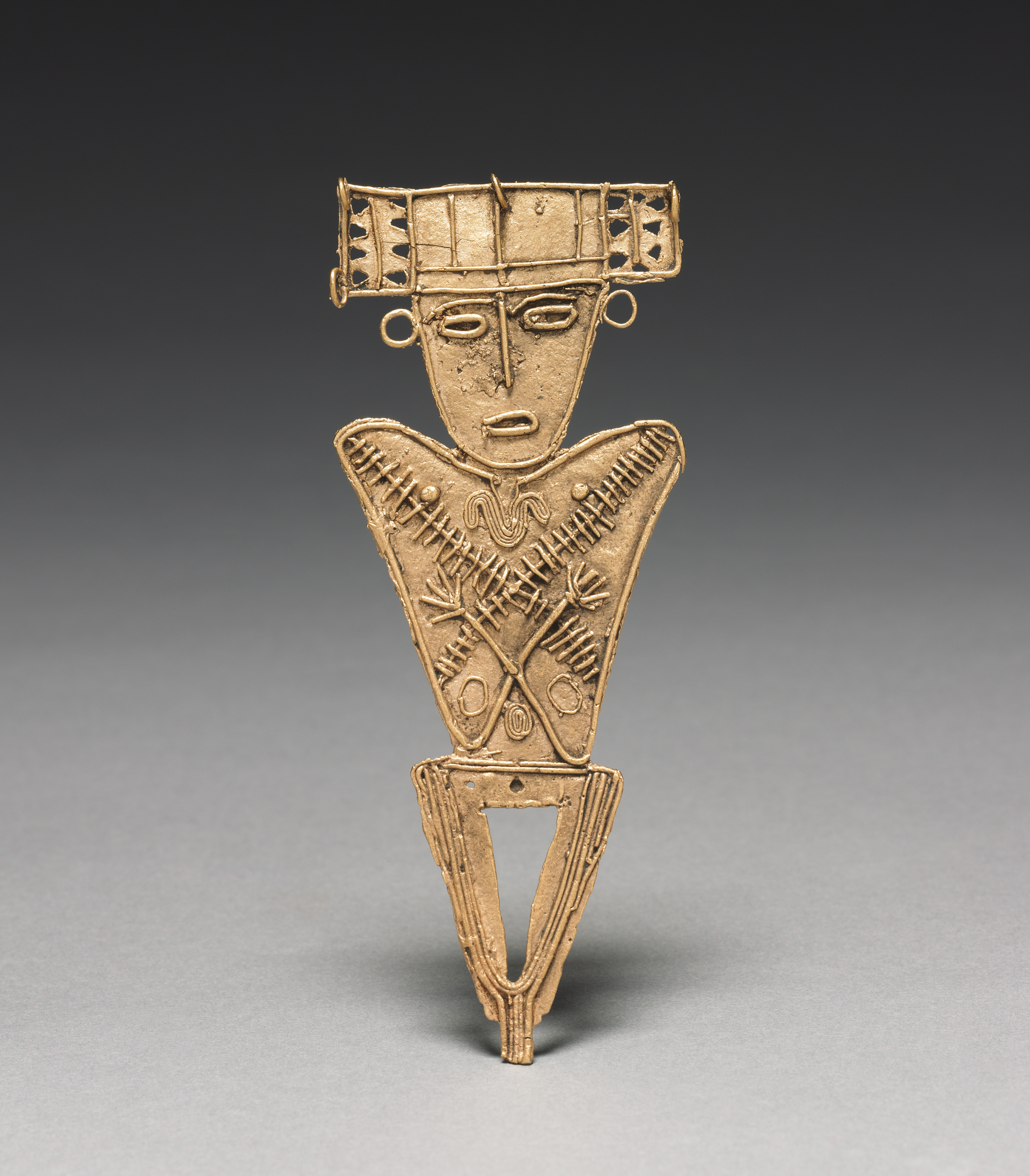
Technical Deconstruction: The Muisca Tunjos as Foundational Form
The Muisca tunjo, a small votive offering of cast gold, presents a profound starting point for avant-garde fabrication. Technically, its significance lies not in complexity but in semiotic purity. These are not ornate adornments but condensed narratives—human and animal forms reduced to essential, geometricized silhouettes through the lost-wax casting process. The material, gold, was not merely decorative for the Muisca; it was alive, a sacred embodiment of solar energy and generative power. For Zoey Fashion Lab, this translates into a foundational principle: material as narrative carrier. The "cast" implies a permanence of form, a frozen moment of spiritual dialogue. In deconstruction, we ask: How can cutting, draping, and seaming emulate this act of votive offering? Can a garment be a vessel for intention, its seams tracing a prayer or a personal narrative? The technical takeaway is the power of reduction and the sacred charge of the chosen material—be it lamé, recycled metal thread, or bioluminescent filament.
Archive Resonance: Mirror, Tomb, and the Duality of Surface
The provided reference—"一面是光洁银镜上以黄金镶嵌的纷繁棕叶纹,另一面是冰冷石棺板上以浮雕诉说的生命叙事" (On one side, the intricate palm frond pattern inlaid in gold on a smooth silver mirror; on the other, the narrative of life told in relief on a cold stone coffin plate)—offers a master key for avant-garde interpretation. This is a philosophy of duality and layered revelation. The mirror represents the surface, the present, the reflective and decorative—akin to the immediate visual impact of fashion. The gold-inlaid pattern is beautiful, controlled, and complex. The stone coffin, however, speaks of depth, history, mortality, and textured narrative—the hidden structure, the personal history, the socio-political context garment carries.
Applying this to the tunjo and our collection, we propose garments that are deliberately dichotomous. Imagine a jacket: one side, a sleek, mirror-finished lamé, laser-cut with an elaborate, tunjo-inspired geometric pattern (the "palm frond on the mirror"). The inside lining or the reverse side is a heavily textured, stone-grey sculptural fabric, perhaps 3D-printed or deeply pleated, embedding literal fragments of narrative—embroidered text, impressionistic reliefs suggesting facial features or tools (the "life narrative on the coffin"). The wearer chooses which face to present to the world, embodying the tension between public persona and private history, between adornment and archaeology.
Avant-Garde Synthesis: The "Votive Silhouette" Collection
From this analysis, Zoey Fashion Lab's "Votive Silhouette" collection emerges, built on three pillars:
1. The Cast Silhouette
Moving away from fluid draping, we explore shapes that appear "cast" or "forged" around the body. Structured, minimally seamed bodices and sleeves that evoke the solid, static form of the tunjo. Seams are not hidden but elevated as sacred lines of offering, outlined in metallic thread or left as intentional, raw-edged apertures. Silhouettes are archetypal—tunic, sheath, cape—but rendered in rigid, paper-like textiles or molded biocomposites, then partially "gilded" with applications of gold leaf or foil transfer that appears worn and devotional rather than uniformly lavish.
2. The Dichotomous Membrane
Every garment is a dialectical object. A skirt may feature a front panel of hyper-modern, reflective e-textile (the mirror) capable of displaying shifting patterns, while the back is a densely hand-embroidered, tactile "relief" mapping the artisan's personal story or data from Muisca territory (the coffin). A coat's exterior might be pristine, silver-coated technical fabric; its immense, detachable lining is a patchwork of upcycled fabrics, each swatch a documented votive offering from a community participant, creating a collective narrative cloak.
3. Material as Ritual
We treat fabrication as ceremony. Gold is used sparingly, as sacred accent—a molten-looking drip solidifying on a seam, a thread in a jacquard weave only visible from certain angles. We incorporate materials with inherent resonance: mud-cloth dyed fabrics referencing earth, recycled bronze mesh, and clear resins encapsulating organic matter (seeds, leaves) like artifacts in a museum. The "casting" process is mirrored in our use of bio-plastics molded directly on mannequins, capturing a momentary form.
Conclusion: Beyond Apparel, Towards Artefact
The Muisca tunjo, viewed through the lens of avant-garde deconstruction, challenges us to see clothing not as seasonal commodity but as contemporary votive object. Each piece in the resulting collection is designed to be a vessel. It carries the duality of the mirror and the tomb—simultaneously a reflective surface for the present self and a textured repository of layered stories. It invokes the tunjo's sacred materiality, treating every stitch, seam, and textile choice as an intentional act of offering.
For Zoey Fashion Lab, this project moves beyond aesthetic referencing into the realm of fashion archaeology and spiritual pragmatism. We are not copying forms but channeling principles: reduction, intentionality, duality, and narrative depth. The final garments stand as silent, powerful testaments—not to deities of sun and earth, but to the complex human condition, worn on the body as both shield and confession, as mirror and memoir. This is fashion that does not merely clothe the body but asks it to bear witness.