Technical Deconstruction: The Anatomy of a Renaissance Marvel
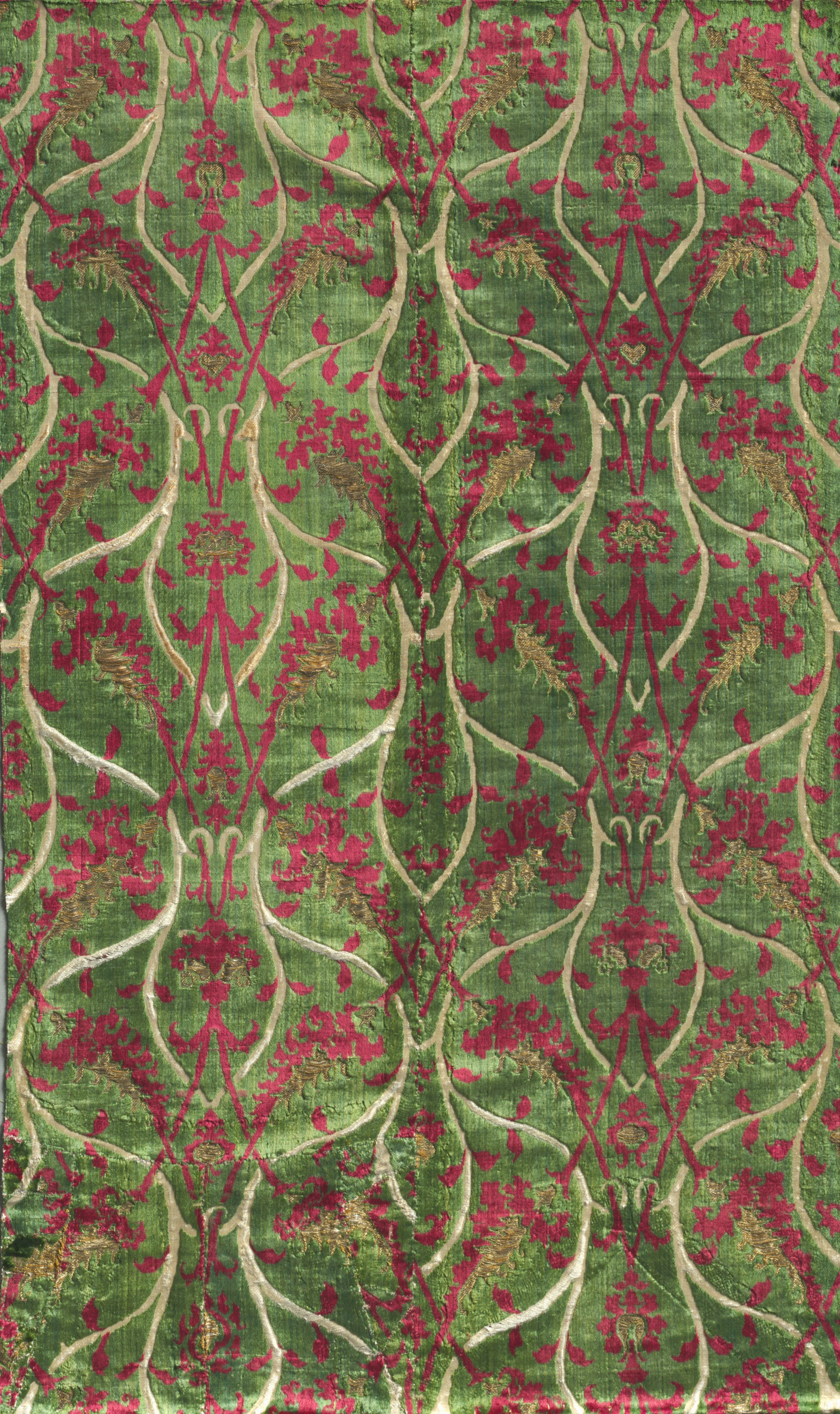
The fabric in question is not merely a textile; it is a topographical landscape of luxury and technical audacity. As your Chief Fabric Deconstructionist, I categorize it as a polychrome voided velvet with brocaded gold, a pinnacle of 15th-century Italian textile engineering. Each term is a deliberate stratum of complexity. The foundation is silk, providing the essential, resilient ground. Upon this, the cut pile technique creates the plush, light-absorbing velvet field—a luxurious negative space. The "voided" aspect is critical: here, the velvet pile is selectively omitted to form the lattice pattern itself, allowing the sleek silk ground (the "void") to become a design element in stark, smooth contrast to the tactile pile.
However, the masterstroke is the brocaded gold thread. This is not an embroidery added later but is woven in-situ during the velvet creation on a drawloom, a monumental and time-consuming process. The gold—likely a silk core wrapped in fine gilded membrane—traverses and unites the composition. It brocades across both the velvet pile and the voided silk ground, acting as a luminous contour, a connective tissue of opulence that elevates the lattice from a mere pattern to a gilded architectural framework. The "two-color" descriptor likely refers to the dominant contrast between the deep, rich hue of the velvet (perhaps crimson or deep green) and the metallic gold, though the silk ground may present a third, subtle tone.
The Pattern: Double Curved Lattice as Avant-Garde Architecture
The double curved lattice is the intellectual heart of this textile. This is not a simple, rigid grid. Imagine a network of split palmettes or rinceaux, where two sets of flowing, botanical lines curve and intertwine, intersecting at organic points to create a dynamic, repeating cellular structure. It is a representation of ordered nature—a geometric capture of growth itself. This reflects the Renaissance mind: seeking to impose humanist geometry on natural forms. The lattice is both a window and a cage; it frames space while creating it.
Your provided reference—"一面是光洁银镜上以黄金镶嵌的纷繁棕叶纹,另一面是冰冷石棺板上以浮雕诉说的生命叙事"—resonates profoundly. It describes "on one side, intricate palm-leaf patterns inlaid in gold on a smooth silver mirror; on the other, a narrative of life told through relief on a cold stone coffin plate." This is the essence of this fabric. The voided and brocaded lattice is that silver mirror: refined, polished, a surface of exquisite artifice and reflection. The plush velvet within the lattice cells is the stone coffin's relief: deep, shadowed, tactile, and imbued with a narrative of sensory life and mortal luxury. The fabric is a dialectic object, holding the tension between surface and depth, between the immortal gleam of gold and the mortal softness of dyed silk.
Zoey Fashion Lab: Avant-Garde Translation Protocol
The directive is Avant-garde. This is not about historical replication. It is about extracting the core principles—dichotomy, structure, material dialogue, and profound symbolism—and propelling them into the future. Our translation must honor the complexity by deconstructing it further, not simplifying it.
Proposed Material & Technical Interventions:
1. Substrate Reimagining: Replace the silk ground with a technical mesh or laser-etched patent leather to modernize the "void." The contrast should no longer be merely matte vs. shiny, but permeable vs. impermeable, transparent vs. opaque.
2. Pile Reinterpretation: The velvet cut pile can be translated into neoprene shaving, recycled denier flocking, or even 3D-printed silicone nodules. The goal is to retain the tactile, shadow-capturing quality of "pile" using unexpected, sustainable, or high-tech materials.
3. Gold Thread Metamorphosis: The brocaded gold must evolve. Consider thermochromic conductive yarns that change color with body heat, or ultra-thin photovoltaic strands that capture light. The gold becomes functional, interactive, losing none of its symbolic weight as a precious, transformative line.
Pattern & Structural Application:
The double curved lattice should escape the two-dimensional plane. Imagine it as a structural exoskeleton on a garment. The "lattice" could be rendered in rigid, gold-anodized aluminum wire or flexible bioplastic, applied over a base garment of technical velvet. It becomes a cage, an armor, a second skin that frames the body and the fabric beneath. Alternatively, use laser-cutting and ultrasonic welding to create the voided lattice directly into composite fabric sheets, fusing layers to reveal understrata—a literal deconstruction of surface and depth.
The avant-garde power lies in juxtaposing the cold, mirror-like precision of the lattice (in modern materials) with the organic, mortal narrative of the textured, responsive "pile" areas. A garment could feature a rigid, lattice-structured bodice that dissolves into a fluid, plush skirt. The narrative of the "stone coffin" (tactile, embodied, mortal) and the "silver mirror" (reflective, imposing, immortal) becomes a commentary on the modern body: armored yet vulnerable, on display yet deeply personal.
Conclusion: The Resonance of Dichotomy
This 15th-century Italian velvet is a masterpiece of controlled tension. For Zoey Fashion Lab, its value lies in its inherent contradictions: void versus pile, silk versus gold, structure versus growth, mirror versus narrative. Our avant-garde mission is to amplify these tensions with contemporary tools and consciousness. We are not weaving a fabric; we are engineering a philosophical garment that questions surface and substance, permanence and decay, the body as object and the body as subject. The archive has provided a profound blueprint. Our task is to build its future echo, one where the gold thread may carry a current, and the velvet may tell a new, urgent story.