Deconstructing the Velvet Fragment: A Convergence of 14th Century Craft and Avant-Garde Vision
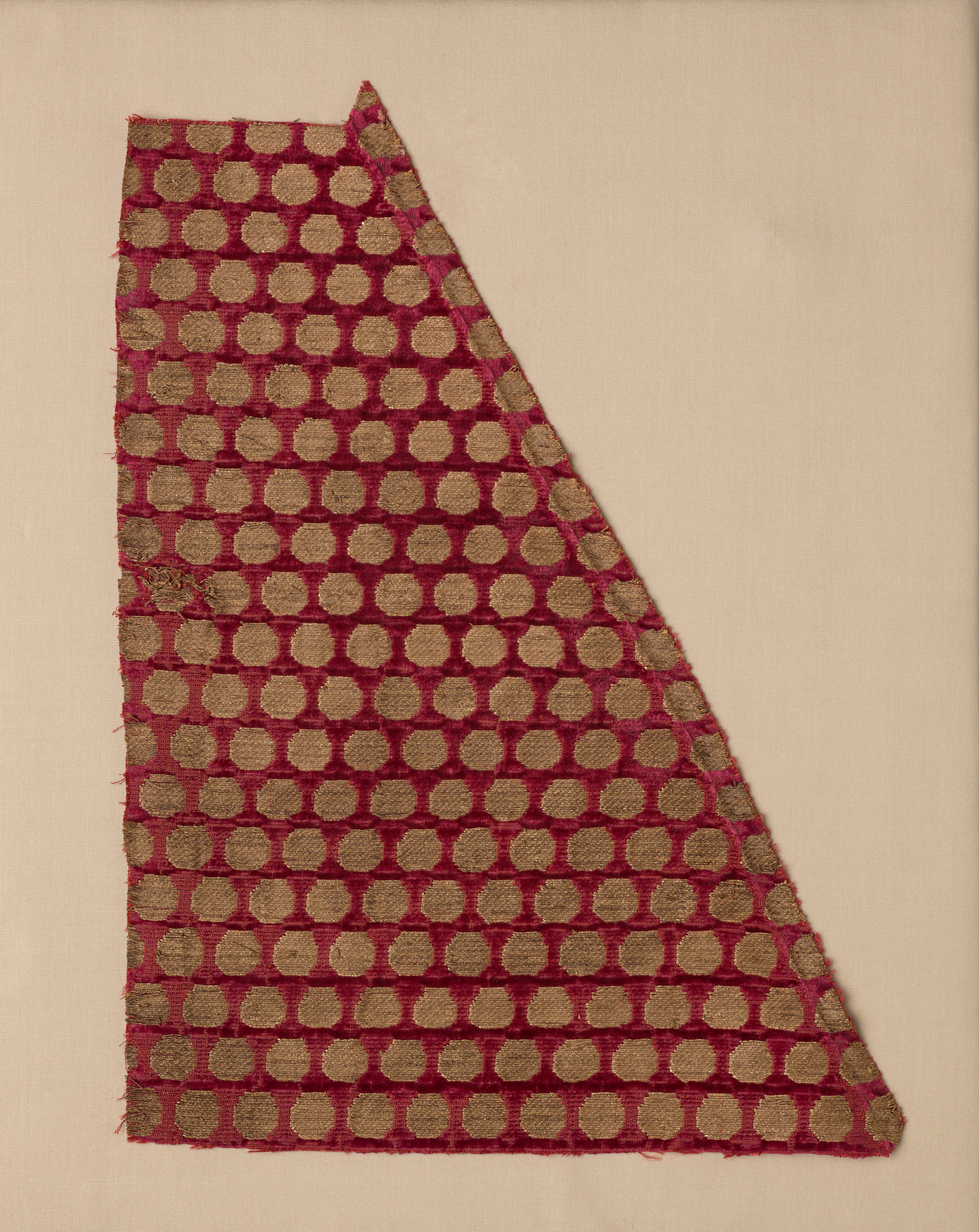
As Chief Fabric Deconstructionist for Zoey Fashion Lab, I am tasked with not merely examining historical textiles but with extracting their latent potential for avant-garde design. The subject of this analysis—a velvet fragment in two pieces, originating from 14th century Iran or Iraq—presents a profound opportunity. This is not a relic to be preserved behind glass; it is a New DNA Strand, a genetic code for a future garment that challenges the very definition of luxury, structure, and narrative. The fragment’s technical composition—velvet, lancé, silk, and Cyprian gold around a silk core—offers a blueprint for a design language that is both ancient and radically new.
Technical Autopsy: The Material Vocabulary
The fragment’s construction is a masterclass in medieval opulence. The velvet ground, achieved through a complex pile weave, creates a surface of deep, absorbent shadow. The lancé technique—a supplementary weft that floats across the back of the fabric—introduces a secondary pattern, often metallic, that catches light. The Cyprian gold, a gilded membrane wrapped around a silk core, is the true protagonist. This is not a mere thread; it is a micro-architecture of metal and protein, flexible yet unyielding, reflective yet warm. The fragment’s two pieces likely represent a single garment—perhaps a robe or a ceremonial hanging—now severed, their edges raw and frayed.
From a deconstructionist perspective, the fragment’s incomplete state is its greatest asset. The cut edges are not flaws but invitations. The warp and weft, exposed, become a blueprint for a new structural logic. The gold thread, once a symbol of imperial power, is now a material to be manipulated—unraveled, re-knotted, or suspended. The velvet pile, compressed over centuries, holds memory of touch, of weight, of time. This is not a fabric to be replicated; it is a genetic sequence to be expressed.
The Avant-Garde Imperative: From Fragment to Form
Zoey Fashion Lab’s avant-garde ethos demands that we reject historical reverence in favor of radical reinterpretation. The 14th century fragment must not be restored; it must be recontextualized. The two pieces, separated by time and damage, are now a diptych—a dialogue between absence and presence. The avant-garde garment must honor this duality. Imagine a coat where one sleeve is constructed from the original velvet (preserved under inert gas) and the other from a 3D-printed scaffold that mimics the gold thread’s geometry. The seam where the two pieces meet becomes a narrative scar, a visible suture between centuries.
The lancé technique informs a new approach to surface ornament. Instead of weaving gold into the fabric, we can laser-cut the velvet to expose the silk core, creating a pattern of voids that echo the original metallic motifs. The gold thread itself can be electroformed onto a modern base, creating a lattice that floats above the fabric. This is not decoration; it is structural engineering. The garment’s silhouette must be asymmetrical, with one side heavy with velvet drapery and the other light, almost skeletal, revealing the gold structure beneath.
Material Alchemy: The New DNA Strand
The fragment’s Cyprian gold is a technical marvel: a gilded animal membrane (likely from a sheep or goat) wrapped around a silk core. This composite material is both precious and fragile. For the avant-garde interpretation, we must deconstruct this composite into its elemental parts. The gold membrane can be extracted and re-laminated onto a modern, flexible polymer, creating a metallic film that can be pleated, crushed, or stretched. The silk core, once freed, becomes a thread for hand-stitched calligraphy—a text that recounts the fragment’s history in a new, abstract script.
The velvet pile offers another avenue for transformation. By chemically dissolving the silk in specific zones, we can create a topographical map of the original pattern, where the pile is selectively removed to reveal the ground weave. This is a form of negative space architecture. The resulting garment would have areas of plush depth alternating with flat, almost transparent sections, mimicking the fragment’s own decay. The two pieces themselves can be joined not by a seam but by a magnetic clasp that references the original garment’s closure, allowing the wearer to choose whether to unite or separate them.
Narrative and Wearability: The Avant-Garde Statement
The final garment is not a costume; it is a wearable manifesto. It must be heavy enough to feel the weight of history but engineered for movement. The gold thread can be woven into a flexible chainmail that drapes like liquid metal, while the velvet forms a second skin that absorbs light. The lancé pattern is reinterpreted as a digital print on the underside of the fabric, visible only when the garment is lifted—a secret language for the initiated.
The fragment’s origin—Iran or Iraq, 14th century—carries geopolitical weight. The avant-garde design must acknowledge this without being didactic. The two pieces can be dyed in contrasting shades of indigo and ochre, referencing the trade routes that brought these materials together. The cut edges are left raw, but frayed with gold thread that has been unraveled and re-knotted into a fringe that mimics the calligraphic borders of Persian manuscripts. The garment becomes a palimpsest: a text overwritten by time, now rewritten by Zoey Fashion Lab.
Conclusion: The Fragment as Blueprint
This velvet fragment is not a historical artifact; it is a New DNA Strand for the future of fashion. Its technical complexity—velvet, lancé, silk, Cyprian gold—offers a vocabulary for a new material language. Its incomplete state is an invitation to create a garment that is both a tribute and a rebellion. The avant-garde design must be unstable, unfinished, and unapologetically transformative. It is a garment that wears its history on its sleeve, but that sleeve is cut, frayed, and re-stitched with gold. The fragment is no longer a piece of the past; it is the first stitch of a future that has yet to be woven.