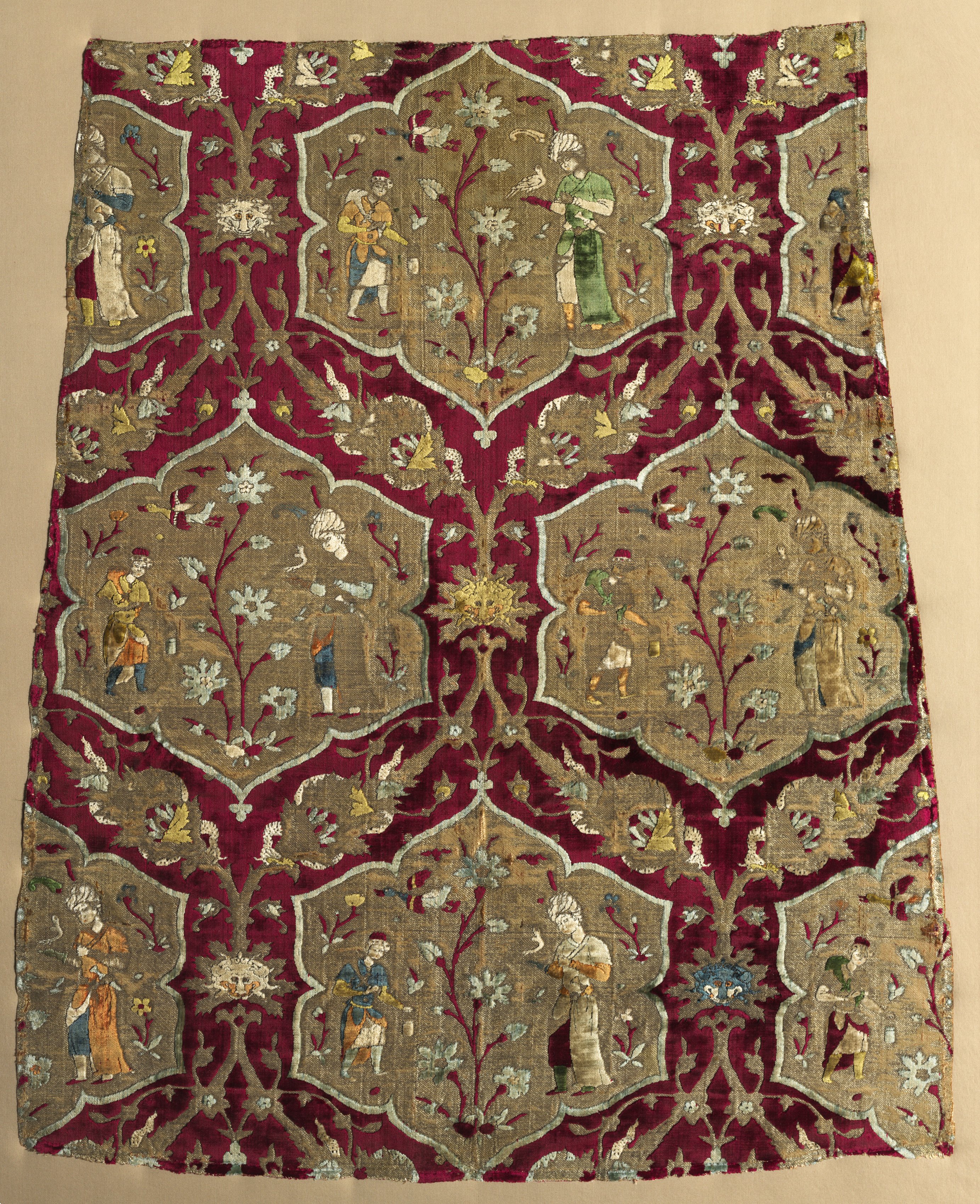
Deconstructing the Safavid Avant-Garde: A Technical and Stylistic Analysis of the Kashan Falconer Fragment
At Zoey Fashion Lab, we approach historical textiles not as artifacts to be preserved, but as living blueprints for radical reinterpretation. The fragment from a Safavid-period robe, originating in Kashan, Iran (circa 1501–1722), presents a compelling case study in deconstructive fashion. This piece, featuring a falconer and attendant within an animated lattice, is executed in silk velvet with brocaded details, pile-warp substitution, and gilt-metal thread. Its technical complexity and thematic richness offer a new DNA strand for avant-garde design—a fusion of opulent craft and subversive structure that challenges conventional garment logic.
Technical Mastery as Subversive Foundation
The fragment’s construction is a testament to Safavid textile innovation, yet its very precision invites deconstruction. The velvet base, created through pile-warp substitution, establishes a dense, plush surface that absorbs and reflects light unevenly. This technique, where additional warp threads are woven to create raised patterns, is inherently structural—a grid that can be broken. For avant-garde purposes, we view this as a tactile lattice ripe for dissection. The brocaded gilt-metal thread, woven into the fabric as supplementary wefts, introduces a metallic rigidity that contrasts with the silk’s suppleness. This juxtaposition of materials—soft against hard, matte against shimmer—is a foundational principle in deconstructive fashion, where tension between elements becomes a design feature.
The animated lattice pattern, which frames the falconer and attendant, is not merely decorative. It functions as a visual cage, yet the figures within appear dynamic, suggesting movement. This paradox—confinement versus liberation—is central to our analysis. In an avant-garde context, the lattice can be reinterpreted as a structural exoskeleton, either exposed or fragmented. The pile-warp substitution creates a three-dimensional topography, allowing us to consider how the fabric’s surface might be manipulated through cutting, layering, or reversing. The gilt-metal thread, often used to denote status in the Safavid court, becomes a tool for irony: its opulence can be subverted by exposing raw edges or deliberately fraying the metallic strands to create a distressed, industrial aesthetic.
The Falconer Motif: Power, Motion, and Material Dialogues
The central figure—a falconer with a bird of prey—symbolizes mastery and control, a theme that resonates with fashion’s own power dynamics. The attendant, positioned in a subordinate role, reinforces a hierarchy that avant-garde design often seeks to dismantle. However, the animated lattice disrupts this static hierarchy. The figures are not isolated; they are embedded within a network of repeating geometric and floral forms, suggesting interdependence. For Zoey Fashion Lab, this translates into a design philosophy where garments are not singular statements but systems of relationships. The falconer’s raised arm, for instance, can inspire a sleeve construction that appears to detach from the body, while the attendant’s posture might inform asymmetrical draping that challenges balance.
The use of gilt-metal thread introduces a metallic sheen that, when combined with the velvet’s depth, creates a chiaroscuro effect. This interplay of light and shadow is crucial for avant-garde silhouettes that rely on volume and negative space. The fragment’s original function as part of a robe suggests a garment designed for movement—a robe that flows and drapes. By isolating the fragment, we can extract its kinetic energy: the lattice pattern can be reinterpreted as a structural grid for modular garment components, where sections are attached with visible seams or left unstitched to create deliberate gaps. The falconer’s bird, a symbol of freedom, might inspire a detached collar or a cape that can be removed, emphasizing the wearer’s agency over the garment.
Avant-Garde Recontextualization: From Safavid Court to Deconstructive Runway
To translate this fragment into an avant-garde collection, we must first strip it of its original context. The Safavid robe was a marker of status and luxury, but in our hands, it becomes a raw material for rebellion. The pile-warp substitution technique, which creates a velvet pile of varying heights, can be exploited through selective shearing—cutting away sections of the pile to create a distressed, worn appearance that contrasts with the intact brocaded areas. This process mimics the deconstructive approach of designers like Rei Kawakubo or Martin Margiela, where imperfection is elevated to a design principle.
The gilt-metal thread, typically woven with precision, can be intentionally broken or left loose to create metallic tendrils that escape the fabric’s boundaries. This technique introduces a tactile, almost chaotic element that subverts the fragment’s original order. The animated lattice, when deconstructed, can be transformed into a network of straps, loops, or cutouts that restructure the garment’s silhouette. For example, a jacket might feature a lattice-inspired back panel where the fabric is cut away to reveal the wearer’s skin, with the remaining threads forming a web-like structure. This approach honors the original pattern while redefining its function.
Material Alchemy: Silk, Velvet, and Metal in Dialogue
The fragment’s material composition—silk, velvet, and gilt-metal thread—presents a rich palette for alchemical transformation. Silk, a protein fiber, accepts dye and manipulation beautifully, allowing for techniques like pleating, shibori, or devoré (burning away sections of the fabric to create patterns). The velvet’s pile can be crushed, embossed, or selectively removed to create texture contrasts. The gilt-metal thread, often made of silver-gilt wrapped around a silk core, is surprisingly durable yet can be chemically treated to tarnish or patina, introducing an aged, archaeological quality. For an avant-garde piece, we might combine these techniques: a velvet base with devoré patterns that reveal a silk underlayer, while gilt-metal threads are left exposed and oxidized to create a verdigris effect.
The pile-warp substitution technique, which creates a raised pile only in specific areas, is particularly suited for deconstruction. By reversing the fabric or cutting into the pile, we can expose the foundation weave, creating a binary of texture—smooth versus plush, matte versus shiny. This binary can be extended to the garment’s construction: one sleeve might be fully velvet, while the other is reduced to a skeletal lattice of gilt-metal threads. The result is a garment that tells a story of decay and renewal, reflecting the fragment’s journey from a Safavid robe to a contemporary fashion statement.
Conclusion: The Fragment as a Blueprint for Radical Fashion
The Kashan falconer fragment is more than a historical artifact; it is a new DNA strand for avant-garde design. Its technical sophistication—velvet, brocade, pile-warp substitution, gilt-metal thread—provides a vocabulary for material experimentation. Its thematic content—power, motion, confinement—offers a narrative for subversive garment construction. At Zoey Fashion Lab, we deconstruct not to destroy, but to reveal hidden potentials. The animated lattice becomes a structural system; the falconer becomes a symbol of liberated form; the gilt-metal thread becomes a tool for irony. In this fragment, we find the seeds of a fashion that is both historically rooted and radically forward-looking—a testament to the enduring power of textile deconstruction.