Deconstructing the Avant-Garde: A Technical and Aesthetic Analysis of an 18th-Century French Flower Embroidery Design for Zoey Fashion Lab
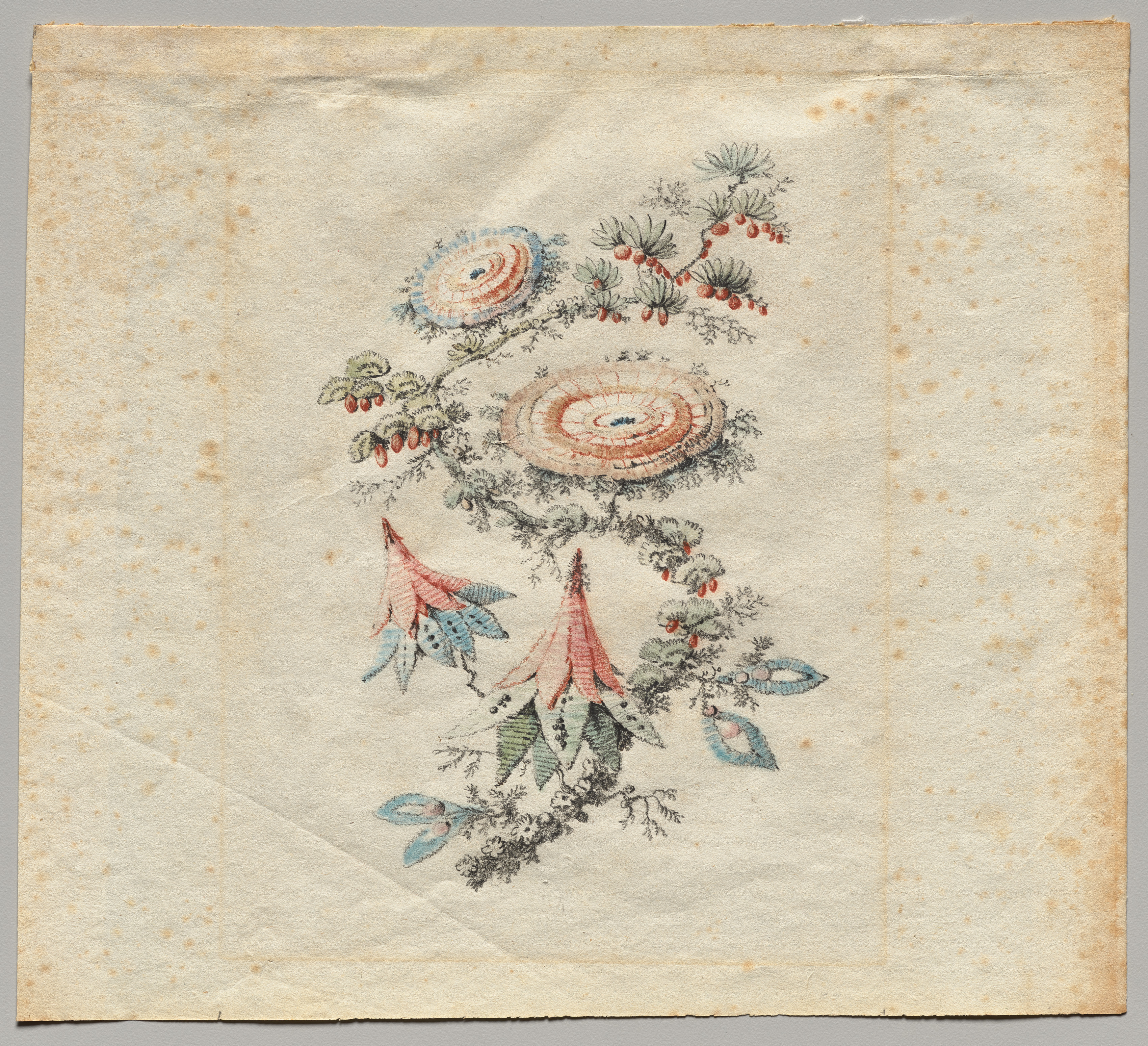
At Zoey Fashion Lab, our mission is to unravel the hidden narratives within historical textile artifacts, transforming them into new DNA strands for contemporary fashion. Today, we deconstruct a singular artifact: an 18th-century French flower embroidery design, executed in black and colored crayon on wove paper, originating from the renowned Silk Manufactory of Lyon. This piece, far from being a mere botanical study, represents a critical node in the evolution of textile design. Through the lens of the avant-garde, we will dissect its technical execution, its historical context, and its potential to inform radical new fabric constructions.
I. The Technical Matrix: Crayon on Wove Paper
The choice of medium—black and colored crayon on wove paper—is the first clue to the design’s avant-garde potential. In the 18th century, wove paper was a relatively new technology, offering a smoother, more uniform surface than laid paper. This allowed for unprecedented precision in rendering fine details, such as the delicate veins of petals or the subtle gradations of light and shadow. The use of crayon, rather than ink or watercolor, suggests a deliberate emphasis on line and texture. The artist’s hand is visible in the varying pressure of the crayon strokes, creating a tactile quality that anticipates modern drawing techniques.
Technically, the design employs a binary system of black and color. Black crayon establishes the structural framework—the stems, the central axes of petals, and the geometric underlayment of the composition. Colored crayons, likely limited to a palette of reds, blues, yellows, and greens, are applied in layered, cross-hatched strokes to build volume and depth. This is not a naturalistic rendering; rather, it is a deconstruction of floral form into its essential components. The petals are not painted in smooth gradients but are articulated through discrete, almost pixelated, marks. This technique prefigures the pointillist and divisionist approaches of the late 19th century, revealing an early understanding of optical color mixing.
Furthermore, the paper itself becomes a participant in the design. The off-white ground of the wove paper serves as a negative space that defines the contours of the flowers. The artist has left areas of the paper untouched, creating a tension between the drawn marks and the blank field. This is a sophisticated use of non-finito, a concept that would later become central to avant-garde aesthetics. The design is not a finished illustration but a blueprint for translation—a set of instructions for the weaver to interpret in silk thread.
II. Historical Context: The Silk Manufactory of Lyon as a Crucible of Innovation
The Silk Manufactory of Lyon was not merely a production center; it was a laboratory of design innovation. By the 18th century, Lyon had become the epicenter of European silk weaving, driven by a complex interplay of royal patronage, mercantile ambition, and technical mastery. The Jacquard loom, though not yet invented, was foreshadowed by the systematic approach to pattern design seen in these crayon drawings. Each flower, each leaf, was a modular unit that could be repeated, scaled, or rotated to create a continuous fabric pattern.
This particular design, with its bold use of black outlines and vibrant color accents, reflects the roccoco spirit of the period—a love for asymmetry, natural forms, and playful exuberance. However, the avant-garde reading reveals a deeper layer. The flowers are not depicted in a state of organic growth; they are frozen, isolated, and abstracted. The stems are drawn with a mechanical precision, almost like architectural blueprints. This suggests a proto-industrial mindset, where nature is subjected to the logic of the machine. The design is a hybrid of the organic and the geometric, a tension that would define much of modern art and fashion.
Moreover, the use of black crayon as a primary structural element is significant. In the 18th century, black was often associated with mourning, but here it functions as a graphic anchor, giving the design a bold, almost poster-like quality. This anticipates the Art Nouveau sensibility of the late 19th century, where black outlines were used to unify complex floral motifs. The Lyon manufactory, through its rigorous training of designers, inadvertently laid the groundwork for a visual language that would later be embraced by avant-garde movements like the Vienna Secession and the Bauhaus.
III. The Avant-Garde Lens: Deconstruction and Reconstruction
To view this design through an avant-garde lens is to see it as a deconstruction of the floral trope. The avant-garde, by definition, seeks to challenge conventions, to break down established forms and reassemble them in unexpected ways. This 18th-century drawing, with its deliberate fragmentation of the flower into crayon marks, is a proto-deconstruction. It refuses to offer a seamless, naturalistic image; instead, it exposes the process of its own making.
Consider the use of negative space. The untouched areas of the paper are not mere backgrounds but active voids that define the positive forms. This is a radical concept: the flower is as much defined by what is not drawn as by what is. In contemporary fashion, this translates into cutouts, sheer panels, and strategic omissions in fabric design. Zoey Fashion Lab can extract this principle to create garments that play with visibility and concealment, where the body becomes the negative space that completes the pattern.
The color application is equally avant-garde. The colored crayons are not blended to create smooth transitions; they are applied in distinct, separate strokes. This creates a pointillist effect that, when viewed from a distance, optically merges to form a coherent color. This technique, later codified by Georges Seurat, is a direct precursor to digital pixelation. In our lab, this can be translated into jacquard weaving with discontinuous color threads, or into digital print designs that mimic the granular texture of crayon marks. The result is a fabric that vibrates with optical energy, challenging the viewer’s perception of depth and surface.
Furthermore, the black crayon lines function as a kind of graphic skeleton. They are not decorative outlines but structural elements that dictate the flow of the composition. In an avant-garde garment, these lines could become seams, darts, or stitched embroidery that define the silhouette. The design becomes a pattern for construction, not just decoration. Zoey Fashion Lab can reimagine this as a deconstructed dress where the black lines are literal seams that hold the garment together, while the colored sections are inserted as panels or appliqués.
IV. New DNA Strands: Translating the Design into Contemporary Fashion
This 18th-century design offers a new DNA strand for fashion innovation. Its core components—binary structure (black/color), granular texture (crayon marks), and negative space (paper ground)—can be recombined in infinite ways. For Zoey Fashion Lab, the next step is to extract these principles and apply them to modern materials and technologies.
Imagine a silk organza woven with black warp threads and colored weft threads, creating a fabric that shifts in appearance depending on the angle of light. The black threads form the structural grid, while the colored threads create the floral motifs. This is a direct translation of the crayon drawing’s binary system. Alternatively, consider a laser-cut leather garment where the black lines are cut out, revealing a colored lining beneath. The negative space of the paper becomes the cutout, and the color is the underlayer—a literal deconstruction of the original design.
Finally, the avant-garde spirit of this artifact lies in its refusal to be static. It is a design in process, a set of instructions for transformation. Zoey Fashion Lab can honor this by creating modular garments that allow the wearer to rearrange the floral components, or by using thermochromic inks that change color with body heat, echoing the optical mixing of the crayon strokes. The 18th-century flower, when deconstructed, becomes a living archive of future possibilities.
In conclusion, this French embroidery design is not a relic of the past but a blueprint for the avant-garde. Its technical mastery, historical resonance, and radical visual language offer Zoey Fashion Lab a rich source of inspiration for creating garments that are both intellectually rigorous and visually stunning. By deconstructing the flower, we reconstruct the future of fashion.