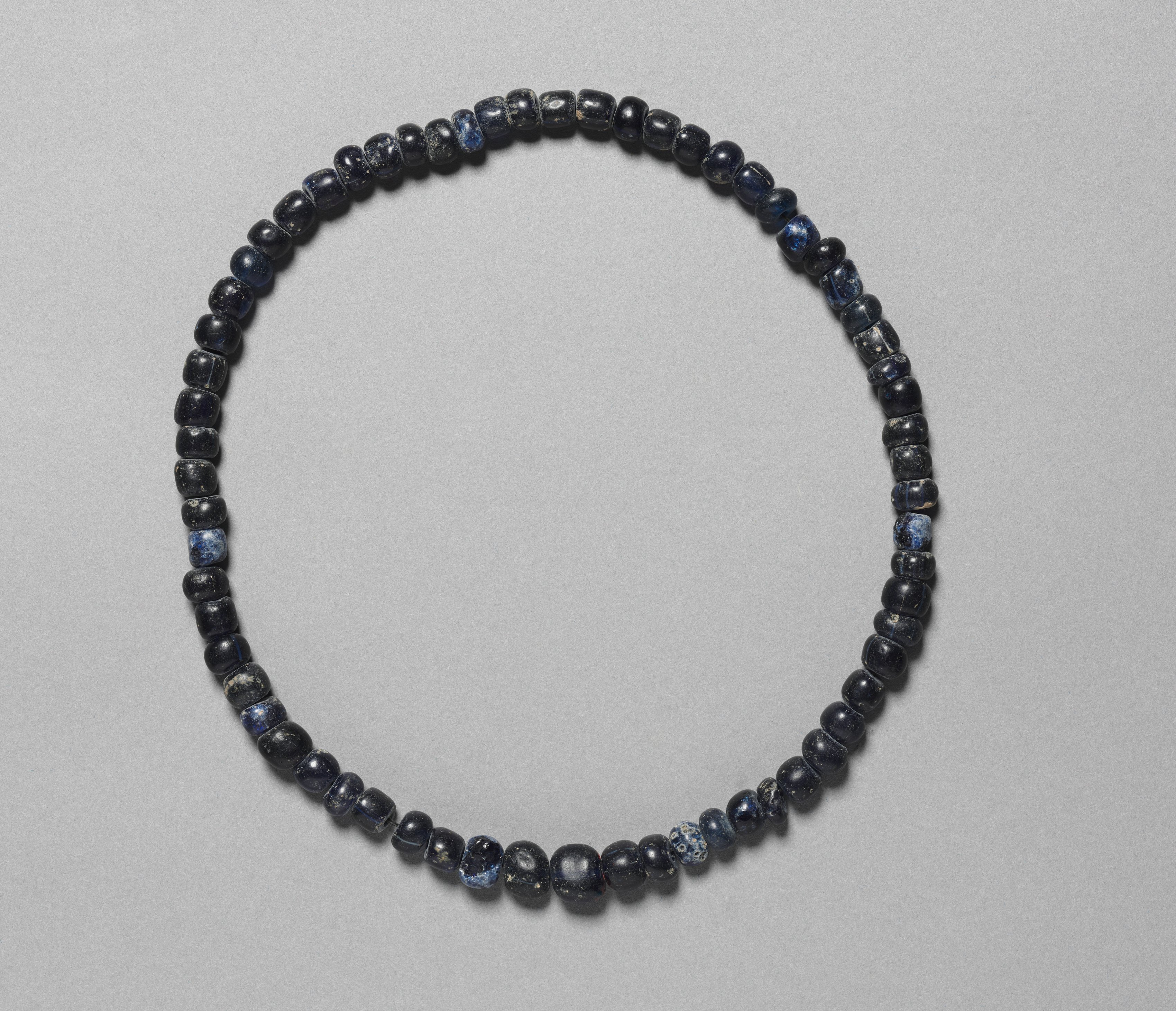
Deconstructing the String of Glass Beads: A Proto-DNA Avant-Garde Analysis for Zoey Fashion Lab
At Zoey Fashion Lab, our mission is to unravel the hidden narratives embedded within historical artifacts, transforming them into avant-garde design lexicons. The subject of this analysis—a string of glass beads from Korea’s Three Kingdoms period (57 BCE–668 CE)—presents a profound opportunity. These beads are not merely decorative; they are a material code. Using the reference of a New DNA Strand, we will deconstruct this artifact to reveal its potential as a blueprint for a futuristic, wearable language of identity and connectivity.
I. Material and Technical Deconstruction: Glass as a Digital Codex
The beads are composed of glass, a material that in the Three Kingdoms period was a sophisticated technical achievement. Glass production required controlled temperatures, precise chemical formulas (silica, soda, lime), and specialized kilns. This technical mastery is analogous to modern digital fabrication. For Zoey Fashion Lab, this glass is not a passive substance but an active data carrier. Each bead, with its unique hue, opacity, and internal striations, functions like a pixel in a larger image or a nucleotide in a genetic sequence.
The New DNA Strand reference is critical here. In biological DNA, the sequence of four bases (adenine, guanine, cytosine, thymine) encodes all genetic information. Similarly, the glass beads’ variations—color (cobalt blue, emerald green, amber), transparency (opaque, translucent), and surface texture (smooth, faceted, iridescent)—form a visual and tactile alphabet. The string itself is the backbone, the phosphodiester bond that holds the code in a linear, readable order. By deconstructing the bead’s technical properties, we can propose a new material language: glass as a tangible codex, where each bead is a symbol in a wearable genome.
II. Historical and Cultural Context: The Bead as a Connector of Worlds
During the Three Kingdoms period (Goguryeo, Baekje, Silla), glass beads were not indigenous to Korea. They were imported via trade networks stretching across the Silk Road, from the Roman Empire, Persia, and China. These beads were markers of transcultural connectivity, status, and spiritual protection. They adorned royalty, shamanic regalia, and burial goods, serving as intermediaries between the living, the dead, and the divine.
In the avant-garde context of Zoey Fashion Lab, we reimagine this connectivity as a networked, bio-digital system. The original beads linked disparate cultures; our reinterpretation links individual expressions into a collective, mutable identity. The string is no longer a necklace but a wearable social graph. Each bead represents a node—a person, a memory, a data point. The spacing between beads, their arrangement, and their sequence create a unique pattern, akin to a personalized DNA sequence that can be read, transmitted, and reconfigured.
III. Avant-Garde Design Lexicon: From Artifact to Algorithm
To translate this artifact into avant-garde fashion, Zoey Fashion Lab must move beyond replication. We propose a design methodology that treats the string of beads as a generative algorithm. The original beads were handcrafted, each with slight imperfections—a bubble, a color shift, a asymmetrical shape. These imperfections are not flaws but mutations that introduce uniqueness. In our design, we will embrace and amplify these mutations as the basis for a new aesthetic.
Key Design Principles:
- Sequential Coding: The string’s linearity is preserved but transformed into a programmable sequence. Beads can be added, removed, or reordered to change the “message.” This mirrors the editing of DNA sequences via CRISPR technology.
- Translucent Architecture: The glass’s translucency allows light to pass through, creating a layered, holographic effect. We will use this to create garments that project data—not as screens but as physical, optical phenomena. For example, a dress woven with glass bead “genes” that catch and refract light to display abstract patterns or real-time environmental data (temperature, sound).
- Hybrid Materiality: Combine glass beads with bio-fabrics (mycelium, algae-based fibers) and smart textiles (conductive threads, fiber optics). The beads become sensors or transmitters, while the string is a conductive circuit. This creates a garment that is both a historical relic and a living, responsive organism.
IV. The New DNA Strand: A Framework for Wearable Identity
The New DNA Strand reference is not merely metaphorical; it is a structural framework. In biology, DNA is double-stranded, with complementary base pairing. For our design, we propose a dual-strand system:
- Strand A (Historical): A fixed sequence of glass beads that preserves the original artifact’s color palette, spacing, and material integrity. This strand represents the ancestral code—the unchangeable heritage.
- Strand B (Avant-Garde): A mutable sequence of contemporary materials (recycled glass, LED beads, biodegradable polymers) that can be reprogrammed by the wearer. This strand represents the evolving self—the code that adapts to context, mood, or digital input.
The two strands are woven together, creating a double helix structure when worn. The interaction between them—the tension between fixed history and fluid present—generates the garment’s meaning. This is not fashion as static object but as performative, living code.
V. Technical Implementation and Avant-Garde Application
To realize this vision, Zoey Fashion Lab will employ several advanced techniques:
- Micro-etching on Glass: Use laser etching to embed microscopic QR codes or data glyphs onto individual beads. These can be scanned by a smartphone or augmented reality device to reveal hidden narratives—historical provenance, wearer’s bio-data, or collaborative art.
- Thermochromic and Photochromic Glass: Develop glass beads that change color in response to body heat or UV light. This creates a dynamic, responsive code that shifts with the wearer’s environment or emotional state.
- Wearable Interface: The string itself becomes a haptic interface. Conductive threads woven into the string allow the wearer to “read” the beads through touch—a raised surface for one base, a smooth one for another. This creates a tactile language for non-visual communication, accessible to all.
VI. Conclusion: The Bead as a Future Artifact
The string of glass beads from Korea’s Three Kingdoms period is a profound artifact of human ingenuity and connection. For Zoey Fashion Lab, it is not a relic to be preserved but a catalyst for radical reimagination. By treating it as a New DNA Strand, we unlock a design philosophy where fashion is a mutable, communicative, and deeply personal code. The avant-garde garment becomes a wearable genome—a living document of heritage, identity, and future possibility. This is not clothing; it is a new language, written in glass, light, and data.