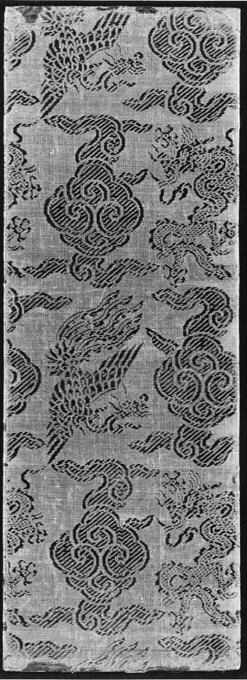
Deconstructing the Celestial Code: A Futuristic Silhouette Analysis of the Chinese Sutra Cover
In the crucible of avant-garde couture, where tradition is not a relic but a raw material for radical reinvention, the Chinese sutra cover—a plain weave silk artifact adorned with dragons and phoenixes amid clouds—emerges as a profound blueprint for SS26. This piece, originally a vessel for sacred text, transcends its liturgical origins to become a manifesto of structural innovation. For Zoey Fashion Laboratory, it is not a historical artifact to be preserved but a cybernetic organism to be dissected, reanimated, and projected into a future where fabric becomes architecture and mythology becomes code. This analysis deconstructs the sutra cover’s material logic and symbolic syntax, translating its supplementary weft patterning into a framework for futuristic silhouettes that defy gravity, time, and convention.
Material Alchemy: From Plain Weave to Parametric Armor
The sutra cover’s foundation—a plain weave in silk—is deceptively simple. Yet, in the hands of an avant-garde curator, this base becomes a canvas for radical material manipulation. The supplementary weft patterning introduces a second layer of thread that floats above the ground weave, creating a raised, almost sculptural topography. For SS26, this technique is not a decorative flourish but a structural principle. Imagine a garment where the silk base is laser-cut into a honeycomb lattice, while the supplementary wefts are extruded into carbon-fiber-reinforced filaments that form exoskeletal panels. The dragons and phoenixes, traditionally woven in gold or silver threads, are reinterpreted as biomimetic scales—each scale a micro-module that can pivot, reflecting light and shifting the garment’s silhouette in real time. This is not embroidery; it is a kinetic armor that breathes with the wearer, a fusion of ancient handcraft and futuristic prosthetics.
Silhouette as Narrative: The Cloud as Collapsible Volume
The clouds in the sutra cover are not mere background; they are the key to rethinking volume in SS26. Traditional Chinese cloud motifs (xiangyun) are characterized by flowing, organic curves that suggest endless transformation. In the sutra cover, these clouds are rendered in supplementary wefts, creating a contrast between the flat ground and the raised, swirling forms. For avant-garde couture, this translates into collapsible volume—a silhouette that can expand and contract like a nebula. Picture a cocoon coat constructed from a double-layered silk: the outer layer is a plain weave that clings to the body, while the inner layer is a series of pneumatic chambers woven with supplementary wefts. When activated by body heat or micro-sensors, these chambers inflate, forming cloud-like bulges around the shoulders, hips, and spine. The silhouette is no longer static; it becomes a living cloudscape, a garment that redefines personal space as a shifting, ethereal territory.
Structural Innovation: The Dragon’s Spine as Exoskeletal Ribcage
The dragon, a symbol of cosmic power, is traditionally depicted with a sinuous, serpentine body. In the sutra cover, its form is constrained by the weft patterning, creating a tension between the dragon’s fluidity and the fabric’s rigidity. For SS26, this tension becomes a structural innovation: the exoskeletal ribcage. The dragon’s spine is reinterpreted as a series of interlocking, 3D-printed vertebrae that are woven into the garment’s seams. These vertebrae are not hidden; they are exposed, protruding through the silk like a cybernetic skeleton. The phoenix, with its sweeping tail feathers, becomes a deployable fan structure—a series of telescoping rods that extend from the waist, creating a train that can be retracted into the garment’s core. This is not ornamentation; it is architecture that empowers the wearer, allowing them to modulate their presence from a compact, almost monastic form to a majestic, billowing spectacle.
The Supplementary Weft as Algorithmic Pattern
The supplementary weft technique, historically used to add intricate, repetitive designs, is reimagined as an algorithmic pattern language. In the sutra cover, each weft thread is a data point, a pixel in a larger image of dragons and phoenixes. For avant-garde couture, this translates into garments that are coded with hidden messages—QR codes woven into the fabric, or thermochromic threads that change color with body temperature. The dragons and phoenixes, when viewed under UV light, reveal a second layer of imagery: a futuristic cityscape or a genetic sequence. The clouds become parametric gradients, where the density of weft threads controls the opacity of the fabric, creating a garment that is both transparent and opaque, revealing and concealing. This is not a print; it is a living document, a sutra that the wearer can read and rewrite through movement and interaction.
Futuristic Silhouettes: The Asymmetric Gravity of the Sacred
The sutra cover’s rectangular, almost planar form is a challenge to traditional Western tailoring, which prioritizes symmetry and structure. For SS26, this asymmetry becomes a core aesthetic. The garment is designed as an asymmetric drape that falls from one shoulder, with the dragon and phoenix motifs migrating across the body in a spiral. The clouds are not confined to the surface; they are cut into the fabric, creating negative spaces that reveal the skin beneath. The silhouette is not balanced; it is deliberately off-kilter, as if the garment is caught in a gravitational field that is not of this earth. This is the sacred asymmetry—a nod to the sutra cover’s role as a protective wrapper, but reimagined as a garment that protects not the text but the wearer’s identity, shielding them from the mundane and elevating them into the realm of the cosmic.
Conclusion: The Sutra Cover as a Time Machine
The Chinese sutra cover, with its dragons, phoenixes, and clouds, is not a relic of the past but a time machine for the future. For Zoey Fashion Laboratory, it is a repository of structural codes that, when decoded, yield silhouettes that are both ancient and futuristic, sacred and profane, organic and mechanical. The plain weave silk is a ghost in the machine of SS26; the supplementary wefts are the threads that connect us to a lineage of craft while propelling us into a future of algorithmic fashion. This is not homage; it is transformation. The sutra cover becomes a garment that is not worn but inhabited—a second skin that is a portal to a new dimension of fashion, where dragons and phoenixes are not symbols but systems, and clouds are not forms but forces. This is the avant-garde imperative: to look at the past not with reverence but with a scalpel, and to stitch together a future that is both impossible and inevitable.