Deconstructing the Celestial: An Avant-Garde Analysis of Tang Dynasty Phoenix Ornaments
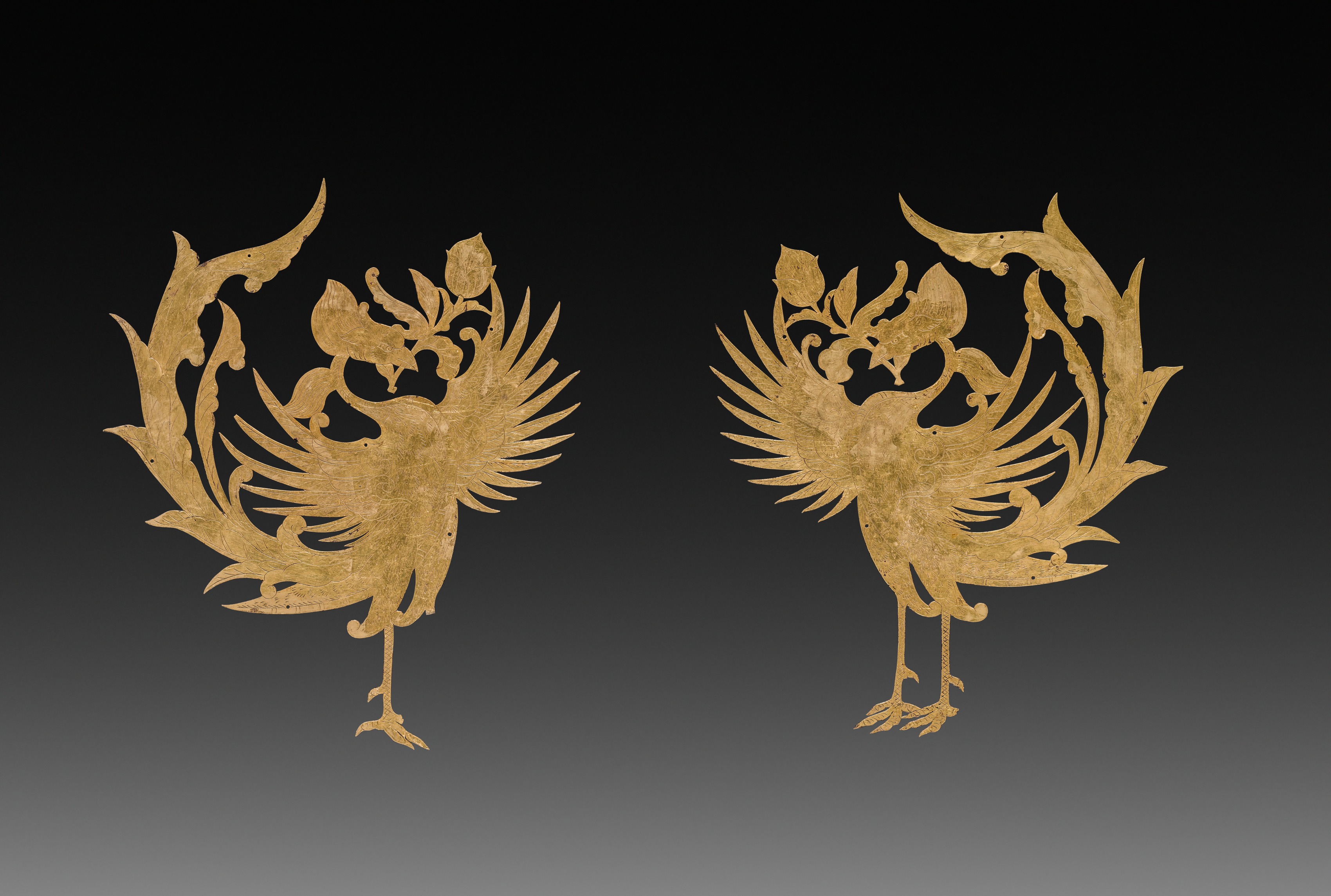
At Zoey Fashion Lab, our mission is to dismantle historical artifacts and reconstruct their essence through an avant-garde lens. Today, we examine a pair of Tang dynasty (618-907) phoenix ornaments, crafted from beaten gold with chased detail. These objects, originally symbols of imperial grace and cosmic harmony, are not mere relics; they are a manifesto of material audacity. For the contemporary designer, they offer a lexicon of tension: between fragility and permanence, between organic form and geometric precision. This analysis will deconstruct their technical, symbolic, and aesthetic DNA, extracting principles that can inform radical, future-facing textile design.
Technical Dissection: The Choreography of Gold
The primary material—beaten gold—is a paradox. Gold is inert, incorruptible, yet the act of beating it into thin sheets renders it vulnerable. The artisan’s hammer becomes a tool of controlled violence, stretching the metal to a membrane-like thinness. This process creates a dynamic surface that captures and refracts light, a property we can translate into textiles through the use of metallic threads, iridescent organza, or laser-cut mylar laminates. The chased detail—incised lines and textures—adds a second layer of narrative. Unlike engraving, which removes material, chasing displaces it, creating ridges and valleys. This is a tactile topography that invites touch, a quality often lost in modern flat-screen design. For Zoey Fashion Lab, we propose a textile analog: a base fabric of ultra-fine stainless steel mesh, overlaid with hand-stitched copper wire in a pattern that mimics the phoenix’s feather vanes. The result is a fabric that is both armor and air, rigid yet fluid.
The pair of phoenixes themselves are not identical; they are mirror images, a yin-yang of form. One faces left, the other right, their beaks open as if in eternal song. This bilateral symmetry is not static but dynamic, suggesting a perpetual dance. In textile design, this can be reimagined as a reversible jacquard where the front and back of the fabric tell opposing but complementary stories. Imagine a coat: one side in matte black silk with a gold phoenix in relief, the other in glossy gold with a black phoenix. The wearer becomes a living artifact, constantly shifting between states of being.
Symbolic Deconstruction: The Phoenix as Avant-Garde Icon
In Tang cosmology, the phoenix (fenghuang) was not a bird of fire but a composite being: the head of a golden pheasant, the body of a mandarin duck, the tail of a peacock, the legs of a crane, and the wings of a swallow. This hybridity is a radical concept. It defies biological taxonomy and embraces the monstrous, the surreal. For the avant-garde, the phoenix is a metaphor for deconstruction itself—a creature assembled from disparate parts, much like a garment constructed from deconstructed vintage pieces or a print that merges digital glitch with hand-painted brushstrokes.
The Tang dynasty was a period of cosmopolitan exchange, with the Silk Road bringing Persian, Indian, and Central Asian influences into Chinese art. These phoenixes, with their sinuous, almost Sasanian curves, are evidence of this cross-pollination. They are not “pure” Chinese; they are a hybrid of cultures. This resonates deeply with the contemporary fashion landscape, where cultural appropriation is a fraught term. The avant-garde approach is not to appropriate but to resonate—to find universal principles in specific forms. The phoenix’s tail, for example, can be abstracted into a series of overlapping, asymmetrical panels in a skirt, each panel cut from a different fabric: brocade, neoprene, and laser-cut leather. The result is a garment that speaks to the Tang spirit of fusion without mimicking its literal form.
Aesthetic Extraction: From Chased Gold to Textured Textiles
The chased detail on these ornaments is not random; it follows the natural grain of feathers. The artisan used a series of fine punches and tracing tools to create a pattern that is both repetitive and organic. This is a lesson in controlled chaos. For Zoey Fashion Lab, we can replicate this through thermoplastic pleating or chemical distressing. Imagine a silk organza that has been pleated into a feather-like fan shape, then selectively burned with a hot tool to create a pattern of holes that mimics the chased lines. The result is a fabric that is simultaneously delicate and aggressive, a perfect embodiment of the Tang aesthetic of vigorous elegance.
The gold itself is a color, but it is also a light behavior. In natural light, beaten gold shifts from bright yellow to deep amber to almost greenish-gray. This is a chameleonic property that can be translated into textiles through the use of photochromic dyes or multilayered organza in varying shades of gold, copper, and bronze. A garment made from such fabric would change its appearance as the wearer moves from sunlight to shadow, from indoors to outdoors. This is not mere decoration; it is a performative material that engages the environment.
Avant-Garde Application: The Zoey Fashion Lab Collection
Drawing from this analysis, we propose a capsule collection titled “Resonant Gold.” The centerpiece is a deconstructed gown that references the phoenix’s tail. The skirt is composed of twenty individual panels, each a different length and width, attached to a high-waisted belt. Each panel is made from a different material: one in gold lamé, one in black neoprene with gold foil stamping, one in transparent PVC with embedded gold leaf, and one in hand-embroidered silk with gold thread. The panels are not sewn together; they are connected by gold-plated hinges, allowing them to move independently, creating a sound like wind chimes—a direct reference to the phoenix’s song.
The top is a structural bodice made from carbon fiber, molded to the shape of a phoenix’s breast. The carbon fiber is left raw, with a matte black finish, but inset with beaten gold scales that are hand-hammered into the composite. This juxtaposition of high-tech and ancient craft is the essence of the avant-garde. The bodice is asymmetrical, with one shoulder bare and the other covered by a wing-like structure made from laser-cut leather and feathers from ethically sourced ostrich, dyed in shades of gold and black.
Finally, the collection includes a series of accessories: a pair of gloves made from gold mesh, each finger tipped with a small, chased gold nail that mimics the phoenix’s claws; and a headpiece that is a direct translation of the Tang ornament—a crown of beaten gold, but reimagined as a 3D-printed titanium lattice with hand-applied gold leaf. The crown is asymmetrical, with one phoenix wing extending downward over the wearer’s ear, creating a sound-scape as it moves.
Conclusion: The Eternal Resonance
The Tang dynasty phoenix ornaments are not artifacts to be preserved in a glass case. They are blueprints for rebellion. By deconstructing their materials, symbols, and techniques, we unlock a vocabulary that is ancient yet urgently contemporary. The beaten gold teaches us about the beauty of impermanence; the chased detail teaches us about the power of touch; the hybrid form teaches us about the necessity of cultural fusion. For Zoey Fashion Lab, these lessons are not academic—they are the raw material for a new kind of fashion that is both armor and adornment, both historical and futuristic. The phoenix, after all, is a bird that rises from ashes. In our hands, it rises from gold, from carbon fiber, from silk, and from code. It is not a symbol of the past; it is a prophecy of what fashion can become.