Deconstructing the Hanger: An Avant-Garde Analysis for Zoey Fashion Lab
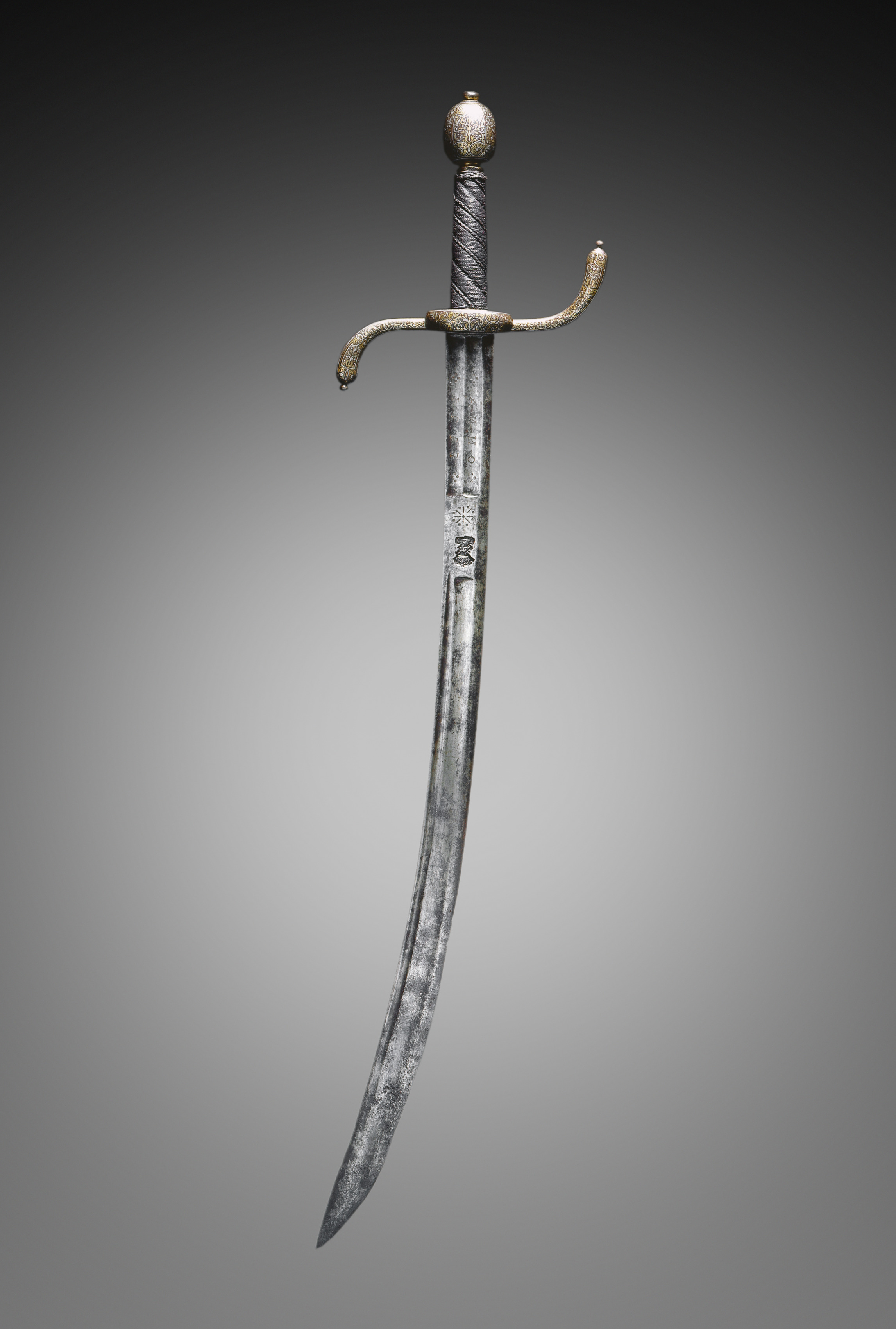
At Zoey Fashion Lab, we do not merely observe historical artifacts; we interrogate them. We strip them of their original context, dissect their material DNA, and re-sequence their genetic code into something entirely new. The subject of today’s deconstruction is the Hanger (Hunting Sword), a weapon of both utility and status. Its origins are a fascinating hybrid: a hilt possibly from Italy, paired with a blade forged in Saxony, Germany, during the late 16th to 17th Century. The technical specification—steel, with gold and silver damascened hilt—is our starting point. But for Zoey Fashion Lab, this is not a relic. It is a new DNA strand, a blueprint for an avant-garde collection that redefines power, precision, and ornamentation.
Phase I: Material Deconstruction – The Axial Tension of Steel and Precious Metal
The Hanger’s core paradox lies in its material composition. The blade is pure, functional steel—cold, hard, and designed for a single purpose: to cut. The hilt, however, is a riot of gold and silver damascening—a technique of inlaying one metal into another to create intricate, often floral or geometric patterns. This is not mere decoration; it is a statement of wealth, craftsmanship, and the owner’s place in a rigid social hierarchy.
For our avant-garde interpretation, we must amplify this tension. The blade represents the minimalist, utilitarian future—a clean, sharp line that cuts through excess. The hilt, conversely, is the baroque past—a celebration of surface, texture, and labor. In our collection, we will not blend these elements. We will pit them against each other. Imagine a garment where a single, razor-sharp seam of liquid steel (realized through bonded metallic thread) runs from shoulder to hem, bisecting a field of hand-embroidered gold and silver micro-paillettes. The seam is the blade; the paillettes are the damascening. The result is a visual and tactile argument between function and ornament, a dialogue that forces the wearer and observer to question which is more powerful.
Phase II: Form and Function – The Architecture of the Hunt
The Hanger is a hunting sword, not a weapon of war. Its design is specific: a short, broad blade for dispatching game, a guard that protects the hand while allowing for rapid movement, and a grip that balances weight for a single, decisive swing. This is a tool of controlled violence, of precision over brute force. The hunt itself is a ritual of dominance—man over beast, culture over nature.
In our avant-garde context, we translate this into structural silhouettes. The sword’s guard becomes a rigid, sculpted shoulder piece—a corset of steel and leather that frames the upper body like an exoskeleton. The grip, often wrapped in wire or leather, inspires a series of twisted, tensile straps that wrap the torso or limbs, creating a sense of latent energy, as if the garment is coiled and ready to strike. The blade itself is not a literal sword but a vertical line of force—a dramatic, floor-length train that is both a statement of power and a practical limitation, forcing the wearer to move with the deliberate grace of a hunter.
We will also explore the concept of the “kill”—the moment of impact. This is not a literal representation of blood, but a chromatic shock. A garment that is predominantly matte black or deep forest green (the colors of the hunt) will be interrupted by a single, violent splash of oxidized copper or deep crimson lacquer at a strategic point—the elbow, the hip, the throat. This is the visual echo of the blade’s work, a reminder that beauty and violence are often inseparable.
Phase III: Cultural Re-Sequencing – The Hybrid Identity
The Hanger’s dual origin—Italian hilt, German blade—is its most compelling feature for Zoey Fashion Lab. It is a hybrid artifact, a product of cross-border trade, cultural exchange, and the desire for the best of both worlds. Italy provided the artistry and refinement; Germany provided the metallurgical precision. This is not a contradiction but a new synthesis.
Our collection will mirror this hybridity by mixing codes from different eras and cultures. We will take the draped, fluid forms of Renaissance Italian tailoring (think of a doublet’s slashed sleeves or a gown’s cascading folds) and combine them with the sharp, geometric precision of Germanic armor design. A jacket might have a soft, asymmetrical collar that evokes a 16th-century Italian cappa, but its shoulders are cut with the clean, angular lines of a Saxon cuirass. The result is a garment that feels both historical and futuristic, both European and global.
Furthermore, we will re-sequence the symbolic language of the sword. The damascened hilt is covered in motifs—vines, animals, mythical creatures—that speak to the hunter’s connection to nature and the divine. We will abstract these motifs into digital prints and laser-cut overlays. A pattern of interlocking vines becomes a repeating geometric lattice. A stag’s head becomes a fragmented, pixelated emblem. This is not appropriation; it is translation. We are taking the DNA of a 17th-century symbolic system and encoding it into a 21st-century visual language.
Phase IV: The Avant-Garde Imperative – Power as Performance
Finally, we must address the Hanger’s ultimate purpose: it is a tool of power display. The hunter did not merely use the sword; he wore it. It was a visible sign of his status, his skill, and his right to take life. In our avant-garde collection, this power is not literal but performative. The wearer of a Zoey Fashion Lab Hanger-inspired garment is not a hunter of animals but a hunter of attention, of meaning, of boundaries.
The garments will be unwearable in the conventional sense. They will be too heavy, too sharp, too loud. They will require the wearer to adopt a specific posture, a specific gait, a specific attitude. This is the essence of avant-garde fashion: it does not conform to the body; it redefines the body. A dress with a steel-boned collar that forces the head to tilt back. A pair of trousers with a single, exaggerated leg that drags behind like a blade’s trail. A coat that is entirely covered in silver and gold damascened panels, rendering it a piece of armor rather than clothing.
This is the new DNA strand we are inserting into the fashion genome. The Hanger is not a costume; it is a catalyst. It challenges us to think about the relationship between beauty and violence, between ornament and function, between the past and the future. At Zoey Fashion Lab, we do not replicate history. We deconstruct it, re-sequence it, and release it into the world as something that has never existed before. The hunt is on.