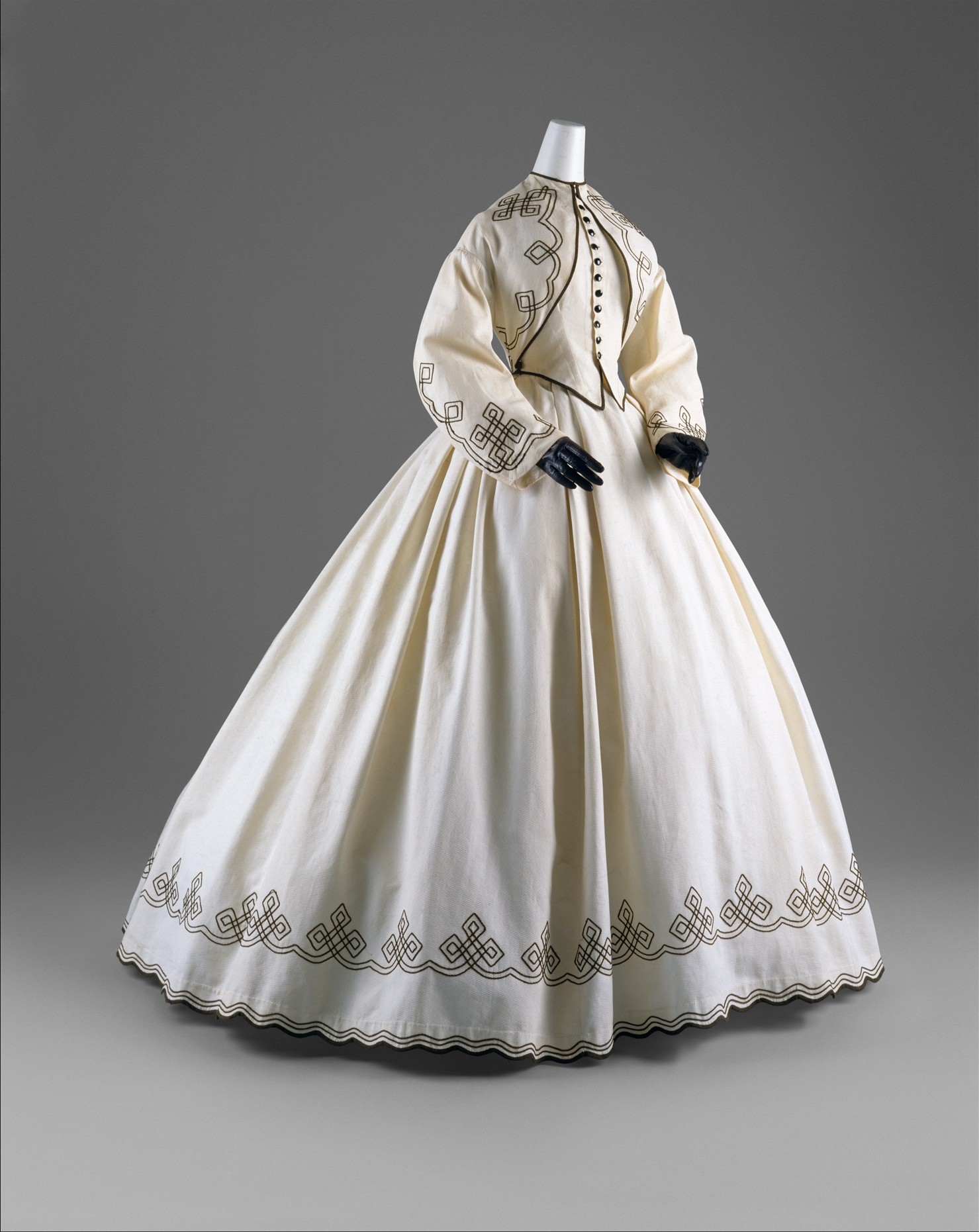
The Deconstructed Canopy: Reimagining the American Promenade Dress for SS26
In the rarefied air of avant-garde couture, where the garment often becomes a manifesto, the Promenade Dress emerges not as a nostalgic relic but as a radical proposition for Spring/Summer 2026. This analysis, conducted for Zoey Fashion Laboratory, deconstructs an archetype of American leisure—the promenade dress—and rebuilds it through a lens of futuristic structuralism. The subject is a singular garment, born from a humble yet potent material: cotton. But this is not the cotton of your grandmother’s garden party. This is cotton as a sculptural medium, a substrate for volumetric experimentation and kinetic architecture. The result is a standalone study in how to weaponize simplicity against itself, creating a silhouette that is both deeply rooted in American textile history and violently propelled into the next decade.
Materiality as Provocation: Cotton in the Age of Deconstruction
The choice of cotton for a futuristic silhouette is a deliberate act of conceptual sabotage. In a season where the industry is obsessed with bio-fabricated synthetics and metallic foils, the use of a natural, historically “democratic” fiber forces the design to earn its avant-garde status through pure form. For SS26, the cotton is not merely a fabric; it is a structural membrane. The analysis reveals a treatment that transcends conventional weaving. The cotton undergoes a proprietary, non-toxic resin-infusion process that allows for permanent, sharp pleating and rigid, architectural folds while retaining a surprising degree of breathability. This is architectonic cotton—a material that can hold a cantilevered shoulder or a floating, asymmetrical hem without internal wiring.
The garment’s surface is a study in negative space. Laser-cut apertures, reminiscent of a Brutalist facade, punctuate the bodice and skirt, revealing glimpses of the wearer’s skin as a living, moving component of the design. This is not decoration; it is a functional deconstruction of the American promenade dress’s typical modesty. The cotton, once a symbol of wholesome coverage, becomes a lattice of exposure, challenging the very notion of the “dress” as a closed form. The color palette is monochromatic—a stark, unbleached ivory and a deep, carbon black—to emphasize the play of light and shadow across the garment’s topographical surface.
Futuristic Silhouettes: The Architecture of Motion
The silhouette for SS26 is defined by what the laboratory terms “kinetic asymmetry.” The Promenade Dress abandons the traditional hourglass or A-line in favor of a biomorphic, exoskeletal form. The bodice is a corset-like structure, but one that has been shattered and reassembled. It features a single, exaggerated shoulder that rises into a sharp, wing-like fin, while the opposite side is completely bare, creating a dramatic, off-kilter balance. This is not a dress for standing still; it is a dress for motion, for the act of promenading as a performative gesture.
The skirt is the most radical departure. It is a deconstructed train, composed of multiple, overlapping panels that are not sewn together but are connected via a series of hidden, magnetic seams. As the wearer walks, the panels separate and re-form, creating a constantly shifting, fractal geometry. The hemline is not a line at all; it is a three-dimensional contour that rises sharply at the front, revealing the leg, before plunging into a long, asymmetrical tail at the back. This silhouette references the future of mobility—a garment that moves with the body, not against it, while maintaining a rigid, sculptural presence. The volume is controlled, not excessive; it is a compressed volume, a balloon that has been partially deflated and then fixed into a new, unnatural shape.
Structural Innovation: The Internal Skeleton of the Promenade
True avant-garde innovation lies in what is unseen. The structural core of this Promenade Dress is a flexible, 3D-printed lattice made from a biodegradable polymer, which is sandwiched between layers of the treated cotton. This internal skeleton provides the necessary support for the cantilevered shoulder and the floating skirt panels without the use of traditional boning or heavy interfacing. The lattice is designed with a gradient of flexibility: rigid at the shoulders and waist, becoming more pliable as it moves toward the hem. This allows the dress to maintain its architectural shape at the top while allowing for a natural, flowing movement in the lower sections.
Another key innovation is the reversible closure system. The dress does not use a zipper or buttons. Instead, it employs a series of magnetic tension points that allow the garment to be wrapped and secured in multiple configurations. This is a direct challenge to the fixed nature of the promenade dress. The wearer can adjust the level of asymmetry, the length of the train, and the degree of skin exposure, making the garment a customizable, interactive sculpture. The seams themselves are exposed and exaggerated, stitched with a heavy, contrasting thread that acts as a drawing on the surface, highlighting the dress’s construction as a form of artistic expression.
Contextual Analysis: The American Promenade as a Futurist Statement
This standalone study recontextualizes the American promenade dress from a symbol of leisure and social ritual into a vessel for critical inquiry. The original promenade dress was designed for a slow, deliberate walk in a controlled environment—a park, a boardwalk, a garden. The SS26 version is designed for the chaos of the future city, for a world of augmented reality and climate instability. The cotton, once a symbol of comfort, is now a shield of structural integrity. The asymmetry reflects the fractured nature of contemporary identity. The magnetic closures speak to a world of modularity and adaptation.
The garment is not a costume; it is a functional prototype for a new way of dressing. It asks the wearer to consider their body as a site of architectural intervention. The Promenade Dress for SS26 is a definitive statement that the future of couture lies not in the complexity of materials, but in the intelligence of structure. It is a cotton-clad manifesto, proving that even the most humble fiber can be transformed into a weapon of radical, futuristic elegance. The American promenade is no longer a leisurely stroll; it is a march into the unknown, and this dress is the uniform.