Deconstructing the Avant-Garde: A Zoey Fashion Lab Analysis of the German Powder Flask
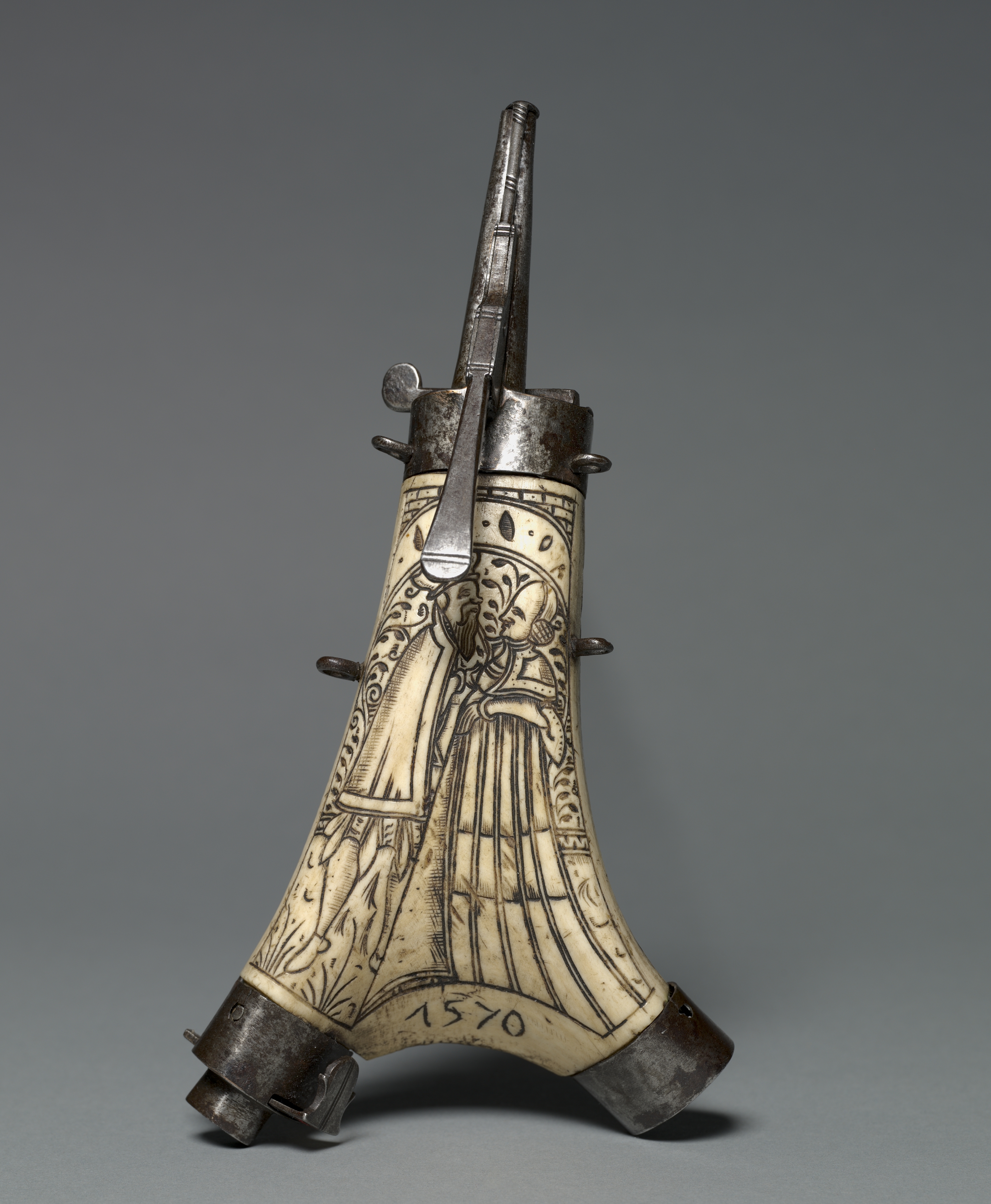
At Zoey Fashion Lab, we do not merely observe historical artifacts; we deconstruct them. We extract their DNA—their core structural, material, and cultural codes—and re-engineer them into the language of high fashion. Our latest subject, a 19th-century German powder flask crafted from elk horn and steel, presents a uniquely challenging and rewarding specimen. This object, traditionally a tool for hunters and marksmen, becomes, under our lens, a profound study in Avant-garde aesthetics. Its juxtaposition of raw, organic material with rigid, industrial metal, and its narrative of power, protection, and the human form, offer a blueprint for a new, disruptive collection.
Material DNA: The Dialogue Between Elk Horn and Steel
The primary structural components of the flask—elk horn and steel—represent a fundamental dichotomy that is central to our deconstruction. Elk horn, a naturally shed, organic material, carries the memory of the wild. Its texture is not uniform; it bears the grain, the growth rings, and the subtle irregularities of a living creature. In fashion terms, this translates to a tactile, non-repetitive surface. We see this as the foundation for a new kind of textile—one that mimics the horn’s organic flow through laser-cut, layered leathers or 3D-printed biopolymers that capture its unique, undulating topography. The color palette is drawn directly from the horn: deep, earthy umbers, rich taupes, and the pale, almost translucent ivory of the core.
In stark contrast, the steel mounts are precise, cold, and engineered. They represent control, structure, and a mechanical intervention into the natural world. The steel is not decorative; it is functional—reinforcing the points of stress, the neck, and the suspension rings. In our Avant-garde interpretation, this becomes a statement of architectural restraint. We envision silver or gunmetal-toned exoskeletal seams that run along the seams of garments, not as hidden construction but as exposed, deliberate design elements. These are the “steel mounts” of our collection: structural corsetry, articulated shoulder plates, and metallic mesh that both constrains and liberates the organic fabric beneath.
Narrative DNA: The Standing Figures and the Human Form
The most compelling feature of this flask is the carved scene of a standing man and woman. This is not a static portrait; it is a frozen moment of interaction, a narrative of relationship, status, and perhaps ritual. The figures are likely rendered in a style that reflects the Germanic folk art of the period—stylized, robust, and deeply symbolic. For Zoey Fashion Lab, this is a direct invitation to explore the human silhouette as a canvas for narrative.
We deconstruct this scene into its essential elements: the verticality of the standing figures, the gesture of their bodies, and the negative space between them. This translates into a design language of elongated, sculptural forms. Think of a gown that is less a garment and more a carved column of fabric, with the “figures” represented by asymmetrical draping or cutout panels that suggest the outline of a torso. The space between the man and woman on the flask becomes a literal gap in the garment—a void that invites the viewer to complete the narrative. We call this technique “narrative voiding,” where the absence of fabric is as meaningful as its presence.
The figures themselves are not to be copied but reinterpreted. The man’s form might be suggested by a strong, padded shoulder and a structured, tailored jacket that mimics the stoic posture. The woman’s form, perhaps more fluid, could be captured through a draped, bias-cut skirt that echoes the softer curves of the carving. Their interaction—the subtle turn of a head, the placement of a hand—becomes a choreography of the collection, with models performing a silent, sculptural dialogue on the runway.
Structural DNA: The Flask as a Wearable Object
A powder flask is, by definition, a portable container. It is designed to be carried, suspended from a belt or strap. This functionality of suspension is a key architectural principle we will exploit. The flask’s form is a flattened, curved shape that conforms to the body. This is a direct precursor to the modern body-con silhouette, but with a crucial difference: the flask is a hard, unyielding object. Our Avant-garde translation will explore the tension between a soft, flowing garment and a rigid, structural element that mimics the flask’s shape.
We propose a “powder flask silhouette” for the collection: a garment that is voluminous and soft in the back, but compressed and sculptural in the front, as if the wearer is carrying a hidden, precious vessel. This can be achieved through strategic boning, molded leather panels, or inflatable structures that create the exact convex curve of the original flask. The suspension rings of the flask become hardware details on belts, harnesses, and bag straps, rendered in polished steel or blackened brass. The flask’s neck, a narrow opening for pouring powder, is reimagined as a high, architectural collar or a funnel-shaped sleeve that channels the eye and the body’s movement.
The New DNA Strand: Re-Engineering the Avant-Garde
The reference to a “New DNA Strand” is critical. We are not creating a historical costume. We are taking the genetic material of this object—its materials, its narrative, its structure—and splicing it with contemporary technology and a radical design ethos. The elk horn becomes a bio-fabricated alternative that can be grown in a lab, dyed in impossible colors, and shaped with a precision that nature cannot achieve. The steel mounts are replaced by smart alloys that change shape with temperature or carbon fiber composites that are lighter and stronger than the original.
The standing figures are no longer carved in horn; they are projected onto fabric using interactive LED embroidery or holographic foils that shift with the wearer’s movement. The narrative becomes mutable, a dialogue between the garment and the environment. The powder flask’s original purpose—to hold gunpowder for a weapon—is subverted. In our collection, it holds perfume, sound, or digital data. The weapon is no longer a firearm; it is the power of personal expression, the armor of identity.
Conclusion: The Runway as a Hunting Ground
The German powder flask is a relic of a world where function and artistry were inseparable. In the hands of Zoey Fashion Lab, it becomes a progenitor of a new Avant-garde. Our collection will not merely reference its form; it will embody its contradictions. The raw versus the refined, the organic versus the mechanical, the narrative versus the abstract. The final garments will be wearable sculptures, each one a deconstructed and re-engineered fragment of this historical DNA. The runway will be a hunting ground, not for game, but for new definitions of beauty, power, and the human form. This is not fashion history; this is fashion evolution.