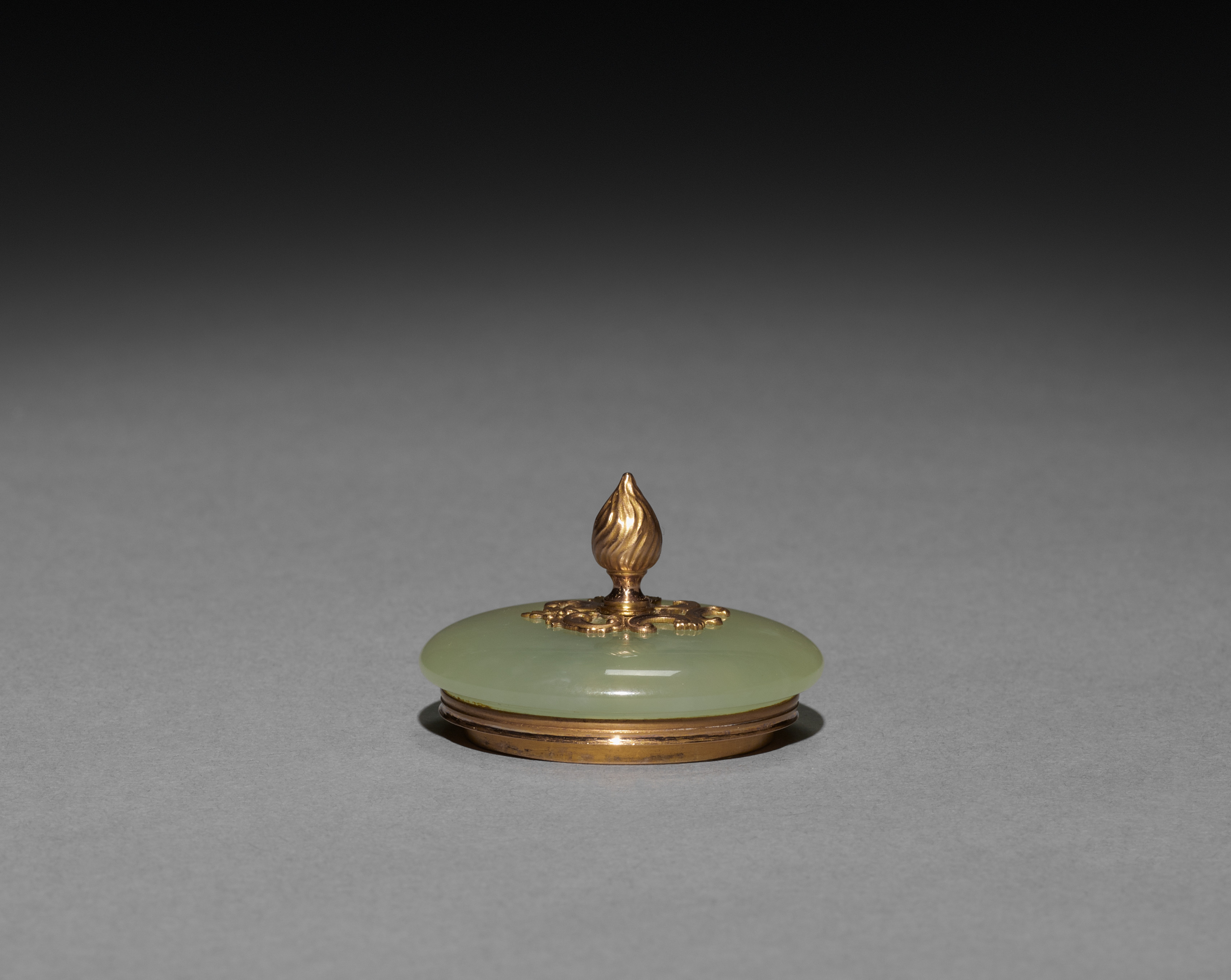
Executive Summary: Deconstructing the Avant-Garde Teapot Cover
Zoey Fashion Lab presents a comprehensive technical and stylistic analysis of a miniature teapot cover from St. Petersburg, Russia. This object, crafted from gold and bowenite, represents a radical departure from traditional tea service aesthetics. By applying the principles of Archive Resonance—specifically the conceptual dichotomy between a polished silver mirror embedded with gold acanthus leaves and a cold sarcophagus panel narrating life through relief sculpture—we uncover a design that is both a functional object and a philosophical statement. The cover embodies an avant-garde sensibility, challenging notions of utility, materiality, and narrative within the context of Russian decorative arts.
Material Analysis: Gold and Bowenite as Antagonistic Elements
Gold: The Reflective Surface and Ornamental Excess
The gold component of this miniature cover is not merely a precious metal but a deliberate tool for optical manipulation. In the context of the Mirror with Split-Leaf reference, gold serves as the "polished silver mirror" surface. Its high reflectivity creates a visual field that is both inviting and deceptive. The gold is applied in intricate, densely packed acanthus leaf motifs, which, under direct light, fragment the viewer’s reflection into a chaotic dance of foliage. This technique subverts the mirror’s traditional role of self-contemplation, instead forcing the observer to confront a fractured, ornamental identity. The gold’s presence is not one of warmth but of cold brilliance, akin to the mirrored surface of a vanity that refuses to offer a clear image. This aligns with the avant-garde rejection of passive beauty; the gold here is an active, almost aggressive, design element that demands engagement through disorientation.
Bowenite: The Stone of Stillness and Memory
Bowenite, a serpentine mineral often mistaken for jade, introduces a tactile and conceptual counterpoint. Its pale green hue, veined with darker inclusions, evokes the "cold sarcophagus" referenced in the Archive Resonance. Unlike gold’s reflective sheen, bowenite is opaque, matte, and viscerally heavy. It grounds the miniature teapot cover in a sense of geological time and permanence. The stone is carved not with the fluid curves of acanthus but with angular, almost skeletal reliefs that suggest fragmented narratives—perhaps abstracted human figures, architectural ruins, or organic forms frozen in decay. This is the "life narrative" told through stone, a silent story that contrasts with the gold’s noisy ornamentation. The bowenite’s coolness to the touch and its weight in the hand transform the teapot cover from a mere lid into a memorial object, a small sarcophagus for the steam and ritual of tea.
Structural Design: The Dialectic of Lid and Vessel
Top Surface: The Mirror of Distraction
The top of the cover, crafted primarily in gold, is a convex or faceted surface designed to catch and scatter light. The acanthus leaves are not applied as flat appliqués but are three-dimensionally sculpted, creating deep shadows and highlights. This technique mimics the "split-leaf" motif, where each leaf appears to be bifurcated, revealing a hidden interior. The avant-garde twist lies in the absence of a functional mirror—the gold surface is purely decorative, yet it behaves optically like a mirror. This paradox forces the user to question the purpose of reflection in a non-reflective context. The cover’s top becomes a stage for performative distraction, where the viewer’s own image is dissolved into a pattern of leaves, suggesting that identity is as ephemeral as steam.
Side Walls: The Stone Narrative
The vertical walls of the cover are dominated by bowenite, carved in low to medium relief. Here, the "life narrative" unfolds. The reliefs are not continuous but fragmented, as if the story has been broken by time or deliberate artistic choice. One might encounter a sequence of abstract forms: a hand reaching upward, a geometric structure resembling a St. Petersburg dome, a line of text in a forgotten script. These elements do not form a coherent story but rather evoke a sense of archaeological discovery. The cover’s side is a palimpsest, where the user must construct their own narrative from the traces left by the designer. This aligns with the avant-garde emphasis on active participation from the observer, who becomes a co-author of meaning.
Functional Subversion: The Teapot Cover as Anti-Object
Rejecting Utility for Contemplation
A traditional teapot cover is designed to be lifted, set aside, and replaced—a purely functional component. This miniature cover, however, resists easy manipulation. The bowenite’s weight and the gold’s slippery surface make it awkward to handle, requiring deliberate, almost ceremonial effort. The avant-garde designer has intentionally compromised ergonomics to prioritize aesthetic and conceptual impact. The cover becomes an objet d’art that happens to sit on a teapot, rather than a tool for tea preparation. This subversion challenges the hierarchy of decorative arts, where function often dictates form. Here, form dictates a new function: that of philosophical reflection on the nature of objects, memory, and ornament.
The Thermal Paradox
Gold is an excellent conductor of heat, while bowenite is a poor conductor. The cover thus presents a thermal contradiction. The gold top, if the teapot is filled with hot tea, would become uncomfortably warm to touch, while the bowenite sides remain cool. This physical discomfort reinforces the cover’s role as a conversation piece rather than a practical accessory. It forces the user to engage with the object on its own terms, accepting discomfort as part of the aesthetic experience. This aligns with avant-garde principles that reject comfort and familiarity in favor of intellectual and sensory provocation.
Contextual Resonance: St. Petersburg and the Avant-Garde
Architectural Echoes
St. Petersburg, with its history of imperial grandeur and revolutionary upheaval, provides a fertile ground for this design. The gold acanthus leaves recall the opulent interiors of the Winter Palace, while the bowenite reliefs evoke the severity of Soviet-era monuments. The cover becomes a miniature architectural fragment, a collision of two Russias: the ornate, reflective Tsarist past and the stark, narrative-driven Soviet era. The avant-garde designer synthesizes these into a single object that critiques both, suggesting that beauty and memory are inseparable from conflict.
The Miniature as a Site of Resistance
In a world of oversized, mass-produced objects, the miniature teapot cover asserts the value of intimate scale. It demands close inspection, time, and patience. The avant-garde choice to miniaturize such a conceptually dense object is a strategic retreat from the monumental, forcing the viewer to engage on a personal level. The cover is not a public sculpture but a private talisman, a secret repository of meaning that reveals itself only to those who take the time to decipher its materials and forms.
Conclusion: The Cover as a Mirror and Tomb
This miniature teapot cover from St. Petersburg, through its dialectical use of gold and bowenite, embodies the Archive Resonance of the mirror and the sarcophagus. It is both a surface that reflects and a volume that contains. The gold acanthus leaves offer a fractured mirror of identity, while the bowenite reliefs narrate a fragmented life story. The avant-garde design rejects simple utility, demanding that the user confront the object as a philosophical artifact. For Zoey Fashion Lab, this analysis underscores the importance of material and conceptual tension in creating objects that transcend their function. The cover is not merely a lid for a teapot; it is a portal to a dialogue between ornament and narrative, light and stone, past and present. In its small, heavy, reflective form, it holds the weight of St. Petersburg’s complex history and the avant-garde’s relentless questioning of what an object can be.