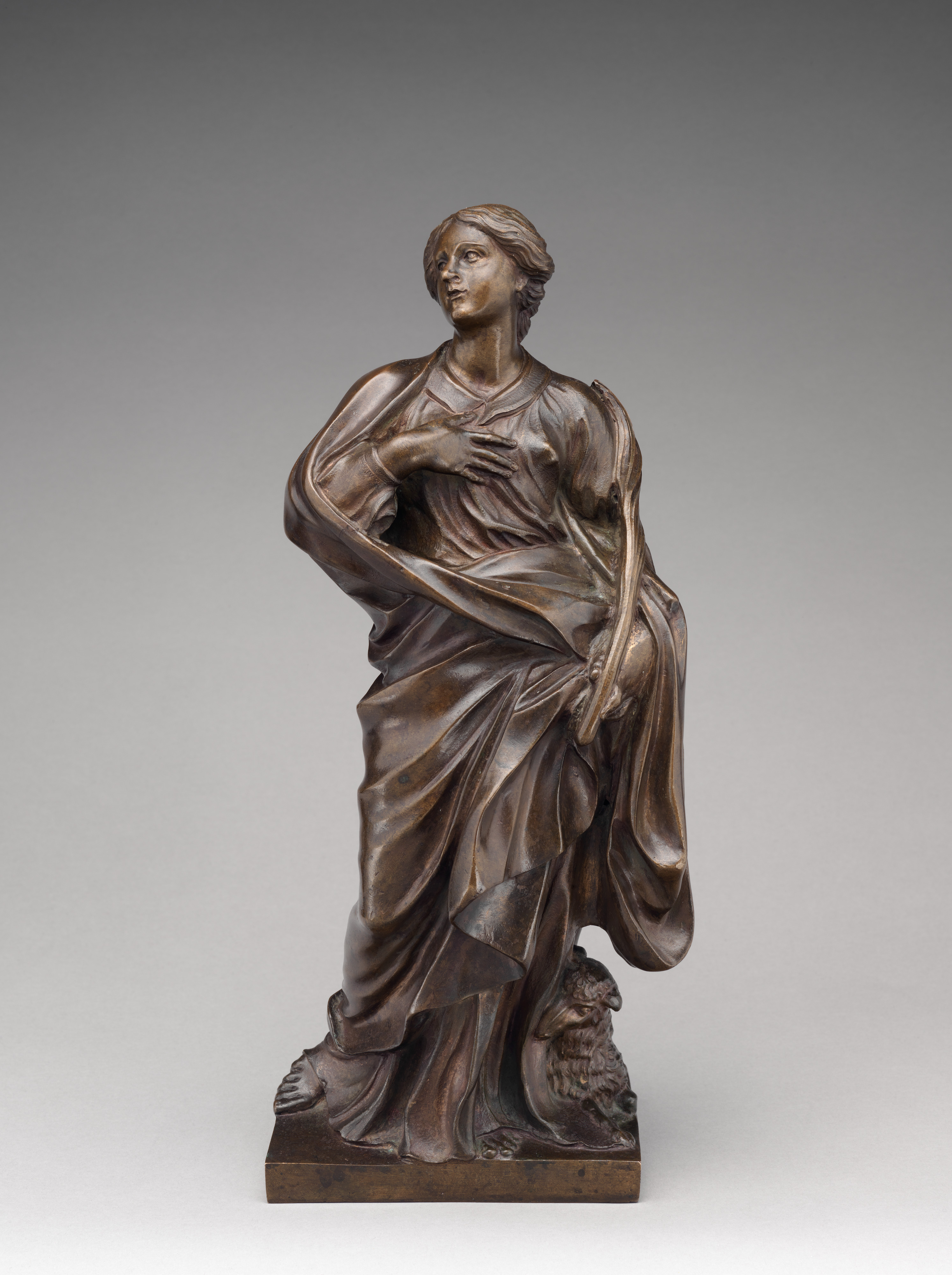
Saint Agnes: The Metallurgical Sublime in SS26 Avant-Garde Couture
In the relentless pursuit of deconstructive aesthetics, Zoey Fashion Laboratory presents a definitive analysis of Saint Agnes as a conceptual archetype for SS26. This figure, originating from the Global Frontier—a liminal space where geopolitical boundaries dissolve into pure creative potential—is reimagined not as a martyr of faith, but as a martyr of material. Her medium is bronze, a metal of ancient endurance and industrial might, yet here it is transmuted into a supple, almost organic second skin. The aesthetic correlation with the archive nodes 《Rock in the form of a fantastic mountain》 and 《Jar in the shape of bronze container (hu)》 reveals a profound paradox: two artifacts, one mimicking geological entropy and the other embodying functional containment, converge to define a new silhouette of structural innovation. This analysis dissects how Saint Agnes embodies a futuristic couture language that refuses to choose between the static and the fluid, the archaic and the post-human.
Deconstructing the Archive: From Geological Chaos to Ceremonial Order
The 《Rock in the form of a fantastic mountain》 is a study in controlled irregularity—a mass that appears hewn by wind and time, yet its surface betrays a deliberate, almost algorithmic geometry. In contrast, the 《Jar in the shape of bronze container (hu)》 is a vessel of precise, ritualistic volume, its contours designed for containment and offering. For Saint Agnes, these two nodes are not historical relics but blueprints for a new body architecture. The bronze of her garments must simultaneously evoke the fantastic mountain’s jagged, unpredictable peaks and the hu jar’s polished, concave emptiness. This duality drives the SS26 collection’s core innovation: a fabric matrix that is both armor and drapery, solid yet pliable. The mountain represents the externalized self—the armor of identity shaped by external forces—while the jar symbolizes the internal void, the sacred space of potential. Saint Agnes’s silhouette emerges from this tension, where bronze is not worn but inhabited.
Futuristic Silhouettes: The Architecture of Metallurgical Skin
The SS26 silhouette for Saint Agnes rejects the conventional hourglass or column in favor of a dynamic asymmetry that mirrors the fantastic mountain’s geological fractures. Imagine a high-waisted, sculpted cuirass that flares asymmetrically to the left, its surface a patchwork of hammered bronze plates that appear to have been shattered and reassembled by a digital algorithm. The right shoulder is articulated as a single, flowing sheet that descends into a train mimicking the hu jar’s elegant curve, yet its edge is serrated like a mountain ridge. This is not a garment; it is a wearable artifact that challenges the boundary between body and object.
Structural innovation lies in the negative-space construction: the bronze is perforated with voids that map the topography of the fantastic rock, allowing the skin beneath to become part of the composition. These perforations are not random; they follow a fractal pattern derived from the jar’s handle loops, creating a lattice that is both load-bearing and translucent. The back of the garment is a bronze exoskeleton that extends from the cervical spine to the sacrum, each vertebra a miniature mountain peak, while the front remains almost bare, a concave plane reflecting the hu jar’s interior. This front-back dichotomy embodies the archive’s correlation: the exterior is a chaotic, protective landscape; the interior is a smooth, ceremonial vessel. The silhouette thus becomes a narrative of vulnerability and fortification, a dialogue between the rock and the jar.
Material Alchemy: Bronze as a Living Medium
Bronze, traditionally a symbol of permanence, is re-engineered for SS26 through cold-forging and electroforming techniques that allow it to mimic textile behavior. The material is treated with a patina that shifts from a deep, oxidized green (echoing the fantastic mountain’s mossy crevices) to a burnished gold (reflecting the hu jar’s ritual luster). This is not a static finish; it is a chromatic memory that responds to ambient light and body heat, evolving over the course of a wear. The bronze is laminated onto a base of recycled micro-mesh, creating a composite that is both rigid and fluid. When the wearer moves, the bronze plates articulate like scales, generating a soundscape of soft clinks and rustles—an auditory signature of the Global Frontier.
This material alchemy extends to the construction of form. The fantastic mountain’s surface texture is replicated through a process of digital erosion, where a 3D scan of the rock is algorithmically mapped onto the bronze panels, then selectively abraded to create peaks and valleys. Meanwhile, the hu jar’s smooth, concave volumes are achieved through hydraulic pressing over a mold of the human torso, resulting in a second skin that is both armor and void. The integration of these two processes yields a garment that is at once a geological specimen and a ceremonial object—a synthesis that defines Saint Agnes’s futuristic identity.
Structural Innovation: The Exoskeletal Vessel
The most radical innovation in this collection is the modular exoskeletal system, which allows the wearer to reconfigure the bronze components into different silhouettes. Inspired by the hu jar’s removable lid and handles, the Saint Agnes garment features detachable panels that can be repositioned to shift from a closed, protective cocoon to an open, expansive fan. This is achieved through a series of magnetic clasps and ratcheting joints embedded within the bronze, enabling the wearer to transform the garment in real-time. The fantastic mountain’s jagged edges become the exoskeleton’s struts, while the jar’s smooth curves become the connecting membranes.
This system introduces a new paradigm of kinetic couture, where the garment is not a static object but a living architecture. For instance, the left shoulder panel can be detached and reattached as a hip drape, altering the silhouette’s center of gravity. The back exoskeleton can be collapsed into a compact, jar-like form for storage, then expanded into a full mountain range for presentation. This modularity challenges the very notion of a finished garment, positioning Saint Agnes as a post-human cyborg who inhabits a perpetual state of becoming.
Conclusion: The Global Frontier as a New Aesthetic Horizon
Saint Agnes, forged from bronze and born of the Global Frontier, represents a definitive break from historical couture. By correlating the fantastic mountain’s chaotic geology with the hu jar’s ceremonial containment, Zoey Fashion Laboratory has engineered a silhouette that is both ancient and futuristic, armored and vulnerable. This SS26 analysis reveals that structural innovation is not merely about form, but about the dialectic between material and void. The bronze is not a decoration; it is a manifesto. It declares that the future of avant-garde couture lies in the synthesis of opposites—the rock and the jar, the chaotic and the ordered, the static and the kinetic. Saint Agnes is not a muse; she is a medium through which these contradictions become wearable. In her, the Global Frontier finds its most potent expression: a body that is both a mountain and a vessel, a monument to the enduring power of deconstructive aesthetics.