Technical Deconstruction & Material Intelligence
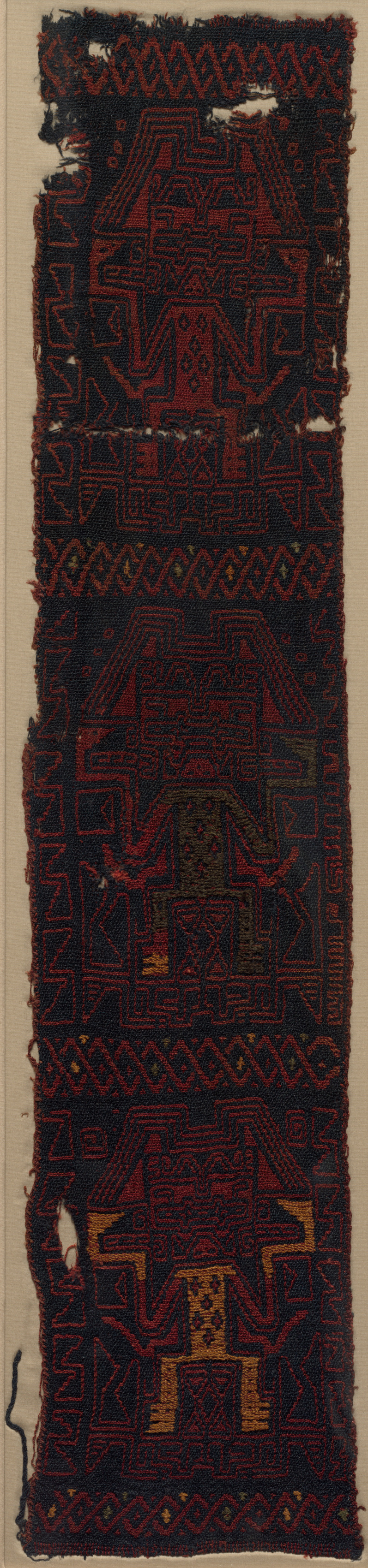
The assigned textile fragment is a profound testament to pre-Columbian Andean mastery, operating on a level of technical sophistication that demands avant-garde reinterpretation. The foundation is double-cloth, a complex structure where two complete sets of warp and weft are woven simultaneously, creating two layers of fabric that are interconnected at the pattern boundaries. This is not mere decoration; it is integrated structural intelligence. The chosen medium, camelid fiber—likely alpaca or vicuña—provides a luminous, resilient substrate. Its inherent thermo-regulatory and light-reflective properties were functionally sacred, aligning with cosmological beliefs, and offer a material dialogue with modern performance textiles.
The defining visual language, however, is imposed via structural embroidery. This is a critical distinction. The embroidered figures are not surface appliqués; they are constitutive, their stitches integral to the fabric's matrix, locking the two cloth layers together. This technique transforms the embroidery from ornament to architecture. The "interlace pattern" is not a separate element but the negative space and connective tissue of this architectural system, a rhythmic, geometric counterpoint to the figurative deities. The labor-intensity encodes a temporal dimension—each stitch a unit of ritual time—which avant-garde practice can translate into concepts of slow fashion and embodied craftsmanship.
Iconographic Analysis: The Triadic Gaze
The three frontal deities present a powerful, hypnotic composition. Their frontality is an act of direct address, breaking the fourth wall of the textile to engage the viewer/spiritual participant. This confrontational gaze resonates with the avant-garde's desire to provoke and engage directly, bypassing passive observation. The repetition in triplicate suggests hierarchy, sequence, or a unified manifestation of a tripartite principle (e.g., celestial, terrestrial, subterranean realms).
Their stylized forms—likely featuring radiating headdresses, staffs, and trophy heads—are databases of Paracas cosmology. Each iconographic element (serpents, felines, plants) is a semiotic node in a system of meaning relating to fertility, ancestor veneration, and shamanic transformation. The interlace pattern surrounding them is not a mere border but a visual representation of the ceque system—the conceptual lines organizing Andean sacred geography and social order. This transforms the fragment from a pictorial scene into a woven map of cosmic and social relations. For Zoey Fashion Lab, this suggests moving beyond printed patterns toward textiles that encode information, narrative, and spatial concepts within their very structure.
Archive Resonance & Avant-Garde Synthesis
Archive Resonance Context: The provided fragment—"在人类文明的长河中,器物与绘画不仅是时代技艺的结晶,更是文化碰撞与美学交融的无声见证。十六至十七世纪...." — references a later period (16th-17th century) of global cultural collision and aesthetic synthesis. This creates a provocative temporal leap. We are analyzing a Paracas fragment (700 BC - AD 1) through a lens that acknowledges the later, violent amalgamations of the colonial era. This resonance is not anachronistic; it is methodological. It forces us to view the Paracas piece not as a static "artifact" but as a node in a long continuum of indigenous aesthetic resistance and adaptation. Its very preservation is an act of cultural endurance.
Conceptual Translation for Zoey Fashion Lab
An avant-garde response to this fragment must avoid pastiche. It requires a deep, conceptual translation of its principles into contemporary form:
1. Structural Embroidery as Exoskeleton: Move embroidery from surface to substance. Develop techniques where stitching creates garment shape, integrates smart-tech conduits, or dictates garment articulation. Seams become sacred lines; fasteners become ritual closures.
2. The Double-Cloth Dichotomy: Explore double-layer fabrics where the interior and exterior tell different stories or perform different functions—a hidden, personal cosmology against a public façade. This speaks to modern identity's layered nature.
3. The Triadic Gaze in Silhouette: The power of frontality can translate into bold, symmetrical silhouettes that command space. The "three" deities inspire modular clothing systems or tripartite garments that can be worn in multiple configurations, reflecting fluid identity.
4. Interlace as Network: The interlace pattern is a proto-algorithm. Translate it into knitwear structures, laser-cut networks, or printed circuit-board designs on fabric, visualizing our interconnected digital and social networks.
5. Material Consciousness: Source camelid fibers from sustainable, ethical cooperatives in the Andes. Honor the origin by establishing a transparent supply chain, making the material's biography part of the garment's story—a direct response to the "cultural collision" of the archive resonance.
Conclusion: The Fragment as Future Codex
This Paracas textile fragment is not a relic but a living codex. Its double-cloth structure is a lesson in integrated complexity. Its structural embroidery is a philosophy of making where decoration is depth. Its triadic deities offer a powerful model of iconic, engaged representation. Its interlace is a map of systems. The "Archive Resonance" pushes us to read it with an awareness of history's fractures and fusions.
For Zoey Fashion Lab, the avant-garde path forward is to deconstruct these principles atomically and re-synthesize them into a new sartorial language. The goal is not to reproduce Paracas motifs, but to create garments that are equally conceptually dense, structurally intelligent, and spiritually resonant for the 21st century. We must weave not just threads, but time, meaning, and a responsible dialogue with source—creating wearable witnesses for our own era of collision and交融 (fusion).