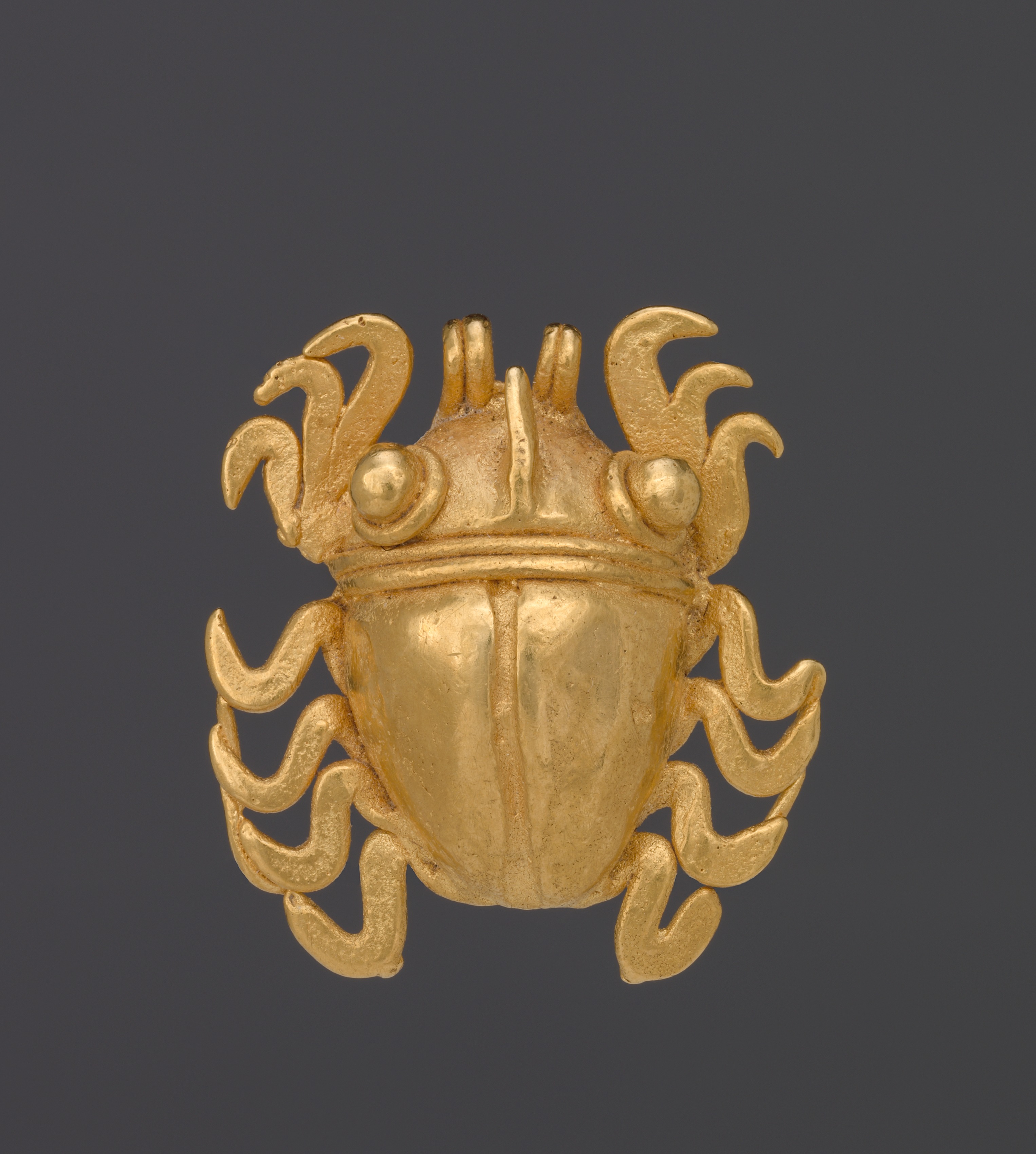
Deconstructing the Coclé Insect Bell Pendant: A Zoey Fashion Lab Analysis
At Zoey Fashion Lab, we approach historical artifacts not as static relics, but as dynamic sources of design intelligence. The Insect Bell Pendant from the Isthmian Region of Panama, specifically the Coclé culture (5th-12th century), is a profound example of pre-Columbian metallurgy and symbolic communication. Cast in gold, this pendant is more than an ornament; it is a sonic and visual archive of a civilization’s relationship with nature, status, and the cosmos. Our analysis deconstructs this piece through an avant-garde lens, extracting principles that can inform radical, contemporary fashion design.
Technical Mastery and Material Alchemy
The pendant’s construction—cast gold—represents a sophisticated understanding of material behavior. The Coclé goldsmiths mastered the lost-wax casting technique, allowing for intricate, three-dimensional forms that would be impossible with simple hammering. For Zoey Fashion Lab, this technical choice is a lesson in structural integrity and weight distribution. The pendant is not a flat appliqué; it is a volumetric object. The insect form, likely a bee, wasp, or beetle, is rendered with anatomical precision, yet stylized through the cultural lens of Coclé aesthetics. The hollow interior, necessary for the bell function, demonstrates a keen awareness of negative space as a design element. In avant-garde fashion, we translate this into garments that use structural boning, air-filled volumes, or layered meshes to create silhouette without mass—a direct parallel to the pendant’s lightweight, resonant form.
The gold alloy itself, often a tumbaga (copper-gold mixture) in Coclé artifacts, introduces a variable surface color. This is not a pure, static gold; it is a living, patina-prone material. This challenges the contemporary fashion industry’s obsession with flawless, uniform surfaces. Instead, we propose a design philosophy that embraces material transformation over time. A garment or accessory designed with this principle would change color, texture, or even shape with wear, oxidation, or environmental exposure—turning the consumer into a co-creator of the object’s final aesthetic.
Symbolic Resonance: The Insect as a Design Trope
The insect motif is not decorative; it is a carrier of meaning. In Coclé cosmology, insects—particularly those that produce sound or light—were often associated with the underworld, transformation, and the cyclical nature of life. The bell function amplifies this: the pendant becomes an auditory talisman, its sound marking the wearer’s presence in ritual or daily life. For Zoey Fashion Lab, this merges two sensory modalities—visual and auditory—into a single design object. This is a direct precursor to our sonic fashion research, where garments incorporate micro-sensors, resonators, or physical bells to create a personalized soundscape.
The avant-garde interpretation of this is the deconstruction of the insect form. We are not interested in literal replication. Instead, we extract the structural logic of the insect: the segmented carapace, the articulated legs, the delicate wings. These can be translated into modular garment components—interlocking panels, hinged joints, or detachable appendages. The bell becomes a wearable sound module, integrated into a jacket’s shoulder or a skirt’s hem. The pendant’s original function—to announce the wearer—is thus reimagined in a contemporary context, where fashion is a tool for personal agency and sensory manipulation.
Archive Resonance: The Mirror and the Pendant
The reference to Archive Resonance: 一面是光洁银镜上以黄金镶嵌的纷繁棕叶纹,另一面是冰冷石棺板上以浮雕诉说的生命叙事 (a silver mirror inlaid with gold palm leaf patterns on one side, and a cold sarcophagus lid telling a life narrative in relief on the other) provides a critical conceptual framework. The Coclé pendant embodies a similar dualistic tension. It is both a reflective surface (the polished gold) and a narrative object (the insect form and its cultural associations). This duality is the cornerstone of our avant-garde methodology.
We propose a binary design system inspired by this pendant. One half of a garment or accessory would be highly reflective, polished, or metallic—representing the surface, the immediate, the present. The other half would be textured, rough, or embedded with symbolic motifs—representing the depth, the historical, the narrative. This could manifest as a coat with a mirrored front panel and a back embroidered with deconstructed Coclé patterns. Or a necklace that is half a smooth, cast gold bell and half a rough, oxidized iron chain. The tension between these two states creates a dynamic, intellectual piece that challenges the wearer and viewer to engage with both the aesthetic and the historical.
Avant-Garde Application: The Zoey Fashion Lab Protocol
Our deconstruction yields three actionable design protocols:
1. The Sonic Silhouette: Garments must incorporate sound-generating elements as integral to the silhouette. This is not about adding a jingling trim; it is about designing the garment’s volume and structure to create specific auditory effects. A skirt’s stiff, petal-like panels could clatter like insect wings. A jacket’s shoulder pads could house small, tuned bells that ring with arm movement. The Coclé pendant teaches us that sound is not an afterthought—it is a primary design parameter.
2. The Living Material: We reject static finishes. All Zoey Fashion Lab pieces inspired by this pendant will use materials that age, patina, or transform. This could be copper alloys that green with wear, fabrics treated with thermochromic dyes that shift color with body heat, or modular components that can be rearranged by the user. The object’s lifecycle becomes part of its design narrative.
3. The Narrative Fragment: Instead of complete, literal iconography, we use fragmented, abstracted symbols. A single insect leg becomes a clasp. A bell’s clapper becomes a dangling earring. The Coclé palm leaf pattern from the mirror reference is reduced to a single, repeated geometric line. This creates a visual language of implication, where the wearer and viewer co-construct the meaning—much like the archive resonance itself, where a mirror and a sarcophagus are juxtaposed without explanation.
Conclusion: The Pendant as a Portal
The Coclé Insect Bell Pendant is not a museum piece; it is a design manifesto in miniature. For Zoey Fashion Lab, it validates our core belief that the most radical fashion emerges from deep, respectful engagement with historical craft. The pendant’s combination of technical mastery, symbolic depth, and sensory integration offers a blueprint for creating garments that are not just worn, but experienced. By deconstructing its form, function, and context, we have extracted principles that are timeless: the power of sound, the beauty of impermanence, and the necessity of narrative. The avant-garde is not about rejecting the past; it is about reanimating it—making it resonate in the present, one bell, one fragment, one transformation at a time.