Deconstructing the Il-Khanid Palmette: A Technical and Stylistic Analysis for Zoey Fashion Lab
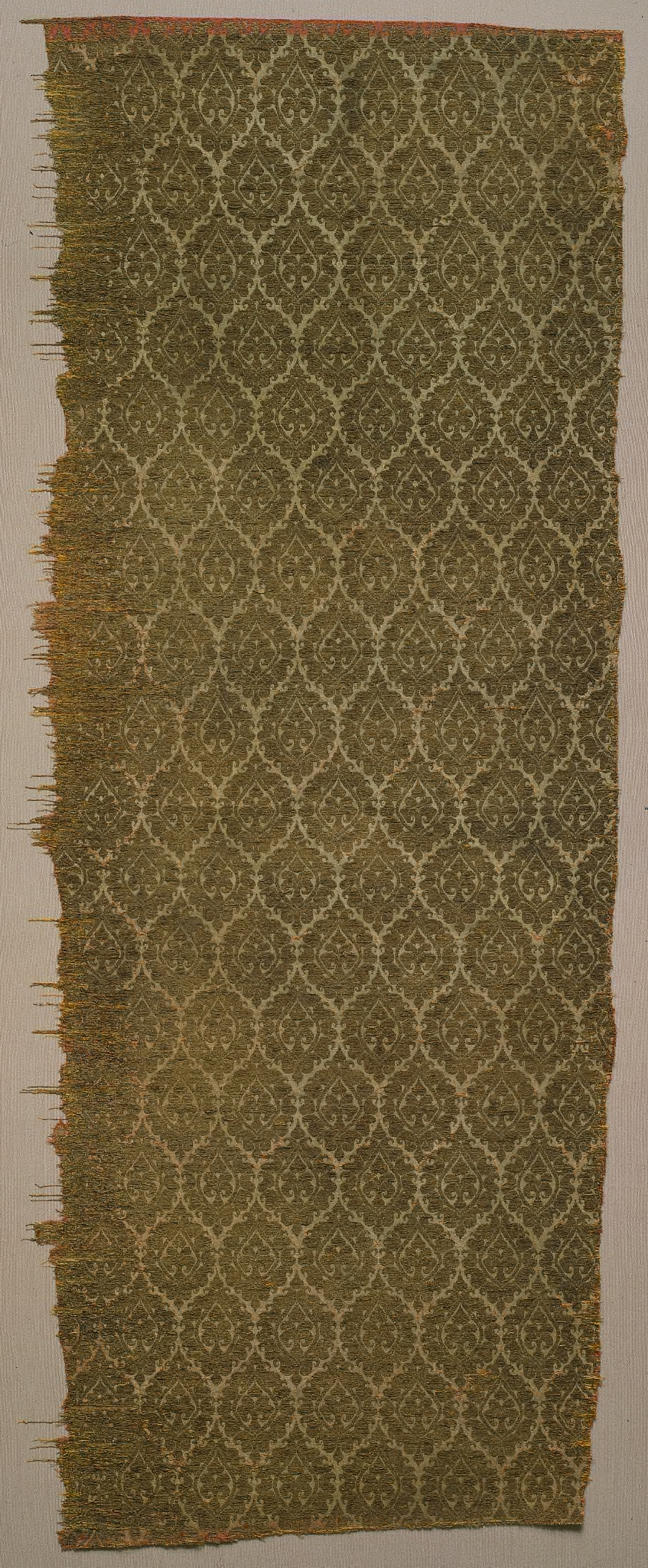
As Chief Fabric Deconstructionist at Zoey Fashion Lab, I present a comprehensive analysis of a rare textile fragment from the Il-Khanid (Mongol) period of Central Asia. This piece, woven with silk and gold thread in a tabby with supplementary weft technique, features the iconic palmette motif. Our deconstruction aims to extract its core DNA—structural, material, and symbolic—and reimagine it through an avant-garde lens, creating a new design strand that bridges historical craftsmanship with radical futurity.
Historical and Cultural Context: The Il-Khanid Synthesis
The Il-Khanid period (1256–1353) represents a pivotal moment in textile history, where Mongol imperial patronage fused Persian, Chinese, and Islamic artistic traditions. This fragment, likely from a ceremonial robe or courtly hanging, embodies a syncretic aesthetic: the palmette—a stylized, radiating floral motif—originates in ancient Near Eastern art but was reinterpreted under Mongol rule. The use of gold thread (gold-wrapped silk or gilded animal membrane) signals status, while the silk base indicates trade along the Silk Road. The supplementary weft technique allowed for intricate, raised patterns, creating a tactile, three-dimensional surface. For Zoey Fashion Lab, this textile is not merely a relic; it is a blueprint for hybridity—a reminder that innovation often arises from cultural collision.
Technical Deconstruction: Tabby with Supplementary Weft
At its foundation, the textile employs a tabby weave—the simplest interlacing of warp and weft—which provides a stable, neutral ground. The supplementary weft, however, introduces complexity: an extra set of non-structural threads that float across the surface to form the palmette design. This technique, known as lampas or taqueté in historical terms, allows for discontinuous patterning without disrupting the base weave. The gold thread, often a thin strip of metal wrapped around a silk core, is woven as the supplementary weft, creating a lustrous, reflective contrast against the matte silk ground.
From a deconstructionist perspective, we identify key structural nodes: the warp tension (likely high to support the supplementary weft), the weft density (variable to accommodate the motif), and the binding points where the supplementary weft is anchored to the ground weave. These nodes are the textile’s “DNA”—the technical constraints that define its behavior. For avant-garde reinterpretation, we can extract these constraints and invert them. For instance, the supplementary weft’s role as a decorative layer can be reconceptualized as a structural one, creating a fabric that is both patterned and load-bearing.
Motif Analysis: The Palmette as a Living System
The palmette motif in this fragment is not a static icon; it is a dynamic, organic form that radiates from a central axis, with symmetrical lobes and curling tendrils. In Il-Khanid art, the palmette often symbolizes eternal life, fertility, and divine order, but it also reflects Mongol shamanistic reverence for nature. The motif’s repetition creates a rhythm—a visual pulse that the eye follows across the fabric. Deconstructing this rhythm reveals a fractal-like structure: each palmette contains smaller, self-similar elements, suggesting a recursive logic.
For Zoey Fashion Lab, this recursive quality is a design opportunity. We can treat the palmette as a generative algorithm—a set of rules for creating infinite variations. By isolating its geometric core (the central axis, lobe curvature, and tendril branching), we can program a digital pattern that mutates across a garment, echoing the original textile’s handcrafted irregularities. This approach aligns with avant-garde fashion’s interest in biomimicry and computational design, where motifs are not printed but grown.
Material Alchemy: Silk, Gold, and the Avant-Garde
The original textile’s materiality—silk’s fluidity and gold’s rigidity—creates a tension between softness and hardness, matte and shine. This dichotomy is central to our deconstruction. Silk, a protein fiber, is inherently responsive to environmental changes (humidity, heat), while gold thread is inert and reflective. In the Il-Khanid piece, this contrast was likely intended to convey wealth and transcendence. For an avant-garde context, we can push this contrast to extremes.
Consider replacing the silk ground with a bio-fabricated cellulose (e.g., lab-grown bacterial cellulose) that mimics silk’s drape but is fully biodegradable. The gold thread can be substituted with recycled metallic polymers or conductive threads that respond to touch or light. This transforms the textile from a static artifact into an interactive surface—a garment that “speaks” through illumination or haptic feedback. The supplementary weft technique itself can be reimagined using 3D-printed filaments that are woven into a base fabric, creating raised, sculptural palmettes that shift with movement.
Structural Inversion: From Decoration to Architecture
The original tabby with supplementary weft treats the motif as a surface decoration—the base weave remains passive. In our avant-garde reinterpretation, we invert this relationship. The supplementary weft becomes the primary structural element, while the tabby ground is reduced to a ghost-like scaffold. This can be achieved through deconstructive weaving, where the supplementary threads are left unbound in specific areas, creating negative space or “holes” that reveal the body beneath. Alternatively, the gold thread can be woven at a higher tension than the silk, causing the fabric to pucker and form three-dimensional palmettes that stand away from the body—a technique reminiscent of Issey Miyake’s pleating but with a historical reference.
Symbolic Recontextualization: The Palmette as a Code
The palmette’s symbolism—eternity, fertility, order—can be subverted for avant-garde critique. In an age of ecological collapse and digital saturation, the palmette can represent artificial nature or algorithmic growth. For Zoey Fashion Lab, we can embed hidden messages within the motif using micro-embroidery or UV-reactive threads. The palmette’s symmetrical lobes can be asymmetrically altered to encode data (e.g., climate change statistics or genetic sequences), transforming the garment into a wearable manifesto. This aligns with the avant-garde tradition of fashion as protest and commentary.
Application: A New DNA Strand for Zoey Fashion Lab
Our deconstruction yields a new design strand: “Nomadic Algorithm: Il-Khanid Palmette Reboot.” This strand combines historical technique with futuristic materials and symbolic subversion. The garment—a deconstructed coat or modular dress—features a bio-silk base with conductive metallic palmettes that pulse with light in response to the wearer’s heartbeat. The pattern is generated by a recursive algorithm that references the original motif but introduces random mutations, creating a unique “fingerprint” for each piece. The supplementary weft is replaced by shape-memory alloys that allow the palmettes to open and close like living flowers, responding to temperature or touch.
This design honors the Il-Khanid textile’s technical mastery while pushing it into a new realm of interactivity and sustainability. It is not a reproduction but a reincarnation—a textile that carries the DNA of the past while evolving into something unprecedented. For Zoey Fashion Lab, this analysis serves as a template for future deconstructions: each historical piece is a code to be cracked, a system to be hacked, and a story to be retold in the language of tomorrow.