Deconstructing the Sacred: The Trap Door as a Portal in Countess Gertrude's Portable Altar
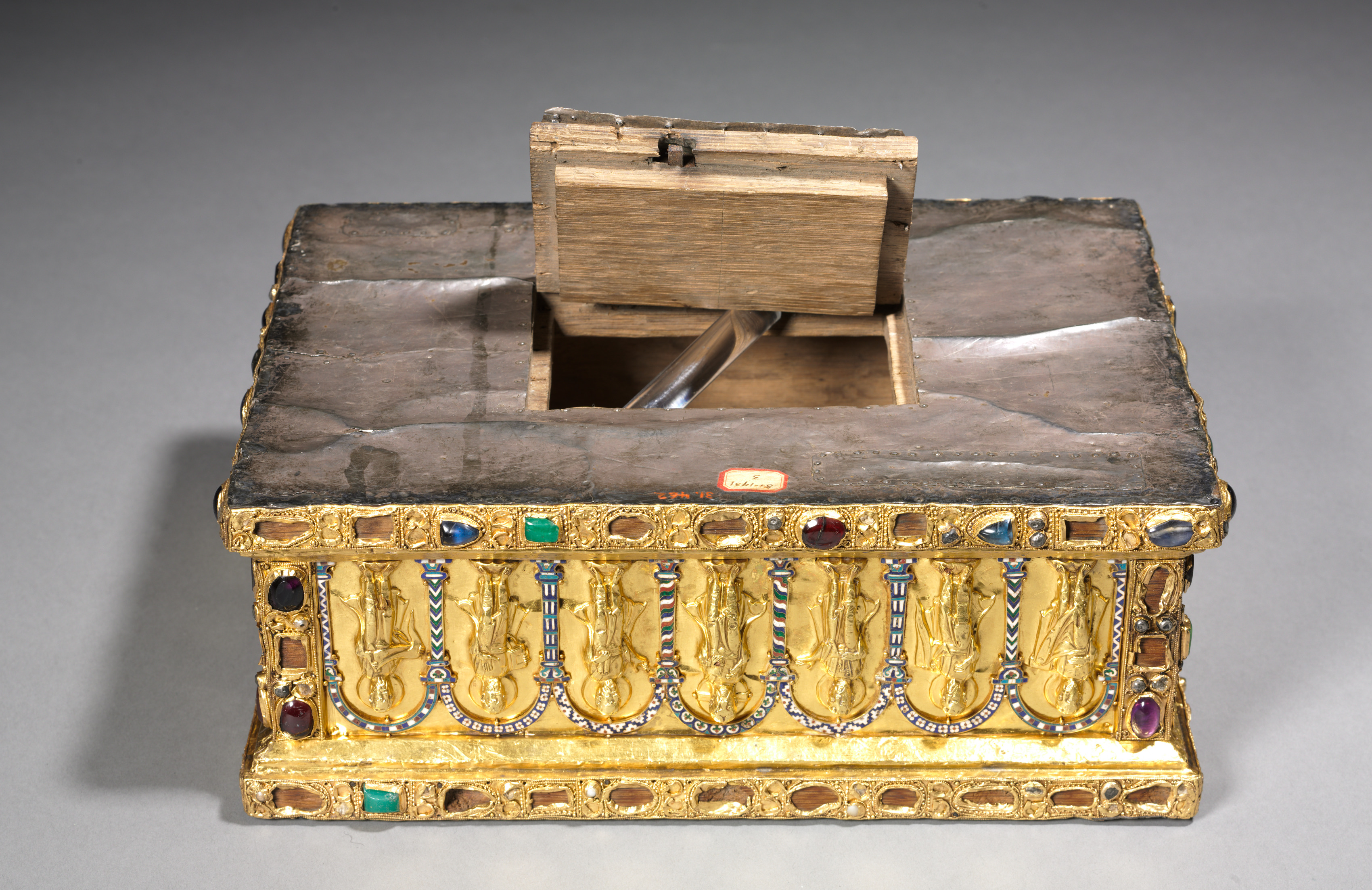
At Zoey Fashion Lab, our mission is to unearth the structural and symbolic DNA of historical artifacts, reimagining them as avant-garde design blueprints. The Trap Door for the Portable Altar of Countess Gertrude—a masterpiece of 11th-century Romanesque craftsmanship from Lower Saxony—offers a profound case study. This object, a hinged panel on a wooden core, is not merely a functional element but a threshold between the earthly and the divine. For our lab, it becomes a new DNA strand: a template for deconstructing material hierarchy, spatial concealment, and ritualistic transformation in contemporary fashion.
Material Alchemy: Gold, Enamel, and the Avant-Garde Palette
The trap door’s technical composition is a symphony of opulence and restraint. Gold, cloisonné enamel, porphyry, gems, pearls, niello, and a wood core converge in a layered narrative. The gold leaf and wire create a luminous framework, while the cloisonné enamel—cells of vibrant blue, green, and red—introduces a painterly, almost pixelated quality. The porphyry, a rare purple stone, anchors the design with its imperial weight, while gems and pearls scatter light like celestial bodies. Niello, a black metallic alloy, carves out dark, graphic lines, contrasting with the brilliance. This is not a simple decoration; it’s a hierarchical material system where each element holds a specific symbolic and tactile role.
In avant-garde fashion, this translates into a deconstructed material palette. Imagine a garment where gold lamé is not a surface but a structural grid, cut away to reveal a base of hand-painted enamel-like resin. Porphyry becomes a heavy, sculpted collar, while niello is reimagined as laser-cut leather appliqué, creating negative space. The wood core—the unseen foundation—suggests a hidden architecture: a corset or bodice made of sustainable, rigid wood, veiled by translucent organza and gemstone embellishments. The trap door’s material diversity challenges us to reject flat, uniform surfaces in favor of stratified, tactile experiences that reveal and conceal simultaneously.
Structural Concealment: The Trap Door as a Wearable Portal
The trap door’s primary function is concealment and revelation: it opens to house relics or sacred objects. This mechanism of hidden access is a powerful metaphor for avant-garde design. In the Romanesque context, the altar was a microcosm of the universe, and the trap door was its secret chamber. For Zoey Fashion Lab, this becomes a design principle of spatial surprise. A coat might feature a hidden pocket accessed via a hinged panel on the shoulder, lined with porphyry-printed silk. A skirt could have a removable panel that reveals a second layer of niello-embroidered mesh, echoing the altar’s dual nature of display and concealment.
The hinge mechanism itself—a simple but precise metal joint—is a detail to celebrate. In our avant-garde vocabulary, hinges become visible structural elements: oversized brass or silver joints on a jacket’s spine, allowing the back to open like a door. This transforms the garment from a static shell into a kinetic object, where the wearer controls the revelation of inner layers. The trap door’s wooden core, often hidden, suggests a skeletal framework—a rigid base that supports the softer, decorative exterior. A dress might have a wooden hoop skirt structure, visible through cutouts, referencing the altar’s engineering while challenging traditional notions of drape and movement.
Symbolic Resonance: Sacred Geometry and Avant-Garde Narrative
The trap door is not just a physical artifact; it is a symbolic portal. In Romanesque theology, the altar contained relics—fragments of saints—that bridged heaven and earth. The trap door was the point of access to this sacred power. For our lab, this translates into a narrative of transformation. A garment can be a “portal” for the wearer’s identity: a jacket that opens to reveal a lining printed with personal symbols or DNA sequences, or a necklace that unclasps to expose a hidden compartment for a talisman. The cloisonné enamel cells, with their precise compartments, evoke a grid-like structure that can be reinterpreted as digital or genetic coding—a new DNA strand that merges medieval craft with futuristic technology.
The niello lines, dark and graphic, offer a calligraphic quality that can be used to inscribe abstract patterns or text on fabric. Imagine a silk scarf where niello-like black ink traces a labyrinth, leading to a hidden gemstone at the center. The pearls and gems become punctuation marks in this narrative, placed at key intersections to draw the eye. The porphyry, with its deep purple hue, symbolizes royalty and spirituality; in fashion, it could be used as a color block or a textural contrast against gold and enamel, creating a visual hierarchy that guides the viewer’s gaze.
Deconstructing the Romanesque: A Blueprint for Avant-Garde Silhouettes
The Romanesque period favored heavy, architectural forms, and the portable altar’s trap door is no exception. Its wood core suggests a rigid, box-like structure, while the gold and enamel create a shimmering surface. For avant-garde fashion, this translates into deconstructed silhouettes that play with volume and weight. A coat might have a square, paneled shoulder reminiscent of the altar’s dimensions, with the trap door motif repeated as a flap pocket or a detachable cape. The cloisonné enamel inspires a patchwork technique: small, colored panels of fabric or leather stitched together with gold thread, creating a mosaic effect that is both medieval and modern.
The niello technique, where dark alloy is inlaid into engraved metal, suggests a negative-space design approach. In a garment, this could be achieved by cutting away sections of a top layer to reveal a darker underlayer, creating a pattern that mimics the altar’s graphic lines. The gems and pearls are not just adornments but structural anchors: they can be used as buttons, toggles, or closures that echo the trap door’s hinges. The porphyry, with its hard, polished surface, inspires hardware elements: stone-like resin buttons or cufflinks that ground the garment in material reality.
The New DNA Strand: Reimagining Ritual in Fashion
The trap door’s ultimate contribution to Zoey Fashion Lab’s avant-garde vision is its ritualistic function. In the 11th century, opening the trap door was a sacred act. Today, we can reimagine this as a personal ritual of dressing. A garment with a hidden panel becomes a ceremonial object, where the act of opening it—to reveal a secret pocket, a hidden message, or a transformative layer—becomes a moment of introspection. This aligns with avant-garde fashion’s interest in wearable art that challenges the wearer and viewer to engage with the object on multiple levels.
By deconstructing the trap door’s materials, structure, and symbolism, we extract a new DNA strand for design: a code that combines medieval craftsmanship with contemporary deconstruction. The gold, enamel, porphyry, gems, pearls, niello, and wood core are not just historical materials but design tools for creating garments that are both sacred and subversive. The trap door, once a portal to relics, becomes a portal to new possibilities in fashion—a testament to the enduring power of hidden spaces, layered materials, and ritualistic transformation. At Zoey Fashion Lab, we honor Countess Gertrude’s altar by turning its trap door into a threshold for the avant-garde, where every garment is a portable altar of personal expression.