Deconstructing the Imperial Silhouette: The Crane Badge as a Catalyst for SS26 Avant-Garde Architecture
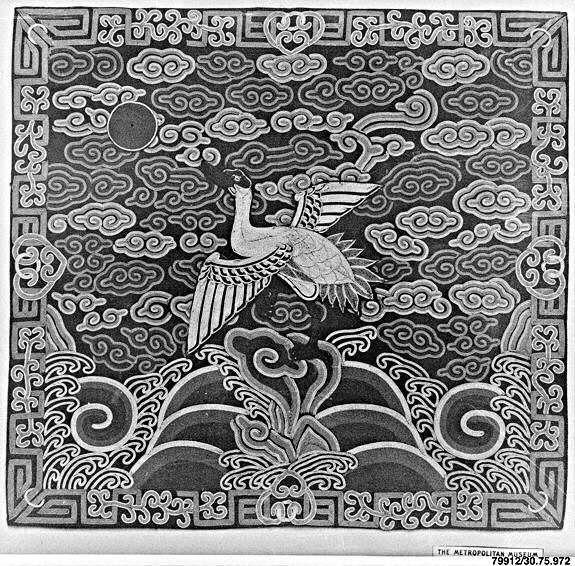
In the relentless pursuit of a new sartorial vernacular, the Zoey Fashion Laboratory turns its gaze upon a relic of imperial hierarchy: the Woman’s Rank Badge with Crane. This 19th-century Chinese artifact, a square of silk meticulously embroidered on a silk ground, is not merely a historical document of status. It is a blueprint for a radical, futuristic deconstruction of the female form. For the Spring/Summer 2026 season, we are not replicating tradition; we are weaponizing its structural DNA. The crane, a symbol of longevity and transcendence, becomes the operative metaphor for a collection that seeks to elevate the body into a living sculpture, where the silhouette is no longer a container but a dynamic, kinetic architecture.
I. The Badge as a Geopolitical Membrane
The rank badge, or buzi, was a rigidly codified signifier of social order. Its square form is a prison of symmetry. Our avant-garde methodology begins with a radical act of deconstruction: we sever the badge from its historical context and reimagine its geometric constraints as a tensile membrane. The silk, in its original state, is a surface of delicate, labor-intensive embroidery. For SS26, we invert this. The silk becomes a structural skin, stretched over a carbon-fiber armature that mimics the crane’s skeletal lightness. The badge’s square is not discarded; it is fragmented, rotated, and extruded into a three-dimensional lattice. This lattice, worn as a detachable exoskeletal collar, hovers around the neck, forming a floating, asymmetrical frame that recalls both the crane’s wingspan and the rigid geometry of the original artifact. The body is not draped; it is framed.
II. The Crane’s Flight: Kinetic Silhouettes
The crane itself—embroidered with meticulous threadwork, its beak pointed skyward—is the collection’s kinetic engine. We extract its aerodynamic contours and translate them into a series of modular, futuristic silhouettes. Consider the “Ascension” bustier: a hybrid of corsetry and armor, constructed from laser-cut, recycled silk panels that are bonded with a thermo-plastic polymer. The crane’s wing feathers are reinterpreted as overlapping, articulated scales that fan outward from the shoulder blades, creating a biomimetic wing structure. These scales are not static; they are hinged with micro-magnets, allowing the wearer to adjust the silhouette from a closed, protective cocoon to an open, expansive form. This is not decoration; it is a functional transformation of the garment’s architectural volume.
The traditional rank badge’s central motif—the crane standing on a rock amidst clouds—is abstracted into a floating, holographic laser-cut overlay. This overlay is suspended from a minimalist, high-waisted skirt that flares asymmetrically, one side cut cleanly to the hip, the other cascading in a series of geometric pleats that mimic the crane’s tail feathers. The silhouette is both severe and ethereal, a paradox of rigid structure and fluid motion. The skirt’s hem is weighted with micro-chains, ensuring that the fabric moves with a deliberate, architectural gravity. The wearer becomes a living totem of controlled chaos.
III. Material Alchemy: Silk as Structural Element
The original silk is a testament to ancient craftsmanship, but for SS26, we subject it to material alchemy. The embroidered silk is digitized and then re-embroidered onto a base of recycled technical mesh, creating a hybrid fabric that retains the visual richness of the original while gaining tensile strength. This new composite is then thermo-formed into sculptural panels that are not sewn but riveted together with matte-black titanium fasteners. The result is a garment that reads as both historically layered and aggressively futuristic. The badge’s original gold and silver threads are replicated using a conductive, metallic yarn that can be integrated with LED micro-chains, allowing the crane’s outline to illuminate in a slow, pulsing rhythm—a nod to the bird’s symbolic connection to the celestial realm.
We also introduce a second skin of liquid silicone, applied in a gradient pattern that echoes the embroidery’s density. This silicone is not merely a surface treatment; it is a structural reinforcement, creating a rigid yet flexible exoskeleton that hugs the torso. The neckline, where the original badge would have been sewn, is now a cutaway, geometric aperture framed by a lattice of carbon fiber and silk. The skin beneath is visible, but the garment’s architecture dominates. The body is no longer the subject; it is the armature for a new form of wearable sculpture.
IV. The Deconstructive Silhouette: Asymmetry and Transparency
The SS26 collection is defined by a deconstructive asymmetry that challenges the traditional, symmetrical silhouette of the rank badge. One shoulder is bare, while the other is encased in a structured, cantilevered sleeve that extends into a wing-like appendage. This sleeve is constructed from a honeycomb of silk and recycled polyester, laser-cut to create a pattern of negative space that reveals glimpses of the wearer’s arm. The waist is cinched not by a belt but by a floating, circular frame made from polished aluminum, which echoes the badge’s original square shape but is now a kinetic orbit around the body. This frame can be adjusted to sit at the natural waist, the high hip, or even the lower ribcage, allowing for a customizable architectural silhouette.
Transparency is employed as a structural device. A sheer, organza cape is layered over the bustier, but it is not draped; it is pleated into a fan shape that echoes the crane’s spread wings. This cape is attached at the shoulders with a single, oversized clasp that is a miniature replica of the badge’s embroidered clouds. The cape’s hem is weighted with small, polished brass beads that create a sonic, percussive movement with each step. The overall effect is one of controlled fragility—a garment that appears delicate but is engineered for radical, modern movement.
V. The Future of the Rank: A New Hierarchy
In this avant-garde study, the Woman’s Rank Badge with Crane is no longer a marker of social status. It is a catalyst for a new hierarchy of form. The crane’s flight becomes a metaphor for the liberation of the silhouette from historical constraint. The wearer is not adorned; she is architecturally transformed. The SS26 collection is a manifesto for a future where garments are not passive coverings but active, structural interventions that redefine the relationship between the body, space, and time. The badge, once a square of silk, is now a fractal of possibility—a starting point for a deconstructive, futuristic, and deeply poetic exploration of what it means to wear a symbol of transcendence in a world of relentless innovation. This is not fashion. This is wearable architecture for the next century.