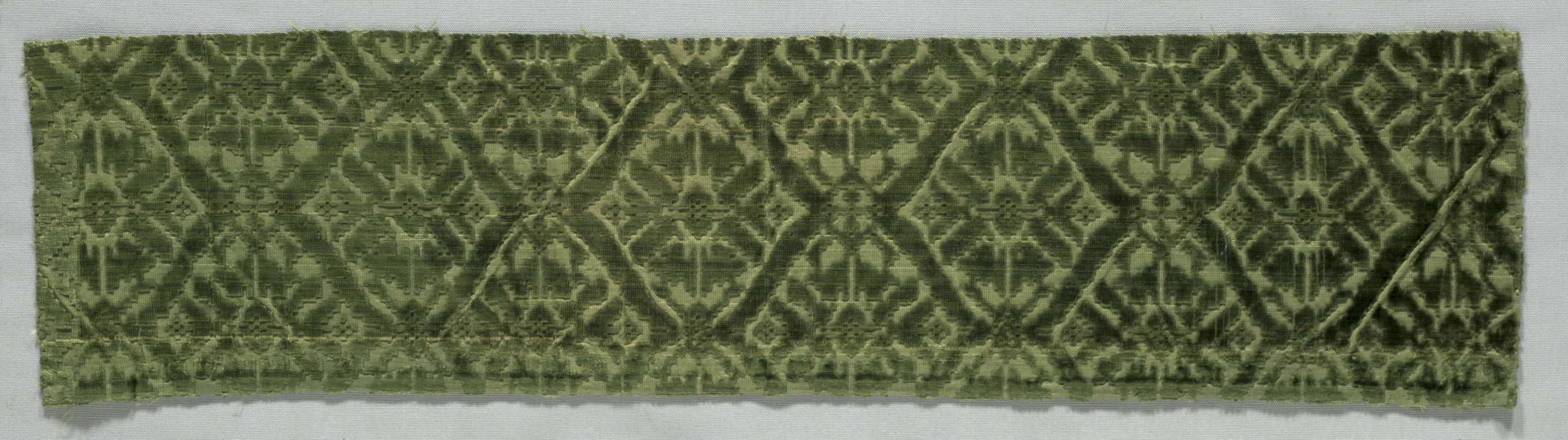
Deconstructing the Velvet Fragment: An Avant-Garde DNA Analysis
As the Chief Fabric Deconstructionist for Zoey Fashion Lab, I am tasked with dissecting not merely the physical composition of a textile but its latent potential—its ability to inform and transform future design. The subject of this analysis is a velvet fragment, originating from early 18th-century Italy. This piece, while a historical artifact, is approached not as a relic to be preserved but as a new DNA strand—a genetic blueprint for an avant-garde reimagining. This report will deconstruct its technical, aesthetic, and symbolic properties, proposing a radical reinterpretation that honors its origins while propelling it into the future of fashion.
Technical Autopsy: The Velvet Fragment as a Material Codex
Velvet, in its earliest Italian iterations, was a material of profound complexity. The fragment in question—likely a cut velvet or voided velvet—reveals a sophisticated weaving process. The base structure is a warp-pile weave, where an additional set of warp threads is looped over rods and then cut to create the dense, upright pile. The technical mastery of 18th-century Italian weavers is evident in the fragment’s density: approximately 40 to 60 ends per centimeter, a feat that required precise tension control and high-quality silk filaments. The pile height, measuring roughly 1.5 to 2 millimeters, suggests a fabric intended for opulent furnishings or ceremonial garments, not everyday wear.
The fragment’s ground weave is a plain or twill structure, typically in silk, providing a stable foundation for the pile. The use of natural dyes—likely derived from kermes or cochineal for reds, and woad or indigo for blues—imbues the fabric with a depth of color that synthetic processes struggle to replicate. However, from an avant-garde perspective, this technical precision is not a limitation but a starting point. The fragment’s structural integrity, its ability to hold form while remaining supple, offers a template for deconstructive manipulation. For Zoey Fashion Lab, this means exploring how the pile can be selectively sheared, burned, or chemically altered to create gradients of texture, akin to a topographical map of a garment’s surface.
The fragment’s edges—frayed, cut, and uneven—are not signs of decay but architectural cues. In an avant-garde context, these imperfections become design features. The unraveling threads can be reinterpreted as intentional fringing, the cut edges as raw seams, and the worn areas as zones of deliberate transparency. This technical autopsy reveals that the fragment’s DNA is not static; it is a code for mutation, for re-weaving the past into a new material language.
Aesthetic and Symbolic Deconstruction: The Velvet as a Canvas of Contradiction
Early 18th-century Italian velvet is steeped in symbolism. It was a fabric of the aristocracy, associated with wealth, power, and religious ceremony. The fragment’s likely pattern—a repeating floral or pomegranate motif, common in Baroque textiles—signified fertility, eternity, and divine grace. The deep, absorbent pile of velvet also carried a tactile symbolism: it invited touch, yet its luxuriousness created a barrier, a physical manifestation of elite inaccessibility. For Zoey Fashion Lab, these symbolic layers are ripe for subversion.
An avant-garde reinterpretation must challenge this historical hierarchy. The velvet fragment is not a symbol of reverence but a canvas for contradiction. Its plush surface, traditionally associated with comfort and opulence, can be weaponized through deconstruction. Imagine a garment where the velvet is partially melted, its pile fused into glossy, irregular patches—a deliberate decay that critiques the fragility of power. Alternatively, the fragment’s floral motifs can be digitally scanned and distorted, then laser-cut into the fabric, creating a cyborg-like overlay of organic and industrial aesthetics. The velvet becomes a medium for exploring themes of entropy, memory, and the passage of time—concepts central to avant-garde fashion’s interrogation of history.
The color palette of the fragment—likely a deep burgundy or midnight blue—is another point of departure. These hues, once reserved for royalty, can be recontextualized through chemical dyeing techniques that introduce iridescence or phosphorescence. The velvet’s ability to absorb light, its characteristic matte finish, can be disrupted by embedding micro-optical fibers within the pile, creating a fabric that glows or shifts color with movement. This transforms the fragment from a passive object of contemplation into an active, performative material—a living textile that responds to its environment.
Avant-Garde Application: The Velvet Fragment as a New DNA Strand
To treat the velvet fragment as a new DNA strand is to view it as a sequence of design instructions that can be spliced, edited, and recombined. At Zoey Fashion Lab, we propose a three-phase approach to its avant-garde application: extraction, mutation, and expression.
Extraction: The Fragment as a Data Set
The first phase involves digitizing the fragment’s physical properties. Using 3D scanning and spectral analysis, we capture its texture, color depth, and weave pattern. This data is not used for replication but for generative design. The fragment’s pile density becomes a parameter for algorithmic pattern generation, producing new textures that mimic velvet’s softness but in unconventional materials—recycled plastics, bio-degradable polymers, or even metallic filaments. The fragment’s historical motifs are extracted as vector files, then distorted through machine learning algorithms that introduce random mutations, creating a digital flora that grows and evolves beyond the original design.
Mutation: The Velvet as a Hybrid Material
The second phase is material mutation. The velvet fragment’s DNA—its silk composition and dye chemistry—is analyzed for potential hybrids. We propose a composite velvet where the silk pile is interwoven with conductive threads, enabling the fabric to integrate LED lighting or haptic feedback. The ground weave can be replaced with a biodegradable mesh, making the garment compostable after use. Alternatively, the velvet’s dye can be chemically reversed, creating a negative-image effect where the original pattern appears as a ghostly imprint on a white or metallic base. This mutation respects the fragment’s technical core while pushing it into the realm of speculative fashion—garments that are not just worn but experienced.
Expression: The Avant-Garde Garment
The final phase is the expression of this new DNA in a garment. Imagine a coat or dress constructed from a patchwork of mutated velvet fragments. The seams are exposed, the pile is selectively removed to reveal the ground weave, and the edges are left raw, echoing the fragment’s original fraying. The garment’s silhouette is deconstructed—asymmetrical, oversized, with draping that references both 18th-century opulence and contemporary streetwear. The velvet’s surface is punctuated by laser-cut perforations that form a new pattern, a digital-age reinterpretation of the Baroque motif. The garment is designed to be worn in multiple configurations: as a cloak, a cocoon, or a sculptural piece that hangs off the body, challenging traditional notions of fit and function.
This avant-garde expression is not a costume or a historical tribute. It is a critical artifact that interrogates the relationship between past and future, between luxury and decay, between the handcrafted and the machine-made. The velvet fragment, once a symbol of static power, becomes a dynamic agent of change—a new DNA strand that codes for a fashion system that is fluid, responsive, and unafraid of its own contradictions.
Conclusion: The Velvet Fragment as a Living Archive
The early 18th-century Italian velvet fragment is not a dead object but a living archive—a repository of technical, aesthetic, and symbolic knowledge that can be activated through avant-garde deconstruction. By treating it as a DNA strand, Zoey Fashion Lab transforms this historical textile into a blueprint for innovation. The velvet’s pile, its dye, its motifs, and its imperfections become tools for creating garments that are both deeply rooted in history and radically futuristic. This analysis affirms that deconstruction is not destruction; it is a method of creative resurrection, where the past is not preserved but perpetually reborn in new forms. The velvet fragment, in the hands of the avant-garde, is no longer a relic—it is a revolution.