Deconstructing the Vanity Case: A Study in Avant-Garde Fragmentation
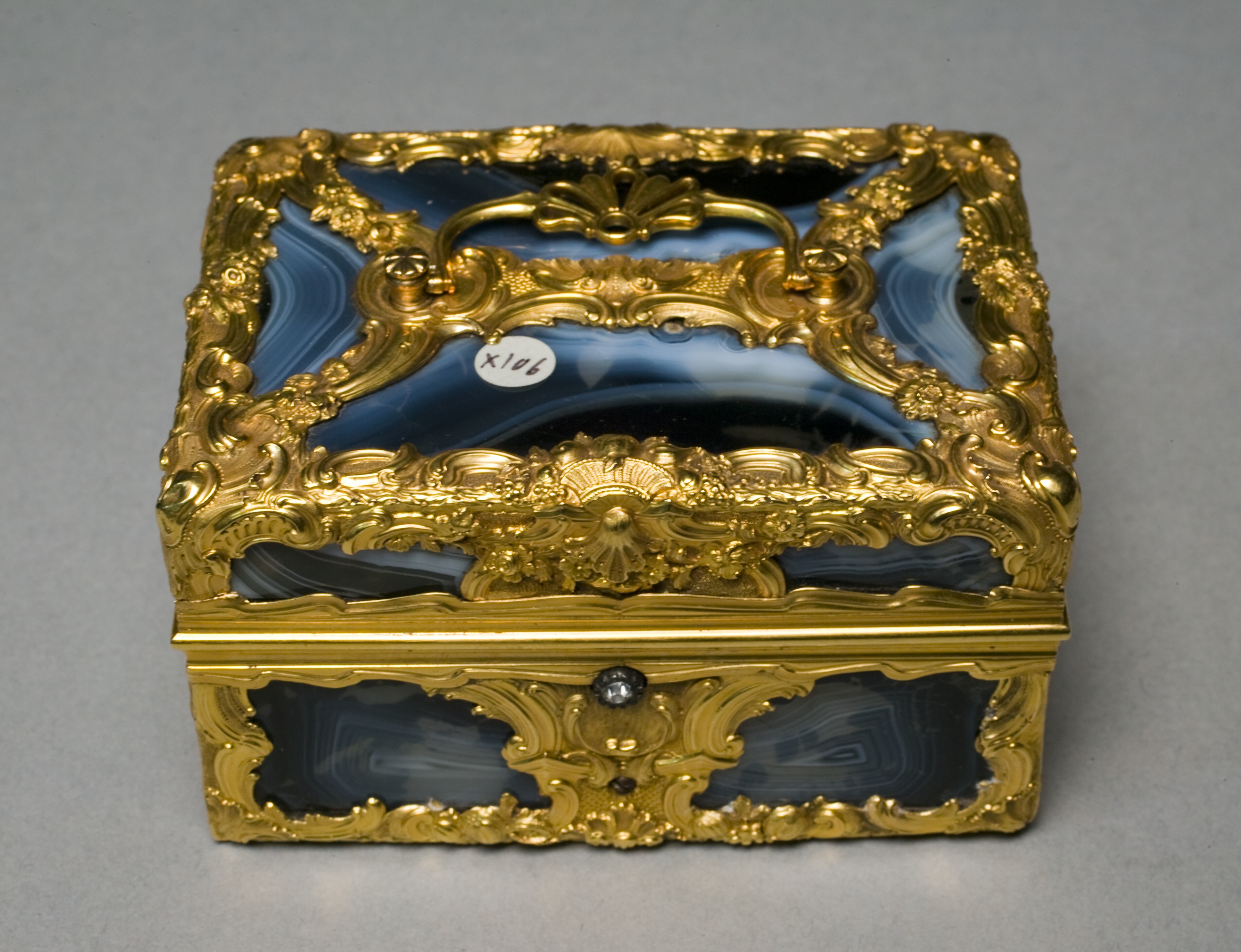
At Zoey Fashion Lab, we do not merely observe historical artifacts; we dissect them. The subject of this analysis—a mid-18th century English Vanity Case (Nécessaire)—presents a paradox of profound technical mastery and existential fragility. Crafted from gold and agate, with a mirror and a full complement of gold-mounted implements, this object was designed for a singular purpose: the maintenance of a public facade. Yet, within its polished surfaces and hidden compartments lies a narrative of control, mortality, and the very nature of self-presentation. Our deconstruction will explore how this artifact, when viewed through an avant-garde lens, becomes a powerful statement on fragmentation, the tension between surface and depth, and the ritualistic violence of beauty.
The Technical Paradox: Gold and Agate
The choice of materials is the first critical point of deconstruction. Gold—the metal of permanence, value, and light—is paired with agate, a stone of earthly grounding, striation, and geological time. This is not a harmonious marriage; it is a deliberate, avant-garde collision. The gold mounting speaks to the 18th-century obsession with luxury and status, a surface that reflects wealth and social standing. The agate body, however, introduces a counter-narrative. Its layered, often translucent bands suggest depth, history, and the slow, inexorable passage of time. In the hands of a fashion lab, this is a material dialogue: the gold is the immediate present—the performance of self—while the agate is the accumulated past—the geological memory of the earth itself.
The technical execution is flawless, but it is a flawlessness that feels almost oppressive. The gold-mounted implements—scissors, tweezers, a file—are not merely tools; they are surgical instruments for the self. They are designed to excise, to trim, to polish. The avant-garde interpretation here is one of controlled violence. The act of beautification is revealed as a ritual of excision, a constant battle against the organic, the unruly, the natural. The mirror, as we shall see, is the stage for this battle.
The Mirror: A Split Surface of Identity
The mirror is the most potent element. It is both a functional object and a philosophical trap. The reference provided—“一面是光洁银镜上以黄金镶嵌的纷繁棕叶纹,另一面是冰冷石棺板上以浮雕诉说的生命叙事”——translates to a profound duality: “On one side, a smooth silver mirror inlaid with intricate gold palm leaf patterns; on the other, a cold stone sarcophagus where a life narrative is told in relief.” This is the core of our deconstruction. The mirror is not a single, unified surface. It is a split subject.
The “smooth silver mirror” represents the surface self—the polished, socially constructed identity that the Vanity Case was designed to maintain. The gold palm leaf patterns are not mere decoration; they are a cage of ornamentation, a frame that defines and confines the reflection. The self is trapped within this gilded frame, forced to conform to the patterns of societal expectation. The “cold stone sarcophagus” is the subterranean self—the hidden, authentic narrative of life, death, and decay. The relief sculpture on the sarcophagus tells a story, but it is a story of the past, a narrative already completed. The avant-garde reading is clear: the mirror is a site of temporal collapse. The present moment of reflection is haunted by the past (the sarcophagus) and the future (the inevitable decay that the Vanity Case attempts to stave off).
Interior Fittings: The Ritual of Fragmentation
The interior of the Vanity Case, fitted with gold-mounted implements, is not a space of order but of fragmented ritual. Each implement—the file, the tweezers, the scissors—is a tool for division. They cut, pluck, and scrape. In an avant-garde context, these tools become symbols of the deconstruction of the body. The body is not a unified whole; it is a collection of parts that require constant maintenance. The case itself is a portable theater for this ritual, a miniature stage where the drama of self-creation unfolds.
The gold mounting of these implements is significant. It elevates them from mere tools to objects of veneration. They are relics of a secular religion—the religion of appearance. The act of using them is a liturgical practice. The user is both priest and sacrifice. The avant-garde fashion lab sees this as a precursor to contemporary body modification and performance art. The Vanity Case is a proto-performance kit, a device for the continuous, repetitive act of becoming.
Archive Resonance: The Mirror with Split-Leaf and Sarcophagus
The Archive Resonance provided—“Mirror with Split-Lea...”—is incomplete, but the fragment itself is instructive. The split is the key. The mirror is not whole; it is divided, cracked by the very act of reflection. The “split-leaf” pattern suggests a botanical motif, but one that is severed, incomplete. This is the avant-garde aesthetic of the fragment. The Vanity Case, in its entirety, is a collection of fragments: the gold, the agate, the implements, the mirror. They do not form a seamless whole; they remain in tension, each element pulling against the others.
The sarcophagus narrative, told in relief, is the counter-narrative to the mirror’s surface. While the mirror reflects the present, the sarcophagus tells the story of a life already lived. The Vanity Case, therefore, is a time machine that collapses past, present, and future into a single, portable object. The user, in engaging with the case, is simultaneously performing a ritual of the present (beautification), remembering the past (the sarcophagus), and anticipating the future (decay).
Avant-Garde Application: The Case as Wearable Deconstruction
For Zoey Fashion Lab, the Vanity Case is not a historical curiosity; it is a design manifesto. The avant-garde interpretation demands that we reimagine this object as a wearable or interactive installation. Imagine a garment that incorporates the split mirror—one side reflective, the other a narrative surface of text or image. Imagine accessories that are not merely decorative but functional tools for self-deconstruction, perhaps with hidden compartments that reveal the “sarcophagus” of the wearer’s own history.
The gold and agate palette can be translated into a fabric of metallic threads and layered, translucent panels, creating a visual tension between surface and depth. The implements could be reimagined as performative jewelry—a necklace of tweezers, a bracelet of files—that the wearer uses in a choreographed ritual. The Vanity Case becomes a body extension, a prosthetic for the continuous act of identity construction.
Conclusion: The Necessary Fragmentation
The mid-18th century English Vanity Case is a masterpiece of technical craft, but its true power lies in its inherent contradictions. It is a tool for unity that reveals fragmentation; a device for permanence that acknowledges decay; a mirror that splits. In the hands of Zoey Fashion Lab, it becomes a critical object—a deconstruction of the very idea of the “self” as a stable, coherent entity. The avant-garde fashion practitioner does not simply wear the past; they reanimate it, exposing its fractures and using them to create something new. The Vanity Case, with its gold, agate, and surgical implements, is not a relic of a bygone era. It is a living document of the eternal, fragmented struggle to be seen. And in that struggle, we find the true resonance of the archive.